Эконометрика (Econometrics) (Coursera)

Эконометрика (Econometrics) (Coursera)

Мы будем учиться находить и оценивать зависимости в реальных данных, а также визуализировать, интерпретировать и использовать их для прогнозирования. We will learn to identify and estimate relationships in the real data, as well as visualize, interpret and apply them for making predictions.

Class Deals by MOOC List - Click here and see Coursera's Active Discounts, Deals, and Promo Codes.

Эконометрика – наука, позволяющая исследовать закономерности в реальных данных. К концу курса мы научимся отвечать на два вопроса. Как одна переменная, y, зависит от другой переменной, x? Как спрогнозировать переменную y?
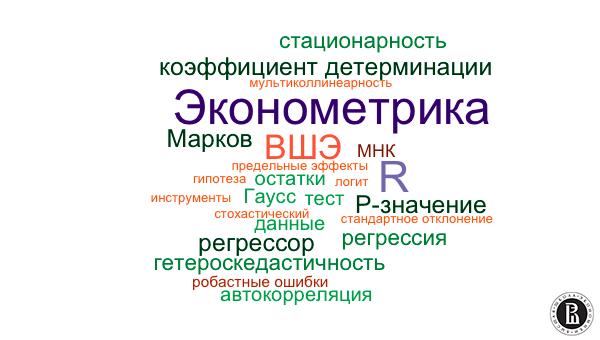
Мы будем подробно изучать линейные регрессионные модели, рассмотрим наиболее частые отклонения от предпосылок классической линейной регрессии. Изучим базовые модели (логит и пробит) для качественных зависимых переменных. Наряду с теоретической основой мы будем работать с реальными данными, используя статистический пакет R.
Econometrics is the science that enables to discover and analyze patterns in data. At the end of the course we will be able to answer two major questions. How can one variable, x, influence another one, y? How can we predict values of y?
We will study in details the linear regression and we will consider the most probable departures from assumptions of the classical liner model. The basic non-linear models for binary dependent variables (logit and probit) will also be covered. We will not only study theoretical concepts, but work with the real data with the help of statistical package R as well.

Go to Class
MOOC List is learner-supported. When you buy through links on our site, we may earn an affiliate commission.

Related Courses

Linear Regression and Modeling (Coursera) Coursera
Duke University

Linear Regression and Modeling (Coursera)

This course introduces simple and multiple linear regression models. These models allow you to assess the relationship between variables in a data set and a continuous response variable. Is there a relationship between the physical attractiveness of a professor and their student evaluation scores? Can we predict the test score for a child based on certain characteristics of his or her mother? In this course, you will learn the fundamental theory behind linear regression and, through data examples, learn to fit, examine, and utilize regression models to examine relationships between multiple variables, using the free statistical software R and RStudio.

Jun 22nd 2026
4 Weeks
Graph Analytics for Big Data (Coursera) Coursera
University of California, San Diego

Graph Analytics for Big Data (Coursera)

Want to understand your data network structure and how it changes under different conditions? Curious to know how to identify closely interacting clusters within a graph? Have you heard of the fast-growing area of graph analytics and want to learn more? This course gives you a broad overview of the field of graph analytics so you can learn new ways to model, store, retrieve and analyze graph-structured data.

Jun 22nd 2026
5-12 Weeks
Leadership Through Marketing (Coursera) Coursera
Northwestern University

Leadership Through Marketing (Coursera)

The success of every organization depends on attracting and retaining customers. Although the marketing concepts for doing so are well established, digital technology has empowered customers, while producing massive amounts of data, revolutionizing the processes through which organizations attract and retain customers. In this course, students will learn how to identify new opportunities to create value for empowered consumers, develop strategies that yield an advantage over rivals, and develop the data science skills to lead more effectively, allocate resources, and to confront this very challenging environment with confidence.

Jun 28th 2026
4 Weeks
Estadística aplicada a los negocios (Coursera) Coursera
Universidad Austral

Estadística aplicada a los negocios (Coursera)

La toma de decisiones está en la esencia de los negocios. Gerenciar es tomar decisiones, muchas veces bajo presión, con información desordenada y en un contexto de incertidumbre. Un aspecto básico es entender y analizar la información, organizar los datos de forma de facilitar su posterior uso y la toma de decisiones.

Jun 22nd 2026
4 Weeks
Principles of fMRI 1 (Coursera) Coursera
Johns Hopkins University

Principles of fMRI 1 (Coursera)

Functional Magnetic Resonance Imaging (fMRI) is the most widely used technique for investigating the living, functioning human brain as people perform tasks and experience mental states. It is a convergence point for multidisciplinary work from many disciplines. Psychologists, statisticians, physicists, computer scientists, neuroscientists, medical researchers, behavioral scientists, engineers, public health researchers, biologists, and others are coming together to advance our understanding of the human mind and brain. This course covers the design, acquisition, and analysis of Functional Magnetic Resonance Imaging (fMRI) data, including psychological inference, MR Physics, K Space, experimental design, pre-processing of fMRI data, as well as Generalized Linear Models (GLM’s).

Jun 22nd 2026
4 Weeks
Big Data Modeling and Management Systems (Coursera) Coursera
University of California, San Diego

Big Data Modeling and Management Systems (Coursera)

Once you’ve identified a big data issue to analyze, how do you collect, store and organize your data using Big Data solutions? In this course, you will experience various data genres and management tools appropriate for each. You will be able to describe the reasons behind the evolving plethora of new big data platforms from the perspective of big data management systems and analytical tools.

Jun 22nd 2026
5-12 Weeks
Bayesian Statistics: From Concept to Data Analysis (Coursera) Coursera
University of California, Santa Cruz

Bayesian Statistics: From Concept to Data Analysis (Coursera)

This course introduces the Bayesian approach to statistics, starting with the concept of probability and moving to the analysis of data. We will learn about the philosophy of the Bayesian approach as well as how to implement it for common types of data. We will compare the Bayesian approach to the more commonly-taught Frequentist approach, and see some of the benefits of the Bayesian approach.

Jun 22nd 2026
4 Weeks
Interprofessional Healthcare Informatics (Coursera) Coursera
University of Minnesota

Interprofessional Healthcare Informatics (Coursera)

Interprofessional Healthcare Informatics is a graduate-level, hands-on interactive exploration of real informatics tools and techniques offered by the University of Minnesota and the University of Minnesota's National Center for Interprofessional Practice and Education. We will be incorporating technology-enabled educational innovations to bring the subject matter to life. Over the 10 modules, we will create a vital online learning community and a working healthcare informatics network.

Jun 22nd 2026
5-12 Weeks
Regression Models (Coursera) Coursera
Johns Hopkins University

Regression Models (Coursera)

Linear models, as their name implies, relates an outcome to a set of predictors of interest using linear assumptions. Regression models, a subset of linear models, are the most important statistical analysis tool in a data scientist’s toolkit. This course covers regression analysis, least squares and inference using regression models.

Jun 22nd 2026
4 Weeks
Experimentation for Improvement (Coursera) Coursera
McMaster University

Experimentation for Improvement (Coursera)

We are always using experiments to improve our lives, our community, and our work. Are you doing it efficiently? Or are you (incorrectly) changing one thing at a time and hoping for the best? In this course, you will learn how to plan efficient experiments - testing with many variables. Our goal is to find the best results using only a few experiments. A key part of the course is how to optimize a system.

Jun 22nd 2026
5-12 Weeks