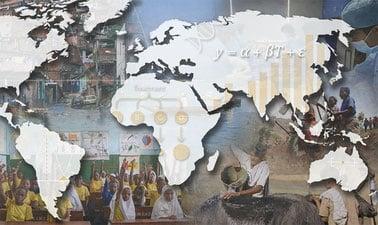
Economic Development (saylor.org)

Offered by Saylor.org,
Economic Development (saylor.org)

This course introduces major theories of economic development and to place them in a historical context.

This course introduces major theories of economic development and to place them in a historical context. In his contributory introduction “Economic Growth, Economic Development and Human Development” in The Development Economics Reader (2008), edited by Giorgio Secondi and published by Routledge, Secondi defines economic development as the “branch of economics that studies relatively poor countries.” In the same book, Mahbub ul Haq, writing under the title “The Human Development Paradigm,” suggests that the “basic purpose of development is to enlarge people’s choices,” which is in line with the views expressed by the Nobel laureate Amartya Sen. Whether development is simply studying poor countries or expanding people’s choices in poor countries, one of the essential requirements is that there must be a means for making the choices available. This means that economic development must include growth, but growth can take place without economic development. Without economic growth, the choices cannot be expanded. At the same time, however, economic growth can take place and people’s choices can still be limited. Therefore, economic development requires economic growth, but the inverse is not required. Indeed, Pearce defines economic development as “the process of improving the standards of living and well-being of the population of developing countries by raising per capita income” (1992). In essence, theories of economic development attempt to explain the process that less developed countries (LDCs) go through to become developed countries (DCs). Further, because economic development is more than economic growth and involves changes in all aspects of the society, both social and political, the discipline tends to be interdisciplinary, drawing from other social sciences such as sociology and geography.

In this course, in addition to discussing the theories of development, we will also try to explain how the theories are applied and how successful they have been in explaining the development patterns of various countries. The oft cited example of Ghana and Malaysia might be instructive at this point. Both countries gained independence from the British in 1957 (Ghana a few months earlier in March and Malaysia in August). At the time, both countries were roughly at the same level of development. If you fast forward to the 2000s, Malaysia’s per capita GDP is five times that of Ghana’s per capita GDP; it is $16,200 in Malaysia and $3,100 in Ghana. The literacy rate in Malaysia is 88.7% and 67.3% in Ghana. Malaysia has 11 times more physicians per 1,000 people than Ghana, and life expectancy is 74.04 in Malaysia but 61.45 in Ghana. There are many questions which the development economist wants the answers to, but mainly this boils down to: What accounts for the vast differences in the many measures of human development indices? We study economic development to learn from the Malaysians so that we can offer useful advice to the Ghanaians.

The units in this course are stacked as building blocks; each successive unit depends on a thorough understanding of the previous unit. The course begins with some of the stylized facts of the countries classified as developing countries. You will find that they are not all alike. Some countries, such as the oil rich ones, may have a very high per capita GDP. You will learn the definitions of major terms and concepts. The sections that follow the introductory unit outline the major theories of economic development, tracing their development throughout history as the dialogue on development economics has progressed. Finally, the course will present a number of development successes and failures and will prompt you to draw your own conclusions on the validity of certain theories based on case studies.

Upon successful completion of this course, you will be able to:

define economic development and its components;
describe major theories of economic development;
explain and apply some basic economic models related to economic development and economic growth, including the Solow Growth model and its extensions;
identify and discuss economic development theories in the social and political context in which they were created; and
critically examine economic development theories in light of a history of poor performance in development programs.
Go to Class
MOOC List is learner-supported. When you buy through links on our site, we may earn an affiliate commission.

Related Courses

Macroeconomics Performance Indicators (edX) EdX
University of Queensland,UQx

Macroeconomics Performance Indicators (edX)

The macroeconomy affects business conditions and broader social outcomes. Learn about key performance indicators of macroeconomics such as GDP, unemployment and inflation. This course consists of two types of materials. The first type of materials concerns with how to measure the performance of the economy as a whole. The second type of materials concerns how to explain why a country underperforms in one or more of these aspects, and what can be done about it. The behaviour of an economy as a whole is often broadly predictable, but sometimes it can suddenly change. You will learn how to understand macroeconomic data and know how it can be interpreted for analysis.

Self Paced
Self-Paced
Political Economy of Institutions and Development (Coursera) Coursera
Leiden University

Political Economy of Institutions and Development (Coursera)

This course is part of the SDG initiative addressing the UN Sustainable Development Goals, specifically for the following SDGs [1, 8, 10 and 16]. We hope you will join in our efforts to reach the SDG’s in small but measurable and actionable ways, cooperating with Development Done Differently. Expand your impact. You can create a better world. In today’s world, politics and economics are interconnected, but what is the nature of this connectivity?

Sep 21st 2026
5-12 Weeks
Principles of Economics: Macroeconomics (MRUniversity) MRUniversity
Marginal Revolution University

Principles of Economics: Macroeconomics (MRUniversity)

In this course, following MRU's Principles of Microeconomics course, you’ll continue to explore the economic way of thinking and the role of incentives in all of our lives. We’ll cover fundamental questions such as: Why do some countries grow rich while others remain poor? How important is a country’s banking system — and what happened during the recent financial crisis? How did Zimbabwe end up with an inflation rate that rose into the quadrillions?

Self-paced
Self-Paced
C'est quoi l'éco ? (FUN) FUN
ENS de Lyon

C'est quoi l'éco ? (FUN)

Chômage, mondialisation, dettes, crise, ubérisation : l’économie est partout dans les médias, mais les explications proposées ne sont pas toujours facilement compréhensibles. Pourtant, nous sommes tous des acteurs de l’économie : nous consommons, nous cherchons un emploi, nous épargnons (quand nous le pouvons). L’objectif de ce cours est de vous aider à dépasser le cadre d’analyse de simples expériences personnelles et acquérir des clés nécessaires à la compréhension du mode de raisonnement des économistes.

No sessions available
5-12 Weeks
Concepts in Sustainable Development: An Introduction to the Key Issues (FutureLearn) FutureLearn
University of Leicester

Concepts in Sustainable Development: An Introduction to the Key Issues (FutureLearn)

Explore some of the key issues in sustainability, tackling the big questions with examples from around the world. Get an introduction to the key issues in sustainability. In this course you will study the conceptual foundations of sustainable development, and discuss the issues around sustainability as a complex problem.

Jan 25th 2021
5-12 Weeks
The Economics of AI (Coursera) Coursera
University of Virginia

The Economics of AI (Coursera)

The course introduces you to cutting-edge research in the economics of AI and the implications for economic growth and labor markets. We start by analyzing the nature of intelligence and information theory. Then we connect our analysis to modeling production and technological change in economics, and how these processes are affected by AI. Next we turn to how technological change drives aggregate economic growth, covering a range of scenarios including a potential growth singularity.

Aug 25th 2026
5-12 Weeks
Exploring Economics: Will the Next Generation Be Worse Off? (FutureLearn) FutureLearn
Griffith University

Exploring Economics: Will the Next Generation Be Worse Off? (FutureLearn)

Will the next generation be better or worse off than their parents? Look at both sides of the debate and decide for yourself. The next generation faces uncertain economic prospects. This online course explains why. You’ll get an introduction to the global economy, how it experiences spikes and dips in economic growth and how this affects prosperity worldwide.

No sessions available
3 Weeks
Gestión de Proyectos de Desarrollo (edX) EdX
Inter-American Development Bank - IDB,IDBx

Gestión de Proyectos de Desarrollo (edX)

“Un MOOC desarrollado en colaboración con el Project Management Institute Educational Foundation (PMI-EF)”. Aprende mejores prácticas para gestionar proyectos que promuevan el desarrollo económico y social en América Latina y el Caribe. Si buscas obtener una titulación sobre Gestión de Proyectos reconocida internacionalmente ¡Este es tu curso! Además de aprender las mejores prácticas para gestionar proyectos de desarrollo, podrás lograr hasta 35 PDUs en el área técnica, avalados por el Project Management Institute Educational Foundation (PMI- EF).

Self Paced
Self-Paced
La realidad del desarrollo social latinoamericano (edX) EdX
Inter-American Development Bank - IDB,IDBx

La realidad del desarrollo social latinoamericano (edX)

Conoce en qué estado se encuentra América Latina y el Caribe en educación, desarrollo infantil temprano, salud, protección social y empleo y sus principales desafíos. ¿Cuáles son los avances y desafíos que América Latina y el Caribe tiene por delante en relación a la pobreza y desigualdad, desarrollo infantil temprano, educación, salud, protección social y empleo? En este MOOC conocerás el panorama actual de cada uno de estos aspectos en la región, así como políticas basadas en evidencia y casos prácticos de programas sociales que han resultado efectivos en la mejora de la calidad de vida de los habitantes de la región.

No sessions available
5-12 Weeks