Differential Equations for Engineers (Coursera)

Differential Equations for Engineers (Coursera)

This course is about differential equations and covers material that all engineers should know. Both basic theory and applications are taught. In the first five weeks we will learn about ordinary differential equations, and in the final week, partial differential equations. The course is composed of 56 short lecture videos, with a few simple problems to solve following each lecture. And after each substantial topic, there is a short practice quiz. Solutions to the problems and practice quizzes can be found in instructor-provided lecture notes. There are a total of six weeks in the course, and at the end of each week there is an assessed quiz.

Class Deals by MOOC List - Click here and see Coursera's Active Discounts, Deals, and Promo Codes.

What You Will Learn

  • First-order differential equations
  • Second-order differential equations
  • The Laplace transform and series solution methods
  • Systems of differential equations and partial differential equations

Syllabus

WEEK 1
First-Order Differential Equations
A differential equation is an equation for a function with one or more of its derivatives. We introduce differential equations and classify them. We then learn about the Euler method for numerically solving a first-order ordinary differential equation (ode). Then we learn analytical methods for solving separable and linear first-order odes. An explanation of the theory is followed by illustrative solutions of some simple odes. Finally, we learn about three real-world examples of first-order odes: compound interest, terminal velocity of a falling mass, and the resistor-capacitor electrical circuit.

WEEK 2
Homogeneous Linear Differential Equations
We generalize the Euler numerical method to a second-order ode. We then develop two theoretical concepts used for linear equations: the principle of superposition, and the Wronskian. Armed with these concepts, we can find analytical solutions to a homogeneous second-order ode with constant coefficients. We make use of an exponential ansatz, and transform the constant-coefficient ode to a second-order polynomial equation called the characteristic equation of the ode. The characteristic equation may have real or complex roots and we learn solution methods for the different cases.

WEEK 3
Inhomogeneous Linear Differential Equations
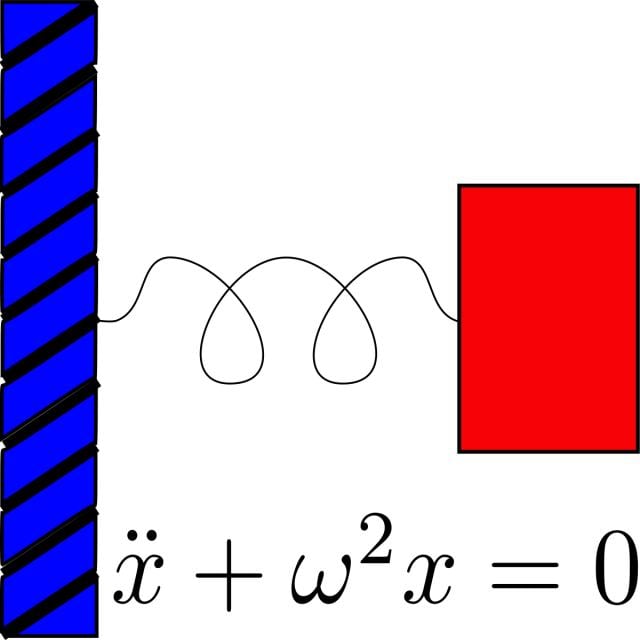
We now add an inhomogeneous term to the constant-coefficient ode. The inhomogeneous term may be an exponential, a sine or cosine, or a polynomial. We also study the phenomena of resonance, when the forcing frequency is equal to the natural frequency of the oscillator. Finally, we learn about three important applications: the RLC electrical circuit, a mass on a spring, and the pendulum.

WEEK 4
The Laplace Transform and Series Solution Methods
We present two new analytical solution methods for solving linear odes. The first is the Laplace transform method, which is used to solve the constant-coefficient ode with a discontinuous or impulsive inhomogeneous term. The Laplace transform is a good vehicle in general for introducing sophisticated integral transform techniques within an easily understandable context. We also introduce the solution of a linear ode by a series solution. Although we do not go deeply here, an introduction to this technique may be useful to students that encounter it again in more advanced courses.

WEEK 5
Systems of Differential Equations
We learn how to solve a coupled system of homogeneous first-order differential equations with constant coefficients. This system of odes can be written in matrix form, and we learn how to convert these equations into a standard matrix algebra eigenvalue problem. The two-dimensional solutions are visualized using phase portraits. We then learn about the important application of coupled harmonic oscillators and the calculation of normal modes. The normal modes are those motions for which the individual masses that make up the system oscillate with the same frequency.

WEEK 6
Partial Differential Equations
To learn how to solve a partial differential equation (pde), we first define a Fourier series. We then derive the one-dimensional diffusion equation, which is a pde for the diffusion of a dye in a pipe. We proceed to solve this pde using the method of separation of variables.
Go to Class
MOOC List is learner-supported. When you buy through links on our site, we may earn an affiliate commission.

Related Courses

Matrix Methods (Coursera) Coursera
University of Minnesota

Matrix Methods (Coursera)

Mathematical Matrix Methods lie at the root of most methods of machine learning and data analysis of tabular data. Learn the basics of Matrix Methods, including matrix-matrix multiplication, solving linear equations, orthogonality, and best least squares approximation. Discover the Singular Value Decomposition that plays a fundamental role in dimensionality reduction, Principal Component Analysis, and noise reduction.

Jun 22nd 2026
5-12 Weeks
Calculus through Data & Modeling: Differentiation Rules (Coursera) Coursera
Johns Hopkins University

Calculus through Data & Modeling: Differentiation Rules (Coursera)

Calculus through Data & Modeling: Differentiation Rules continues the study of differentiable calculus by developing new rules for finding derivatives without having to use the limit definition directly. These differentiation rules will enable the calculation of rates of change with relative ease the derivatives of polynomials, rational functions, algebraic functions, exponential and logarithmic functions, and trigonometric and inverse trigonometric functions.

Jun 29th 2026
5-12 Weeks
Precalculus: Relations and Functions (Coursera) Coursera
Johns Hopkins University

Precalculus: Relations and Functions (Coursera)

This course helps to build the foundational material to use mathematics as a tool to model, understand, and interpret the world around us. This is done through studying functions, their properties, and applications to data analysis. Concepts of precalculus provide the set of tools for the beginning student to begin their scientific career, preparing them for future science and calculus courses. This course is designed for all students, not just those interested in further mathematics courses.

Jun 29th 2026
4 Weeks
Mathematics for Engineers: The Capstone Course (Coursera) Coursera
The Hong Kong University of Science and Technology - HKUST

Mathematics for Engineers: The Capstone Course (Coursera)

Mathematics for Engineers: The Capstone Course provides a capstone project for students who are completing the Mathematics for Engineers specialization. Students will first learn some basic concepts in computational fluid dynamics, and then apply these concepts to compute the fluid flow around a cylinder. Access to MATLAB online and the MATLAB grader is given to all students who enroll.

Jun 29th 2026
3 Weeks
Introduction to Ordinary Differential Equations (Coursera) Coursera
Korea Advanced Institute of Science and Technology - KAIST

Introduction to Ordinary Differential Equations (Coursera)

In this introductory course on Ordinary Differential Equations, we first provide basic terminologies on the theory of differential equations and then proceed to methods of solving various types of ordinary differential equations. We handle first order differential equations and then second order linear differential equations. We also discuss some related concrete mathematical modeling problems, which can be handled by the methods introduced in this course.

Jun 29th 2026
5-12 Weeks
Contenido de las matemáticas de primaria (Coursera) Coursera
Universidad de los Andes

Contenido de las matemáticas de primaria (Coursera)

En este curso de acceso gratuito*, conocerás algunos temas de las matemáticas escolares con la profundidad necesaria para que puedas ayudar a tus estudiantes a aprenderlas. En este curso, podrás conocer las matemáticas desde cuatro perspectivas: su historia, los conceptos y procedimientos que las caracterizan, las distintas formas en que se hacen presentes (p. ej., tablas, gráficas o expresiones simbólicas), y los fenómenos y situaciones que les dan sentido.

Jun 22nd 2026
5-12 Weeks
Mathematics for Machine Learning: Linear Algebra (Coursera) Coursera
Imperial College London

Mathematics for Machine Learning: Linear Algebra (Coursera)

In this course on Linear Algebra we look at what linear algebra is and how it relates to vectors and matrices. Then we look through what vectors and matrices are and how to work with them, including the knotty problem of eigenvalues and eigenvectors, and how to use these to solve problems. Finally we look at how to use these to do fun things with datasets - like how to rotate images of faces and how to extract eigenvectors to look at how the Pagerank algorithm works.

Jun 29th 2026
5-12 Weeks
Algebra: Elementary to Advanced - Equations & Inequalities (Coursera) Coursera
Johns Hopkins University

Algebra: Elementary to Advanced - Equations & Inequalities (Coursera)

This course is intended for students looking to create a solid algebraic foundation of fundamental mathematical concepts from which to take more advanced courses that use concepts from precalculus, calculus, probability, and statistics. This course will help solidify your computational methods, review algebraic formulas and properties, and apply these concepts model real world situations.

Jun 22nd 2026
4 Weeks
Calculus through Data & Modelling: Integration Applications (Coursera) Coursera
Johns Hopkins University

Calculus through Data & Modelling: Integration Applications (Coursera)

This course continues your study of calculus by focusing on the applications of integration. The applications in this section have many common features. First, each is an example of a quantity that is computed by evaluating a definite integral. Second, the formula for that application is derived from Riemann sums. Rather than measure rates of change as we did with differential calculus, the definite integral allows us to measure the accumulation of a quantity over some interval of input values.

Jun 22nd 2026
4 Weeks
Discrete Mathematics (Coursera) Coursera
Shanghai Jiao Tong University

Discrete Mathematics (Coursera)

Discrete mathematics forms the mathematical foundation of computer and information science. It is also a fascinating subject in itself. Learners will become familiar with a broad range of mathematical objects like sets, functions, relations, graphs, that are omnipresent in computer science. Perhaps more importantly, they will reach a certain level of mathematical maturity - being able to understand formal statements and their proofs; coming up with rigorous proofs themselves; and coming up with interesting results.

Jun 22nd 2026
5-12 Weeks
Álgebra Básica (Coursera) Coursera
Universidad Nacional Autónoma de México

Álgebra Básica (Coursera)

Galileo dijo: "El Universo está escrito en lenguaje matemático y los caracteres son triángulos, círculos y otras figuras geométricas, sin las que es humanamente imposible entender una sola palabra". Para entender el Universo, es necesario plantear leyes que expliquen su comportamiento, como pueden ser las leyes de la gravedad, la propagación del calor, el electromagnetismo, la reproducción celular, el crecimiento poblacional, la propagación de las enfermedades, la variación de los precios de las acciones en la bolsa de valores, el comportamiento de las masas ante un conflicto, etcétera.

Jun 29th 2026
5-12 Weeks