Desenvolvimento Ágil de Software (curso baseado em projetos e problemas) (IFSULDEMINAS)

Desenvolvimento Ágil de Software (curso baseado em projetos e problemas) (IFSULDEMINAS)

Desenvolvimento Ágil de Software utilizando Projetos, Problemas e uma Comunidade de Aprendizagem. No curso, o estudante aprende desenvolvendo projetos e resolvendo problemas reais (curso inspirado nas metodologia ativas de aprendizagem baseada em projetos e problemas).

Algumas atividades serão realizadas em par (situação cliente-desenvolvedor e situação par/time). Um cronograma semanal é sugerido, mas neste tipo de curso o estudante aprende no seu ritmo, considerando os seus objetivos de aprendizagem e necessidades. Embora o curso possa ser considerado introdutório e/ou intermediário, não importa o seu nível de conhecimento (iniciante até um especialista) você sempre pode aprender mais e colaborar com os demais participantes. Será importante conhecer pelo menos uma linguagem de programação, por exemplo Java, C, C++, Ruby, dentre outras, a fim de concluir as atividades propostas.

Go to Class
MOOC List is learner-supported. When you buy through links on our site, we may earn an affiliate commission.

Related Courses

Creative Programming for Digital Media & Mobile Apps (Coursera) Coursera
University of London,Goldsmiths, University of London

Creative Programming for Digital Media & Mobile Apps (Coursera)

This course is for anyone who would like to apply their technical skills to creative work ranging from video games to art installations to interactive music, and also for artists who would like to use programming in their artistic practice. This course will teach you how to develop and apply programming skills to creative work. This is an important skill within the development of creative mobile applications, digital music and video games. It will teach the technical skills needed to write software that make use of images, audio and graphics, and will concentrate on the application of these skills to creative projects. Additional resources will be provided for students with no programming background.

Sep 14th 2026
5-12 Weeks
Python Foundations (OpenClass) Other Providers
OpenClass

Python Foundations (OpenClass)

This course aims to introduce beginners to programming in Python, starting at square zero. By the end of this course, learners should *not* expect to be programming wizards; rather, they should expect to have a solid foundational understanding of how Python works to pursue further knowledge in more specific areas of programming, such as natural language processing, web development, or general programming.

Self Paced
Self-Paced
VLSI CAD Part I: Logic (Coursera) Coursera
University of Illinois at Urbana-Champaign

VLSI CAD Part I: Logic (Coursera)

A modern VLSI chip has a zillion parts -- logic, control, memory, interconnect, etc. How do we design these complex chips? Answer: CAD software tools. Learn how to build thesA modern VLSI chip is a remarkably complex beast: billions of transistors, millions of logic gates deployed for computation and control, big blocks of memory, embedded blocks of pre-designed functions designed by third parties (called “intellectual property” or IP blocks). How do people manage to design these complicated chips? Answer: a sequence of computer aided design (CAD) tools takes an abstract description of the chip, and refines it step-wise to a final design.

Sep 21st 2026
5-12 Weeks
Program Arcade Games - Learn Computer Science (Simpson College) Other Providers
Simpson College

Program Arcade Games - Learn Computer Science (Simpson College)

This is a first semester course in learning how to program. Are you here because you want to create your own games? Excellent! But you might soon find that this looks like work. We all know we'd rather skip work and go farming for gold in WoW or Eve or some other game, right? So why learn to program? What does a person get out of it?

Self Paced
Self-Paced
Programming Languages, Part C (Coursera) Coursera
University of Washington

Programming Languages, Part C (Coursera)

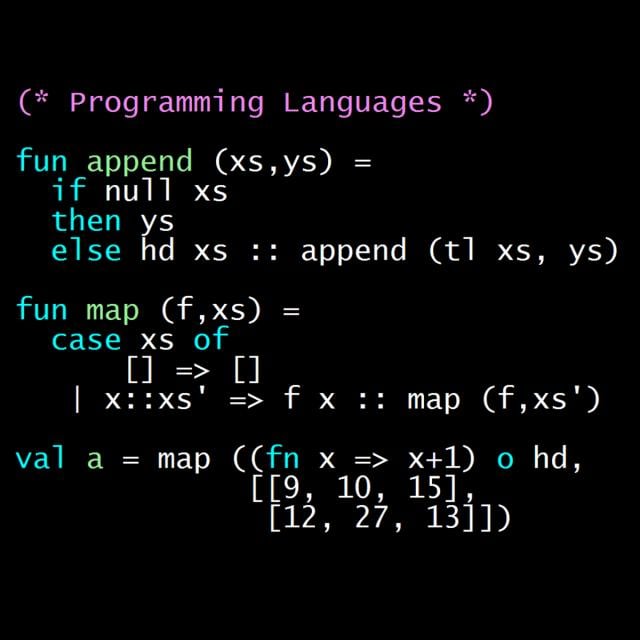
This course is an introduction to the basic concepts of programming languages, with a strong emphasis on functional programming. The course uses the languages ML, Racket, and Ruby as vehicles for teaching the concepts, but the real intent is to teach enough about how any language “fits together” to make you more effective programming in any language -- and in learning new ones.

Sep 21st 2026
3 Weeks
Problem Solving, Python Programming, and Video Games (Coursera) Coursera
University of Alberta

Problem Solving, Python Programming, and Video Games (Coursera)

This course is an introduction to computer science and programming in Python. Important computer science concepts such as problem solving (computational thinking), problem decomposition, algorithms, abstraction, and software quality are emphasized throughout. The Python programming language and video games are used to demonstrate computer science concepts in a concrete and fun manner. However, a learner can take the knowledge and skills from this course and apply them to non-game problems, other programming languages, and other computer science courses.

Sep 21st 2026
5-12 Weeks