Customer Analytics (Coursera)

Customer Analytics (Coursera)

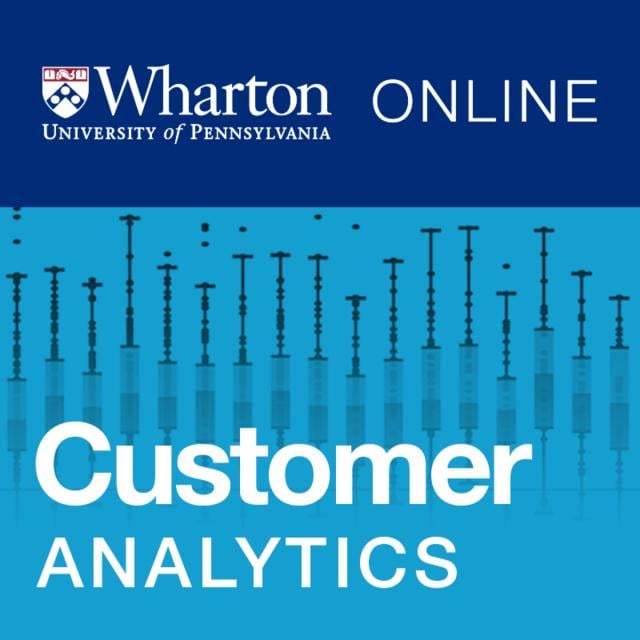
Data about our browsing and buying patterns are everywhere. From credit card transactions and online shopping carts, to customer loyalty programs and user-generated ratings/reviews, there is a staggering amount of data that can be used to describe our past buying behaviors, predict future ones, and prescribe new ways to influence future purchasing decisions. In this brand new course, four of Wharton’s top marketing professors will dive deeper into the key areas of customer analytics: descriptive analytics, predictive analytics, prescriptive analytics, and their application to real-world business practices including Amazon, Google, and Starbucks to name a few.

Class Deals by MOOC List - Click here and see Coursera's Active Discounts, Deals, and Promo Codes.

This course provides an overview of the field of analytics so that you can make informed business decisions. It is an introduction to the theory of customer analytics, and is not intended to prepare learners to perform customer analytics.
Course Learning Outcomes:

  • After completing the course learners will be able to...
  • Describe the major methods of customer data collection used by companies and understand how this data can inform business decisions
  • Describe the main tools used to predict customer behavior and identify the appropriate uses for each tool
  • Communicate key ideas about customer analytics and how the field informs business decisions
  • Communicate the history of customer analytics and latest best practices at top firms

Course 1 of 5 in the Business Analytics Specialization.

Syllabus

Week 1
Introduction to Customer Analytics
What is Customer Analytics? How is this course structured? What will I learn in this course? What will I learn in the Business Analytics Specialization? These short videos will give you an overview of this course and the specialization; the substantive lectures begin in Week 2.

Week 2
Descriptive Analytics
In this module, you’ll learn what data can and can’t describe about customer behavior as well as the most effective methods for collecting data and deciding what it means. You’ll understand the critical difference between data which describes a causal relationship and data which describes a correlative one as you explore the synergy between data and decisions, including the principles for systematically collecting and interpreting data to make better business decisions. You’ll also learn how data is used to explore a problem or question, and how to use that data to create products, marketing campaigns, and other strategies. By the end of this module, you’ll have a solid understanding of effective data collection and interpretation so that you can use the right data to make the right decision for your company or business.

Week 3
Predictive Analytics
Once you’ve collected and interpreted data, what do you do with it? In this module, you’ll learn how to take the next step: how to use data about actions in the past to make to make predictions about actions in the future. You’ll examine the main tools used to predict behavior, and learn how to determine which tool is right for which decision purposes. Additionally, you’ll learn the language and the frameworks for making predictions of future behavior. At the end of this module, you’ll be able to determine what kinds of predictions you can make to create future strategies, understand the most powerful techniques for predictive models including regression analysis, and be prepared to take full advantage of analytics to create effective data-driven business decisions.

Week 4
Prescriptive Analytics
How do you turn data into action? In this module, you’ll learn how prescriptive analytics provide recommendations for actions you can take to achieve your business goals. First, you’ll explore how to ask the right questions, how to define your objectives, and how to optimize for success. You’ll also examine critical examples of prescriptive models, including how quantity is impacted by price, how to maximize revenue, how to maximize profits, and how to best use online advertising. By the end of this module, you’ll be able to define a problem, define a good objective, and explore models for optimization which take competition into account, so that you can write prescriptions for data-driven actions that create success for your company or business.

Week 5
Application/Case Studies
How do top firms put data to work? In this module, you’ll learn how successful businesses use data to create cutting-edge, customer-focused marketing practices. You’ll explore real-world examples of the five-pronged attack to apply customer analytics to marketing, starting with data collection and data exploration, moving toward building predictive models and optimization, and continuing all the way to data-driven decisions. At the end of this module, you’ll know the best way to put data to work in your own company or business, based on the most innovative and effective data-driven practices of today’s top firms.


Go to Class
MOOC List is learner-supported. When you buy through links on our site, we may earn an affiliate commission.

Related Courses

Innovation for Impact (i4i) The Carlson-Polizzotto Method of Value Creation (Coursera) Coursera
Northeastern University

Innovation for Impact (i4i) The Carlson-Polizzotto Method of Value Creation (Coursera)

Welcome! Partnering with Tech industry giants Curtis Carlson and Len Polizzotto, Northeastern University brings you “Value Creation: The Carlson-Polizzotto Method” a short-form course experience like no other. Building careers by solving for the value proposition - Curt and Len are responsible for driving the integration of the software technology behind Apple’s voice command intelligent assistant and creating the standard for high definition television - now known to billions today as Siri and HDTV.

Aug 10th 2026
1 Week
E-Business: Negocios Online (Coursera) Coursera
Universidad de Palermo

E-Business: Negocios Online (Coursera)

El mayor servicio de transporte urbano del mundo no tiene ni un solo auto. El mayor servicio de alojamiento del mundo no tiene ni una sola habitación. La tienda de comercio más grande del mundo no tiene ni un local, y ni siquiera depósito. Uber, AirB&B y Alibaba son tan solo tres ejemplos de los cambios que ha producido en el mundo la tecnología y en particular Internet. Evidentemente, el mundo cambió. Al realizar este curso comprenderás las características que hacen a los negocios en la nueva economía apoyados en la tecnología, para que puedas diseñar tu propia estrategia de e-business.

Aug 10th 2026
4 Weeks
Corporate Sustainability. Understanding and Seizing the Strategic Opportunity (Coursera) Coursera
Università Bocconi

Corporate Sustainability. Understanding and Seizing the Strategic Opportunity (Coursera)

In this course, thought leaders in a wide variety of management and economics fields illustrate how to assess and seize the opportunities offered by these global emergencies. They will offer new ways to understand the purpose and the logic of success of the business enterprise in this new context, providing ideas and examples on how to manage the transition process to realize the value creation potential from corporate sustainability for all involved stakeholders.

Aug 10th 2026
5-12 Weeks
Foundations of Business Strategy (Coursera) Coursera
University of Virginia

Foundations of Business Strategy (Coursera)

Develop your ability to think strategically, analyze the competitive environment, and recommend firm positioning and value creation. In this course, developed at the Darden School of Business at the University of Virginia, top-ranked faculty will help you explore the underlying theory and frameworks that provide the foundations of a successful business strategy and provide the tools you need to understand that strategy: SWOT, Competitor, Environmental, Five Forces, and Capabilities Analyses, as well as Strategy Maps.

Jul 27th 2026
4 Weeks
Publicidad Digital con Google AdWords (Coursera) Coursera
Universidad Austral

Publicidad Digital con Google AdWords (Coursera)

En este curso de Google Adwords, aprenderás sobre los conceptos fundamentales y técnicas avanzadas de la publicidad en Google. Con estos, serás capaz de crear, publicar y optimizar correctamente campañas para promocionar las marcas, productos o servicios que desee en una de las herramientas publicitarias más poderosas del mundo. El curso profundiza tanto en la red de Búsqueda como la red de Display, detallando sus aspectos teóricos y prácticos desde la propia herramienta.

Aug 10th 2026
4 Weeks
Operations Research (1): Models and Applications (Coursera) Coursera
National Taiwan University

Operations Research (1): Models and Applications (Coursera)

Operations Research (OR) is a field in which people use mathematical and engineering methods to study optimization problems in Business and Management, Economics, Computer Science, Civil Engineering, Industrial Engineering, etc. This course introduces frameworks and ideas about various types of optimization problems in the business world. In particular, we focus on how to formulate real business problems into mathematical models that can be solved by computers.

Aug 3rd 2026
5-12 Weeks
Design-Led Strategy: Design thinking for business strategy and entrepreneurship (Coursera) Coursera
The University of Sydney

Design-Led Strategy: Design thinking for business strategy and entrepreneurship (Coursera)

This course is for entrepreneurial managers who are looking for tools and techniques to introduce exciting, innovative products or services to market quickly and informed by high-quality customer insights. It is applicable to a range of organizations from small-medium sized enterprises through to corporates, and across a range of industrial segments.

Aug 3rd 2026
5-12 Weeks
Continuous Delivery & DevOps (Coursera) Coursera
University of Virginia

Continuous Delivery & DevOps (Coursera)

Amazon famously delivers new code every 11.6 seconds. Just a few years ago, this was unthinkable: many ‘cutting edge’ firms would release software quarterly. When it comes to digital innovation, velocity is critical and many would say it’s the most reliable determinant of success. Bringing an organization to the state of the art (or even functional capability) in this area requires strong work in a combination of disciplines and a combination of both technical and managerial skills. There is no single cookie-cutter approach for achieving this capability.

Aug 10th 2026
4 Weeks
Bridging the Gap between Strategy Design and Delivery (Coursera) Coursera
Brightline Initiative

Bridging the Gap between Strategy Design and Delivery (Coursera)

In today’s competitive business environment, organizations are facing unprecedented levels of change and disruption. Only 1 out of 10 executives based on a global survey admit that their organizations successfully deliver all of their strategic initiatives. This course will help you as a leader of your organization to bridge the costly and wasteful gap between strategy design and delivery.

Aug 3rd 2026
5-12 Weeks
Math for MBA and GMAT Prep (Coursera) Coursera
Emory University

Math for MBA and GMAT Prep (Coursera)

This course gives participants a basic understanding of statistics as they apply in business situations. A fair share of students considering MBA programs come from backgrounds that do not include a large amount of training in mathematics and statistics. Often, students find themselves at a disadvantage when they apply for or enroll in MBA programs. This course will give you the tools to understand how these business statistics are calculated for navigating the built-in formulas that are included in Excel, but also how to apply these formulas in an range of business settings and situations.

Aug 10th 2026
5-12 Weeks
Introduction to Accounting Data Analytics and Visualization (Coursera) Coursera
University of Illinois at Urbana-Champaign

Introduction to Accounting Data Analytics and Visualization (Coursera)

Accounting has always been about analytical thinking. From the earliest days of the profession, Luca Pacioli emphasized the importance of math and order for analyzing business transactions. The skillset that accountants have needed to perform math and to keep order has evolved from pencil and paper, to typewriters and calculators, then to spreadsheets and accounting software. A new skillset that is becoming more important for nearly every aspect of business is that of big data analytics: analyzing large amounts of data to find actionable insights. This course is designed to help accounting students develop an analytical mindset and prepare them to use data analytic programming languages like Python and R.

Aug 10th 2026
5-12 Weeks