Create and Lead an Ethical Data-Driven Organization (Coursera)

Offered by CertNexus,
Create and Lead an Ethical Data-Driven Organization (Coursera)

Creating and leading an ethical data-driven organization, when done successfully, is a cultural transformation for an organization. Navigating a cultural shift requires leadership buy in, resourcing, training, and support through creation of boards, policies, and governance. Beyond leadership and organization, it is imperative to engage employees through forums and incentive programs for continual involvement. A strong understanding of ethical organizational policies provides the foundation for consistent monitoring to maintain an ethical culture.

Class Deals by MOOC List - Click here and see Coursera's Active Discounts, Deals, and Promo Codes.

In this fifth course of the CertNexus Certified Ethical Emerging Technologist (CEET) professional certificate, learners will develop strategies to lead an applied ethics initiative, champion its crucial importance, and promote an ethical organizational culture. Learners will learn how to develop and implement ethical organizational policies and a code of ethics. They will also be prepared to evaluate the effectiveness of policies with internal and external stakeholders.
This course is the fifth of five courses within the Certified Ethical Emerging Technologist (CEET) professional certificate. The preceding courses are titled Promote the Ethical Use of Data-Driven Technologies, Turn Ethical Frameworks into Actionable Steps, Detect and Mitigate Ethical Risks, and Communicate Effectively about Ethical Challenges in Data-Driven Technologies.
What You Will Learn

  • Lead an applied ethics initiative, and champion its crucial importance.
  • Promote an ethical organizational culture.
  • Develop and implement ethical organizational policies and a code of ethics.
  • Evaluate the effectiveness of a code of ethics with internal and external stakeholders.

Course 5 of 5 in the CertNexus Certified Ethical Emerging Technologist Professional Certificate.

Syllabus

WEEK 1
Promote an Ethical Organizational Culture
The first module in this course begins by outlining strategies for building ethics into the organization's culture. An ethical culture promotes ethical behavior in all areas of the business and encourages all internal stakeholders to engage in ethical behavior, regardless of department or individual roles and responsibilities.

WEEK 2
Maintain Ethical Considerations in Governance and Policy Making
In this module, you'll explore some of the foremost ethical issues and principles that an organization must consider integrating into its governance and policies. Many of these considerations will be crucial to the process of building an ethical organization.

WEEK 3
Develop and Deploy a Code of Ethics
In this module, you'll begin work on a code of ethics, an important building block for any organization that wishes to promote ethical behavior in the development of its data-driven technologies. You'll explore not only the creation of a code of ethics, but proper methods for deploying that code.

WEEK 4
Develop and Deploy Ethical Organizational Policies
Now that you've created an ethical organizational culture, evaluated key ethical considerations, and developed a code of ethics, you can begin working on the practical implementation of ethics in the form of policies. In this module, you'll develop and deploy policies that ensure your ethical vision is achieved and maintained.

Go to Class
MOOC List is learner-supported. When you buy through links on our site, we may earn an affiliate commission.

Related Courses

Building Trust: Ethics for AI-powered Chatbots (Coursera) Coursera
Coursera Instructor Network

Building Trust: Ethics for AI-powered Chatbots (Coursera)

Many organizations with websites are using chatbots to engage with customers. While this strategy has proved profitable and efficient, there are ethical issues that can arise if users are unaware that their interaction is with an AI bot and not a human. This course will take the learner through the evolution of chatbots, so they are equipped with an appropriate sense of incremental improvements.

Nov 2nd 2026
1 Week
Ethics, Technology and Engineering (Coursera) Coursera
Eindhoven University of Technology

Ethics, Technology and Engineering (Coursera)

There is an increasing attention to ethics in engineering practice. Engineers are supposed not only to carry out their work competently and skilfully, but also to be aware of the broader ethical and social implications of engineering and to be able to reflect on these. According to the Engineering Criteria 2000 of the Accreditation Board for Engineering and Technology (ABET) in the US, engineers must have “an understanding of professional and ethical responsibility” and should "understand the impact of engineering solutions in a global and societal context.”

Oct 26th 2026
5-12 Weeks
Introduction to UX Design MasterTrack Certificate Program (Coursera) Coursera
University of Minnesota

Introduction to UX Design MasterTrack Certificate Program (Coursera)

User experience is a highly in-demand field which requires a holistic understanding of the design process. This course is a "sample" of the UX Design MasterTrack certificate program. You will have the opportunities to explore core topics in UX including Ethics and Research, User Research, User Testing, and Visual Literacy as four modules.

Oct 26th 2026
5-12 Weeks
Corruption (Coursera) Coursera
University of Pennsylvania

Corruption (Coursera)

You can't understand the world today if you don't understand corruption. Every day, we see high-level government officials resigning, governments changing, hundreds of thousands of people standing in squares, holding up signs, and often risking their lives to protest the corruption in the world. It's critically important to the health of our societies to understand what people are protesting against. We want to understand corruption. This course is designed to teach you about what corruption is, what causes corruption, the effects of corruption, and how to control corruption.

Oct 26th 2026
4 Weeks
The Roles and Responsibilities of Nonprofit Boards of Directors within the Governance Process (Coursera) Coursera
University at Buffalo,The State University of New York

The Roles and Responsibilities of Nonprofit Boards of Directors within the Governance Process (Coursera)

This course provides a more in-depth look at the roles and responsibilities of boards of directors in the governance of nonprofit organizations. While the course has been developed with North American culture in mind, we do appreciate that in other parts of the world, the nature of the roles and responsibilities of boards of directors may not be the same. Nevertheless,it is our hope that much of the course content will still be of value to those in other parts of the world.

Oct 21st 2026
5-12 Weeks
Systems Thinking In Public Health (Coursera) Coursera
Johns Hopkins University

Systems Thinking In Public Health (Coursera)

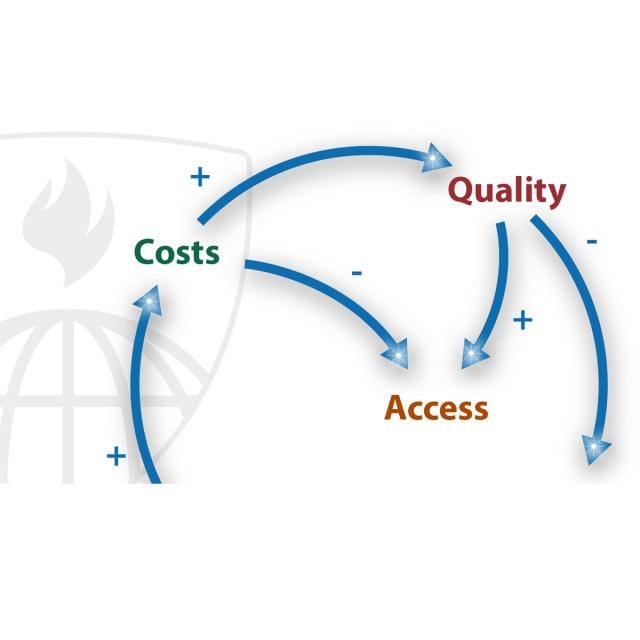
This course provides an introduction to systems thinking and systems models in public health. Problems in public health and health policy tend to be complex with many actors, institutions and risk factors involved. If an outcome depends on many interacting and adaptive parts and actors the outcome cannot be analyzed or predicted with traditional statistical methods. Systems thinking is a core skill in public health and helps health policymakers build programs and policies that are aware of and prepared for unintended consequences.

Nov 2nd 2026
4 Weeks
Managing Responsibly: Practicing Sustainability, Responsibility and Ethics (Coursera) Coursera
University of Manchester

Managing Responsibly: Practicing Sustainability, Responsibility and Ethics (Coursera)

Managers are increasingly confronted with issues of sustainability, responsibility and ethics. Managing responsibly is an integrative approach to sustainability, responsibility and ethics, which allows you as a manager to deal competently with such challenges. This course will facilitate your learning process to engage in changing practices to make them more sustainable, responsible, and ethically informed.

Oct 19th 2026
5-12 Weeks
Organizational Analysis (Coursera) Coursera
Stanford University

Organizational Analysis (Coursera)

In this introductory, self-paced course, you will learn multiple theories of organizational behavior and apply them to actual cases of organizational change. Organizations are groups whose members coordinate their behaviors in order to accomplish a shared goal. They can be found nearly everywhere in today’s society: universities, start-ups, classrooms, hospitals, non-profits, government bureaus, corporations, restaurants, grocery stores, and professional associations are some of many examples of organizations.

Oct 26th 2026
5-12 Weeks
Reputation Crisis? Facebook meets Cambridge Analytica (Coursera) Coursera
Erasmus University Rotterdam

Reputation Crisis? Facebook meets Cambridge Analytica (Coursera)

Do you remember when you first created your Facebook account? Do you know what happens to the data and stories you share on Facebook? Are you aware of the Facebook – Cambridge Analytica crisis and its ramifications? In this course, you will take a deep dive into reputation management by tackling a case study on the crisis, the effects of which are still unravelling for Facebook, the tech industry, and society at large. You will explore the concept of corporate reputation, and touch upon topics such as data privacy implications for the big tech or the importance of leadership and culture, and how Mark Zuckerberg’s leadership might have affected Facebook in particular. In the final project, you will be asked to link theory and practice to provide an analysis of events and make recommendations for Facebook, going forward.

Oct 26th 2026
5-12 Weeks
Tools and Practices for Addressing Pandemic Challenges (Coursera) Coursera
Politecnico di Milano

Tools and Practices for Addressing Pandemic Challenges (Coursera)

An overview of the tools, techniques, and practices that can be enacted by policy makers, countries, and organizations to monitor, manage, and react to pandemics and mitigate and govern their impacts. An introductory, multidisciplinary course covering data science, social science, healthcare, and management, paving the way to various courses on specific matters.

Oct 26th 2026
2 Weeks
Linguistic Diversity, What for? (Coursera) Coursera
Universitat Autònoma de Barcelona

Linguistic Diversity, What for? (Coursera)

What is linguistic diversity? What are its implications and opportunities? How is diversity around the world? How is it experienced, understood and managed in different contexts? What is your knowledge and experience about languages and diversity? In this course we approach linguistic diversity and multilingualism not only from a theoretical point of view, but also from a perspective oriented to help understand and manage various contexts that emerge from diversity in different environments of social interaction.

Oct 26th 2026
5-12 Weeks
Art and the Digital Transformation (Coursera) Coursera
Copenhagen Business School

Art and the Digital Transformation (Coursera)

More than two decades into the new millennium, it is difficult to envision a future in which digital technologies do not play a significant role. Digital technologies frequently make a lot of promises. However, in recent years, we have seen an increasing number of artists address fundamental issues of the Digital Transformation, such as surveillance, lack of representation, and digital illiteracy. Artists have demonstrated that, while digital technologies have the potential to support processes leading to greater equality, they are frequently viewed as perpetuating and even exacerbating inequalities.

Nov 2nd 2026
5-12 Weeks