Computer Communications and Networks (saylor.org)

Offered by Saylor.org,
Computer Communications and Networks (saylor.org)

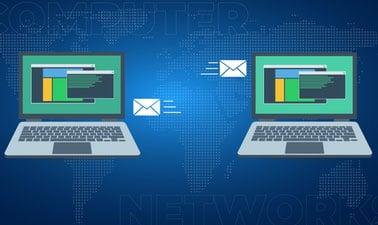
This course is designed to give you a clear understanding of how networks, from in-home local area networks, or LANS, to the massive and global Internet, are built and how they allow us to use computers to share information and communicate with one another.

The Internet has become one of the most important components of our life. We browse the Web, check e-mails, make VoIP phone calls, and have video conferences via computers. All of these applications are made possible by networking computers together, and this complex network of computers is usually referred to as the Internet. This course is designed to give you a clear understanding of how networks, from in-home local area networks, or LANS, to the massive and global Internet, are built and how they allow us to use computers to share information and communicate with one another.

Unit 1 introduces you to an explanation of what computer networks are as well as to some basic terminology fundamental to understanding computer networks. You will also familiarize yourself with the concept of layers, which compose the framework around which networks are built. Next, Unit 2 explains the concept of protocols. A computer communication (or network) protocol defines rules and conventions for communication between network devices.

The rest of the course implements a top-down approach to teach you the details about each layer and the relevant protocols used in computer networks. Beginning in Unit 3, you will explore the concept of application layer protocols, which include the Domain Name System, e-mail protocols, and the Hypertext Transfer Protocol. Unit 3 ends with an overview of how to use socket programming to develop network applications. In Unit 4, you will learn transport layer protocols, including the Transmission Control Protocol (TCP) and the User Datagram Protocol (UDP). You will go on to study the network layer Internet Protocol (IP) and packet routing protocols in Unit 5. Next is Unit 6, which is devoted to a discussion on link layer protocols, and the course concludes with an overview on voice and video protocols, network security, and cloud computing in Unit 7.

Upon successful completion of this course, you will be able to:

  • describe the architecture of a computer network and explain how each device in a network communicates with each other;
  • describe the processes in each layer of the network protocol that enables different networks to share resources;
  • describe the basic network protocols in each layer of a TCP/IP stack and the purpose of each protocol;
  • recognize and differentiate between the various services and functionalities of specific mechanisms in each protocol and their usage in a computer network;
  • explain the role of the Network Request for Comment (RFC);
  • compare and contrast each layer in the TCP/IP model with those in the OSI model;
  • define socket programming and explain its role in application processing;
  • describe IP addressing and explain its purpose;
  • explain packet collisions and how they are corrected in the link layer;
  • define CSMA and describe its use in the link layer;
  • describe and compare application protocols such as VoIP and IPTV; and
  • explain TCP/IP security related issues.
Go to Class
MOOC List is learner-supported. When you buy through links on our site, we may earn an affiliate commission.

Related Courses

Internet History, Technology, and Security (Coursera) Coursera
University of Michigan

Internet History, Technology, and Security (Coursera)

The impact of technology and networks on our lives, culture, and society continues to increase. The very fact that you can take this course from anywhere in the world requires a technological infrastructure that was designed, engineered, and built over the past sixty years. To function in an information-centric world, we need to understand the workings of network technology. This course will open up the Internet and show you how it was created, who created it and how it works. Along the way we will meet many of the innovators who developed the Internet and Web technologies that we use today.

Jun 1st 2026
5-12 Weeks
Computer Architecture (saylor.org) Saylor Academy
Saylor.org

Computer Architecture (saylor.org)

Modern computer technology requires an understanding of both hardware and software, as the interaction between the two offers a framework for mastering the fundamentals of computing. The purpose of this course is to cultivate an understanding of modern computing technology through an in-depth study of the interface between hardware and software.

Self Paced
Self-Paced
Wie 'denkt' ein Computer? Vom Sandkorn bis zur Software (openHPI) OpenHPI
Hasso-Plattner-Institut

Wie 'denkt' ein Computer? Vom Sandkorn bis zur Software (openHPI)

Wie funktioniert ein Computer eigentlich? Diese Frage hast Du Dir wahrscheinlich schon einmal gestellt. Ausgehend von Transistoren und elektrischen Schaltungen finden wir heraus, woraus ein Prozessor besteht und wie er funktioniert. Dabei probieren wir selbst mit verschiedenen Simulationstools das Gelernte aus und entdecken die Welt der Rechnertechnik.

Apr 26th 2023
4 Weeks
Networking Fundamentals (Coursera) Coursera
Akamai Technologies, Inc.

Networking Fundamentals (Coursera)

Students start by learning basic network theory and terminology including network components, node functions, types of networks and network models. Students will gain an understanding of the Open Systems Interconnection (OSI) model and the TCP/IP Model including encapsulation and common network protocols. Students learn about data transmission methods and ethernet including CSMA/CD and CSMA/CA.

Jun 22nd 2026
4 Weeks
Big Data Science with the BD2K-LINCS Data Coordination and Integration Center (Coursera) Coursera
Icahn School of Medicine at Mount Sinai

Big Data Science with the BD2K-LINCS Data Coordination and Integration Center (Coursera)

In this course we briefly introduce the DCIC and the various Centers that collect data for LINCS. We then cover metadata and how metadata is linked to ontologies. We then present data processing and normalization methods to clean and harmonize LINCS data. This follow discussions about how data is served as RESTful APIs. Most importantly, the course covers computational methods including: data clustering, gene-set enrichment analysis, interactive data visualization, and supervised learning. Finally, we introduce crowdsourcing/citizen-science projects where students can work together in teams to extract expression signatures from public databases and then query such collections of signatures against LINCS data for predicting small molecules as potential therapeutics.

Jun 1st 2026
5-12 Weeks
Network Analysis in Systems Biology (Coursera) Coursera
Icahn School of Medicine at Mount Sinai

Network Analysis in Systems Biology (Coursera)

An introduction to data integration and statistical methods used in contemporary Systems Biology, Bioinformatics and Systems Pharmacology research. The course covers methods to process raw data from genome-wide mRNA expression studies (microarrays and RNA-seq) including data normalization, differential expression, clustering, enrichment analysis and network construction. The course contains practical tutorials for using tools and setting up pipelines, but it also covers the mathematics behind the methods applied within the tools.

Jun 8th 2026
5-12 Weeks
人群与网络 (Coursera) Coursera
Peking University

人群与网络 (Coursera)

本课程是北京大学开设的一门在线跨学科选修课程,主要面向信息技术、社会学和经济学等专业的本科生。课程内容涉及用计算思维的方法讨论社会学和经济学的一些经典问题。学习运用计算思维分析社会学、经济学问题的方法,加深对某些生活现象的理解,体会计算与社会科学的互动。

Jun 15th 2026
5-12 Weeks
Real-Time Cyber Threat Detection and Mitigation (Coursera) Coursera
New York University

Real-Time Cyber Threat Detection and Mitigation (Coursera)

This course introduces real-time cyber security techniques and methods in the context of the TCP/IP protocol suites. Explanation of some basic TCP/IP security hacks is used to introduce the need for network security solutions such as stateless and stateful firewalls. Learners will be introduced to the techniques used to design and configure firewall solutions such as packet filters and proxies to protect enterprise assets.

Jun 22nd 2026
4 Weeks
Introduction to Networking (Cousera) Coursera
NVIDIA

Introduction to Networking (Cousera)

Welcome to the Introduction to Networking Course. In this course we will cover the basics of networking, introduce commonly used TCP/IP protocols and cover the fundamentals of an Ethernet network. In addition, you’ll be equipped with the basic knowledge to understand the main data center requirements and how they can be fulfilled.

Jun 15th 2026
2 Weeks