Classical Sociological Theory (Coursera)

Classical Sociological Theory (Coursera)

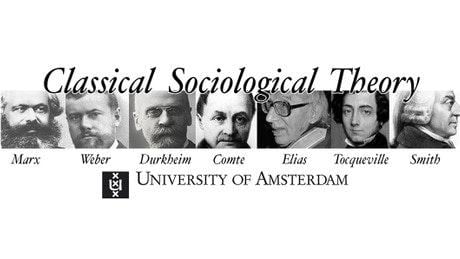
This Massive Open Online Course (MOOC) will offer the participants an introduction into the most important classical sociological readings between the 18th and 20th century. Highly influential social science scholars, such as Karl Marx, Max Weber and Emile Durkheim, will be discussed during 8 sessions. Combined with small tests, based on the video’s and recommended readings, the participants will be encouraged to dive deeply into the complex texts and get familiar with classical sociological concepts that are still very relevant today.

Class Deals by MOOC List - Click here and see Coursera's Active Discounts, Deals, and Promo Codes.

Syllabus

WEEK 1
Classical Sociological Theory - An Introduction
In this session the field of classical sociological theory will be introduced. It explains the historical roots of sociology. It shows you why classical sociological theories are still important in modern societies and it explains the Aims and Claims of this Course.

WEEK 2
Bernard Mandeville (1670-1733) and Adam Smith (1723-1790)
This session explains the work of Adam Smith. It shows you how a poem written by Bernard Mandeville inspired Adam Smith. Adam Smith's theory shines light on the consequences of industrialization. You will learn what the consequences are of the Division of Labour.

WEEK 3
Auguste Comte (1798-1857)
This session will cover the author of the word “sociology”, August Comte. He often engaged in theorizing the social world in order to attempt to discover invariant laws. Terms like “positivism”, “the law of the three stages” and “Functionalism” are prominent topics in this session. Comte believed that positivism could both advance science (theory) and change the ways people live their lives (practice).

WEEK 4
Alexis de Tocqueville (1805-1859)
Tocqueville’s works shaped 19th-century discussions of liberalism and equality, and were rediscovered in the 20th century as sociologists debated the causes and cures of tyranny and revolutions. His famous work “Democracy in America” remains widely read and even more widely quoted. This session will cover Tocqueville’s most important ideas.

WEEK 5
Karl Marx (1818-1883)
The German philosopher, radical economist, and revolutionary leader Karl Marx founded modern "scientific" socialism. His basic ideas, known as Marxism, form the foundation of socialist and communist movements throughout the world. Several topics like alienation, class struggle, and capitalism will be covered in this week's session.

WEEK 6
Émile Durkheim (1858-1917)
When thinking of Durkheim, one thinks of social facts. According to Durkheim these social facts are the social structures and cultural norms and values that are external to, and coercive over, individuals. Durkheim argues that two social facts, in particular, influence suicide rates: integration, and regulation. This session will cover the views of Durkheim on topics like solidarity, suicide, and religion.

WEEK 7
Max Weber (1864-1920)
This week shines a light on the work of Max Weber. From social action, verstehen, and ideal types to rationalisation and his famous work on the Protestant Ethic. Weber's theory of society tried to account for the manner in which various symbolic factors take part in establishing social status, stratification and inequality. His influence still runs throughout the realms of politics, religion and economics.

WEEK 8
Norbert Elias (1897-1990)
Elias is the last of the Classical Sociologists. Elias' theory focusses on long term trends, with his so called process or figurational sociology. He shows us how the civilisation proces can be explained in terms like Self-Constraint and Figurations.
Classical Sociological Theory Final Test
This is the final test. This test contains 87 question. To pass this test you need to answer at least 57 questions correct.

Go to Class
MOOC List is learner-supported. When you buy through links on our site, we may earn an affiliate commission.

Related Courses

Information & Digital Literacy for University Success (Coursera) Coursera
The University of Sydney

Information & Digital Literacy for University Success (Coursera)

This Specilaization is aimed at preparing students for undergraduate study in an English-speaking university. The course equips you for full participation and engagement with your studies by building awareness and understanding of the core values and expectations of academic culture, and providing you with practical strategies to apply to your studies. In this course, you will learn how to develop your Information & Digital Literacy Skills to help you achieve success in your university studies.

Jun 22nd 2026
5-12 Weeks
Les transitions énergétique-écologiques dans les pays du Sud (Coursera) Coursera
École normale supérieure

Les transitions énergétique-écologiques dans les pays du Sud (Coursera)

Ce MOOC co-produit par l'Agence Française de Développement et l'ENS se situe à la confluence du développement des pays du Sud et le développement durable. Il a : une dimension macroéconomique et financière portée notamment par Gael Giraud et Alain Grandjean en tant qu’intervenants; une dimension écologique et climatique portée notamment par David Claessen et les intervenants de l’ENS, et une dimension de focus sur les pays du Sud portée notamment par les intervenants de l’AFD.

Jun 22nd 2026
5-12 Weeks
What Is Sociology? An Introduction (FutureLearn) FutureLearn
The University of Newcastle, Australia

What Is Sociology? An Introduction (FutureLearn)

Examine perspectives on society, and the cultural issues facing society. Apply sociological theory to researching social groups. Discover the fascinating field of sociology. How can society be analysed? And what are some of the contemporary cultural issues in society? Get answers to these questions and more with this introduction to sociology course.

No sessions available
3 Weeks
Global Sociology (edX) EdX
Wellesley College,WellesleyX

Global Sociology (edX)

Connect your personal biography to global history as you develop your sociological imagination. Ever wondered why some countries are rich and others poor? Or why some people believe hard work results in upward mobility and others don’t? To answer these questions, you need to “see” the world sociologically.

No sessions available
4 Weeks
Introduction to Global Sociology (edX) EdX
Wellesley College,WellesleyX

Introduction to Global Sociology (edX)

Connect your personal biography to global history as you develop your sociological imagination. Ever wondered why some countries are rich and others poor? Or why some people believe hard work results in upward mobility and others don’t? To answer these questions, you need to “see” the world sociologically. In this introductory sociology course, we will explore the concerns of an interconnected global world through classic sociological concepts.

No sessions available
4 Weeks
Multimodal Literacies: Communication and Learning in the Era of Digital Media (Coursera) Coursera
University of Illinois at Urbana-Champaign

Multimodal Literacies: Communication and Learning in the Era of Digital Media (Coursera)

Whereas the focus of traditional literacy pedagogy has been the written word in its standard and literary forms, this courser expands the scope of literacy learning to encompass contemporary multimodal texts and the wide range of ways of making meaning that occur in different social and cultural contexts. Another course, "Literacy Teaching and Learning: Aims, Approaches and Pedagogies" addresses pedagogical aspects of literacies. This "Multimodal Literacies" learning module does not require or expect that participants will have already completed the "Literacy Teaching and Learning" module.

Jun 22nd 2026
4 Weeks
Understanding economic policymaking (Coursera) Coursera
IE Business School

Understanding economic policymaking (Coursera)

This course will employ a non-technical approach to analyze how governments use policy to influence a country's economy. Upon completing the course you should be able to discuss national debts and deficits, examine fiscal and monetary policy and their appropriateness to the situation of an economy, and anticipate the results of fiscal and monetary policies and structural reform on a country.

Jun 22nd 2026
5-12 Weeks
Becoming a Sports Agent (Coursera) Coursera
Case Western Reserve University

Becoming a Sports Agent (Coursera)

An immersive experience in the world of sports that will take students through the four stages of a professional athlete's career. Utilizing lectures, guest speakers, reading assignments and hypothetical walkthroughs, students will learn how the best sports agents manage clients at each of these four stages. This course will provide each student with the skills necessary to guide an athlete through the difficult decisions that can make or lose the athlete millions of dollars, as well as affect their public image and career.

Jun 22nd 2026
5-12 Weeks
Beyond the Sustainable Development Goals (SDGs): Addressing Sustainability and Development (Coursera) Coursera
University of Michigan

Beyond the Sustainable Development Goals (SDGs): Addressing Sustainability and Development (Coursera)

We’re excited you’re here! This course, “Beyond the Sustainable Development Goals (SDGs): Addressing Sustainability and Development,” is the first course in the upcoming Sustainability and Development MasterTrack Certificate program (Fall 2020), but you can also take this course as a stand-alone learning opportunity.

Jun 24th 2026
5-12 Weeks
Positive Psychology: Applications and Interventions (Coursera) Coursera
University of Pennsylvania

Positive Psychology: Applications and Interventions (Coursera)

Positive interventions are one of the building blocks for the application of positive psychology in our day-to-day lives. In this course taught by Dr. James Pawelski, we explore positive interventions through theory, research and practice. We provide learners the basic tools for using and measuring positive psychology in professional or personal contexts. Suggested prerequisite: Positive Psychology: Martin E. P. Seligman’s Visionary Science.

Jun 22nd 2026
4 Weeks
Analizando las Políticas Económicas (Coursera) Coursera
IE Business School

Analizando las Políticas Económicas (Coursera)

Este curso utiliza un enfoque no técnico para analizar la forma en la que los gobiernos utilizan políticas económicas para influenciar la economía de sus países. Al finalizar el curso el participante hablará con propiedad sobre temas tan importantes como la deuda y el déficit de los países, podrá examinar las políticas fiscales y monetarias así como las reformas estructurales de los países.

Jun 22nd 2026
5-12 Weeks
Villes africaines: Mobilités et transports urbains (Coursera) Coursera
École Polytechnique Fédérale de Lausanne

Villes africaines: Mobilités et transports urbains (Coursera)

Les villes africaines, en particulier les grandes agglomérations, sont marquées depuis la 2ème moitié du XXème siècle par une croissance démographique et spatiale sans précédent, ce qui accroit les besoins de mobilité pour relier des lieux de plus en plus éloignés. Il s’agira durant le cours, dans un premier temps, de documenter le contexte de mobilité dans les villes africaines.

Jun 22nd 2026
5-12 Weeks