Brain Tumor Classification Using Keras (Coursera)

Brain Tumor Classification Using Keras (Coursera)

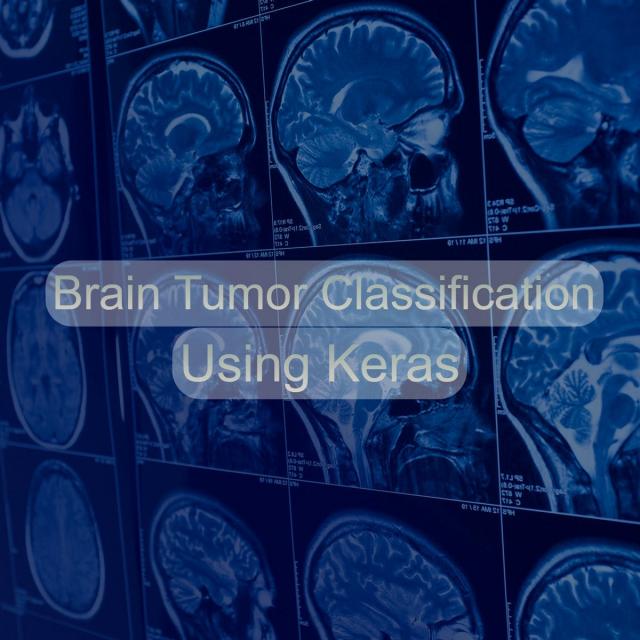
In this 2-hour-long guided project, we will use an efficient net model and train it on a Brain MRI dataset. This dataset has more than 3000 Brain MRI scans which are categorized in four classes - Glioma Tumor, Meningioma Tumor, Pituitary Tumor and No Tumor. Our objective in this project is to create an image classification model that can predict Brain MRI scans that belong to one of the four classes with a reasonably high accuracy. Please note that this dataset, and the model that we train in the project, is for educational purposes only.

Class Deals by MOOC List - Click here and see Coursera's Active Discounts, Deals, and Promo Codes.

Project Prerequisite: Before you attempt this project, you should be familiar with programming in Python. You should also have a theoretical understanding of Convolutional Neural Networks, and optimization techniques. This is a hands on, practical project that focuses primarily on implementation, and not on the theory behind Convolutional Neural Networks.
We will be carrying out the entire project on the Google Colab environment so you will need a free Gmail account to complete this project.
This Guided Project was created by a Coursera community member.

In this Guided Project, you will:

  • Learn to use Efficient Net to classify Brain MRI Scans in one of the four classes of Brain Tumor in Keras.

Learn step-by-step

  1. Introduction to the project.
  2. Clone dataset and Import Libraries
  3. Create directories to store Training and Test Data
  4. Data Visualization
  5. Create a function to crop images
  6. Save the cropped images to respective directories.
  7. Data Augmentation and Data Loading
  8. Model Creation
  9. Training and evaluating the model
  10. Prediction on Test Data
Go to Class
MOOC List is learner-supported. When you buy through links on our site, we may earn an affiliate commission.

Related Courses

Accounting Data Analytics with Python (Coursera) Coursera
University of Illinois at Urbana-Champaign

Accounting Data Analytics with Python (Coursera)

This course focuses on developing Python skills for assembling business data. It will cover some of the same material from Introduction to Accounting Data Analytics and Visualization, but in a more general purpose programming environment (Jupyter Notebook for Python), rather than in Excel and the Visual Basic Editor. These concepts are taught within the context of one or more accounting data domains (e.g., financial statement data from EDGAR, stock data, loan data, point-of-sale data).

Jun 22nd 2026
5-12 Weeks
Hypothesis Testing with Python and Excel (Coursera) Coursera
Tufts University

Hypothesis Testing with Python and Excel (Coursera)

In today's job market, leaders need to understand the fundamentals of data to be competitive. An essential procedure to understand business and analytics is hypothesis testing. This short course, designed by Tufts University expert faculty, will teach the fundamentals of hypothesis testing of a population mean and a population proportion, using Excel and Python for calculations. You'll also discover the central limit theorem, which is essential for hypothesis testing. To conclude the course, you will apply your newfound skills by creating a plan for an experiment in your own workplace that uses hypothesis testing.

Jun 23rd 2026
1 Week
Using Python to Interact with the Operating System (Coursera) Coursera
Google

Using Python to Interact with the Operating System (Coursera)

By the end of this course, you’ll be able to manipulate files and processes on your computer’s operating system. You’ll also have learned about regular expressions -- a very powerful tool for processing text files -- and you’ll get practice using the Linux command line on a virtual machine. And, this might feel like a stretch right now, but you’ll also write a program that processes a bunch of errors in an actual log file and then generates a summary file. That’s a super useful skill for IT Specialists to know.

Jun 23rd 2026
5-12 Weeks
Cloud Networking (Coursera) Coursera
University of Illinois at Urbana-Champaign

Cloud Networking (Coursera)

In the cloud networking course, we will see what the network needs to do to enable cloud computing. We will explore current practice by talking to leading industry experts, as well as looking into interesting new research that might shape the cloud network’s future. This course will allow us to explore in-depth the challenges for cloud networking—how do we build a network infrastructure that provides the agility to deploy virtual networks on a shared infrastructure, that enables both efficient transfer of big data and low latency communication, and that enables applications to be federated across countries and continents? Examining how these objectives are met will set the stage for the rest of the course.

Jun 22nd 2026
5-12 Weeks
Computational Thinking for Problem Solving (Coursera) Coursera
University of Pennsylvania

Computational Thinking for Problem Solving (Coursera)

Computational thinking is the process of approaching a problem in a systematic manner and creating and expressing a solution such that it can be carried out by a computer. But you don't need to be a computer scientist to think like a computer scientist! In fact, we encourage students from any field of study to take this course. Many quantitative and data-centric problems can be solved using computational thinking and an understanding of computational thinking will give you a foundation for solving problems that have real-world, social impact.

Jun 22nd 2026
4 Weeks
Delivery Problem (Coursera) Coursera
University of California, San Diego,Higher School of Economics - HSE University

Delivery Problem (Coursera)

We’ll implement (in Python) together efficient programs for a problem needed by delivery companies all over the world millions times per day — the travelling salesman problem. The goal in this problem is to visit all the given places as quickly as possible. How to find an optimal solution to this problem quickly? We still don’t have provably efficient algorithms for this difficult computational problem and this is the essence of the P versus NP problem, the most important open question in Computer Science.

Jun 22nd 2026
3 Weeks
Customising your models with TensorFlow 2 (Coursera) Coursera
Imperial College London

Customising your models with TensorFlow 2 (Coursera)

Welcome to this course on Customising your models with TensorFlow 2! In this course you will deepen your knowledge and skills with TensorFlow, in order to develop fully customised deep learning models and workflows for any application. You will use lower level APIs in TensorFlow to develop complex model architectures, fully customised layers, and a flexible data workflow. You will also expand your knowledge of the TensorFlow APIs to include sequence models.

Jun 22nd 2026
5-12 Weeks
The Raspberry Pi Platform and Python Programming for the Raspberry Pi (Coursera) Coursera
University of California, Irvine

The Raspberry Pi Platform and Python Programming for the Raspberry Pi (Coursera)

The Raspberry Pi is a small, affordable single-board computer that you will use to design and develop fun and practical IoT devices while learning programming and computer hardware. In addition, you will learn how to set up up the Raspberry Pi environment, get a Linux operating system running, and write and execute some basic Python code on the Raspberry Pi. You will also learn how to use Python-based IDE (integrated development environments) for the Raspberry Pi and how to trace and debug Python code on the device.

Jun 22nd 2026
4 Weeks
Browser-based Models with TensorFlow.js (Coursera) Coursera
DeepLearning.AI

Browser-based Models with TensorFlow.js (Coursera)

Bringing a machine learning model into the real world involves a lot more than just modeling. This Specialization will teach you how to navigate various deployment scenarios and use data more effectively to train your model. In this first course, you’ll train and run machine learning models in any browser using TensorFlow.js. You’ll learn techniques for handling data in the browser, and at the end you’ll build a computer vision project that recognizes and classifies objects from a webcam.

Jun 22nd 2026
4 Weeks
Cloud Computing Applications, Part 2: Big Data and Applications in the Cloud (Coursera) Coursera
University of Illinois at Urbana-Champaign

Cloud Computing Applications, Part 2: Big Data and Applications in the Cloud (Coursera)

Welcome to the Cloud Computing Applications course, the second part of a two-course series designed to give you a comprehensive view on the world of Cloud Computing and Big Data! In this second course we continue Cloud Computing Applications by exploring how the Cloud opens up data analytics of huge volumes of data that are static or streamed at high velocity and represent an enormous variety of information. Cloud applications and data analytics represent a disruptive change in the ways that society is informed by, and uses information.

Jun 22nd 2026
4 Weeks
Sequence Models (Coursera) Coursera
DeepLearning.AI

Sequence Models (Coursera)

This course will teach you how to build models for natural language, audio, and other sequence data. Thanks to deep learning, sequence algorithms are working far better than just two years ago, and this is enabling numerous exciting applications in speech recognition, music synthesis, chatbots, machine translation, natural language understanding, and many others.

Jun 22nd 2026
3 Weeks