Beginning Game Programming with C# (Coursera)

Beginning Game Programming with C# (Coursera)

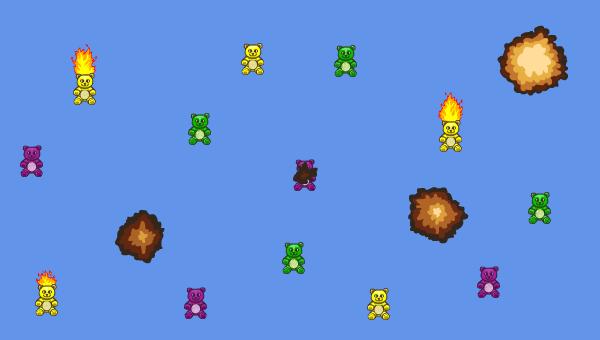
The Beginning Game Programming with C# course is all about learning how to develop video games using the C# programming language. Why use C# instead of C++, Java, ActionScript, or some other programming language you may have heard of? First, using C# lets us use the open-source MonoGame framework, which help us quickly develop games for Windows, Android, iOS, Mac OS X, and others. Second, the Unity game engine is very popular with indie game developers, and C# is one of the programming languages you can use in the Unity environment. And finally, C# is a really good language for learning how to program.

Class Deals by MOOC List - Click here and see Coursera's Active Discounts, Deals, and Promo Codes.

That learning how to program comment is important because this course doesn't assume you have any previous programming experience. Don't worry if you've never written code before; we'll start at the very beginning and work our way up to building a small, complete game by the end of the course. Throughout the course you'll learn core programming concepts that apply to lots of programming languages, including C#, and you'll also learn how to apply those concepts when you develop games: drawing all the entities in the game world, updating the game world based on user input and simple physics, playing music and sound effects in your games, and so on.
Computer programming is really fun in general, and programming games is even better!
Go to Class
MOOC List is learner-supported. When you buy through links on our site, we may earn an affiliate commission.

Related Courses

Introduction to CSS3 (Coursera) Coursera
University of Michigan

Introduction to CSS3 (Coursera)

The web today is almost unrecognizable from the early days of white pages with lists of blue links. Now, sites are designed with complex layouts, unique fonts, and customized color schemes. This course will show you the basics of Cascading Style Sheets (CSS3). The emphasis will be on learning how to write CSS rules, how to test code, and how to establish good programming habits.

Jun 8th 2026
4 Weeks
Learn to code with AI (Coursera) Coursera
Scrimba

Learn to code with AI (Coursera)

Imagine waking up tomorrow as a web developer. What would you want to build? With AI tools like ChatGPT, you're already a developer, regardless of your experience, if you know how to work with them. So in this course, you'll build functional, interactive front-end projects while learning how to write effective prompts and debug and refine your code with the help of AI.

Jun 10th 2026
2 Weeks
Neural Networks and Deep Learning (Coursera) Coursera
DeepLearning.AI

Neural Networks and Deep Learning (Coursera)

If you want to break into cutting-edge AI, this course will help you do so. Deep learning engineers are highly sought after, and mastering deep learning will give you numerous new career opportunities. Deep learning is also a new "superpower" that will let you build AI systems that just weren't possible a few years ago. In this course, you will learn the foundations of deep learning.

Jun 8th 2026
4 Weeks
Parallel Programming in Java (Coursera) Coursera
Rice University

Parallel Programming in Java (Coursera)

This course teaches learners (industry professionals and students) the fundamental concepts of parallel programming in the context of Java 8. Parallel programming enables developers to use multicore computers to make their applications run faster by using multiple processors at the same time. By the end of this course, you will learn how to use popular parallel Java frameworks (such as ForkJoin, Stream, and Phaser) to write parallel programs for a wide range of multicore platforms including servers, desktops, or mobile devices, while also learning about their theoretical foundations including computation graphs, ideal parallelism, parallel speedup, Amdahl's Law, data races, and determinism.

Jun 8th 2026
4 Weeks
Functional Program Design in Scala (Coursera) Coursera
École Polytechnique Fédérale de Lausanne

Functional Program Design in Scala (Coursera)

In this course you will learn how to apply the functional programming style in the design of larger applications. You'll get to know important new functional programming concepts, from lazy evaluation to structuring your libraries using monads. We'll work on larger and more involved examples, from state space exploration to random testing to discrete circuit simulators. You’ll also learn some best practices on how to write good Scala code in the real world.

Jun 8th 2026
5-12 Weeks
Introduction to Web Development (Coursera) Coursera
University of California, Davis

Introduction to Web Development (Coursera)

This course is designed to start you on a path toward future studies in web development and design, no matter how little experience or technical knowledge you currently have. The web is a very big place, and if you are the typical internet user, you probably visit several websites every day, whether for business, entertainment or education. But have you ever wondered how these websites actually work? How are they built? How do browsers, computers, and mobile devices interact with the web? What skills are necessary to build a website? With almost 1 billion websites now on the internet, the answers to these questions could be your first step toward a better understanding of the internet and developing a new set of internet skills.

Jun 8th 2026
5-12 Weeks
How To Create a Website in a Weekend! (Project-Centered Course) (Coursera) Coursera
The State University of New York

How To Create a Website in a Weekend! (Project-Centered Course) (Coursera)

In this project-centered course*, you’ll design, build, and publish a basic website that incorporates text, sound, images, hyperlinks, plug-ins, and social media interactivity. We’ll provide you with step-by-step instructions, exercises, tips, and tools that enable you to set up a domain name, create an attractive layout for your pages, organize your content properly, ensure that your site functions well across different operating systems and on mobile devices, keep your site safe, and finally, let people know your site is online. We’ll even show you how to track your visitors.

Jun 8th 2026
3 Weeks
Interfacing with the Raspberry Pi (Coursera) Coursera
University of California, Irvine

Interfacing with the Raspberry Pi (Coursera)

The Raspberry Pi uses a variety of input/output devices based on protocols such as HDMI, USB, and Ethernet to communicate with the outside world. In this class you will learn how to use these protocols with other external devices (sensors, motors, GPS, orientation, LCD screens etc.) to get your IoT device to interact with the real world.

Jun 8th 2026
4 Weeks
Advanced Data Structures in Java (Coursera) Coursera
University of California, San Diego

Advanced Data Structures in Java (Coursera)

How does Google Maps plan the best route for getting around town given current traffic conditions? How does an internet router forward packets of network traffic to minimize delay? How does an aid group allocate resources to its affiliated local partners? To solve such problems, we first represent the key pieces of data in a complex data structure. In this course, you’ll learn about data structures, like graphs, that are fundamental for working with structured real world data.

Jun 8th 2026
5-12 Weeks
Cloud Computing Concepts, Part 1 (Coursera) Coursera
University of Illinois at Urbana-Champaign

Cloud Computing Concepts, Part 1 (Coursera)

Cloud computing systems today, whether open-source or used inside companies, are built using a common set of core techniques, algorithms, and design philosophies—all centered around distributed systems. Learn about such fundamental distributed computing "concepts" for cloud computing. Some of these concepts include: clouds, MapReduce, key-value/NoSQL stores, classical distributed algorithms, widely-used distributed algorithms, scalability, trending areas, and much, much more!

Jun 8th 2026
5-12 Weeks
The Arduino Platform and C Programming (Coursera) Coursera
University of California, Irvine

The Arduino Platform and C Programming (Coursera)

The Arduino is an open-source computer hardware/software platform for building digital devices and interactive objects that can sense and control the physical world around them. In this class you will learn how the Arduino platform works in terms of the physical board and libraries and the IDE (integrated development environment). You will also learn about shields, which are smaller boards that plug into the main Arduino board to perform other functions such as sensing light, heat, GPS tracking, or providing a user interface display. The course will also cover programming the Arduino using C code and accessing the pins on the board via the software to control external devices.

Jun 8th 2026
4 Weeks