Bacterial Bioinformatics (Coursera)

Bacterial Bioinformatics (Coursera)

This course provides demonstrations and exercises for performing common genomics-based analysis tasks of bacterial sequence data. It uses PATRIC, the PathoSystems Resource Integration Center, as the platform for analysis. PATRIC is the NIH/NIAID-funded bacterial Bioinformatics Resource Center, providing comprehensive bacterial genomic data with integrated analysis tools and visualizations.

Class Deals by MOOC List - Click here and see Coursera's Active Discounts, Deals, and Promo Codes.

PATRIC also provides a private workspace where users can upload and analyze their own data.
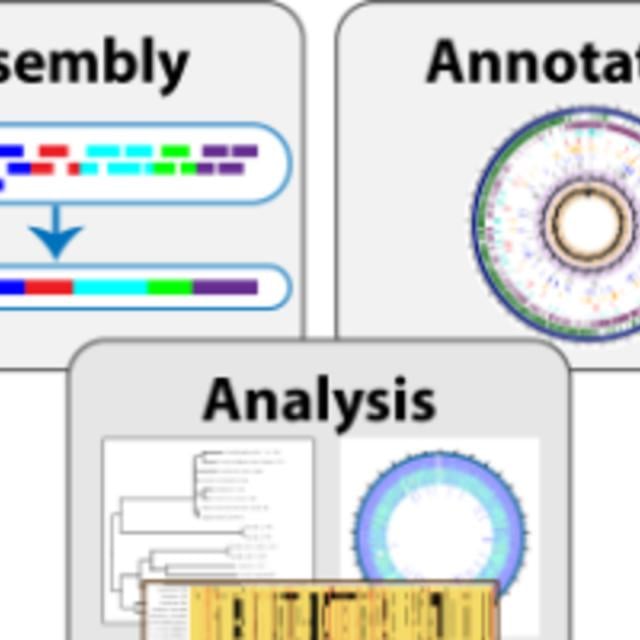
Course participants will gain skills needed to do comparative analysis of bacterial genomes, starting with raw sequence data.The lessons in the first module cover genome assembly, annotation, phylogenetic tree construction, and protein family / proteome comparisons. Each lesson builds on the previous, creating a complete baseline analysis workflow.

Syllabus

WEEK 1
Introduction
This lesson provides an introduction to PATRIC, the PathoSystems Resource Integration Center, a Bioinformatics Resource Center dedicated to supporting bacterial research. PATRIC provides comprehensive bacterial genomic data with integrated analysis tools and visualizations. PATRIC also provides a private workspace where users can upload and analyze their own data. PATRIC will serve as the platform for the analysis methods covered in this module.

WEEK 2
Assembly
This lesson provides step-by-step instructions for assembling a genome from a set of bacterial sequence reads using the PATRIC Genome Assembly Service. Exercises are included to enhance comprehension and build proficiency in using the assembly process.

WEEK 3
Annotation
This lesson provides step-by-step instructions for annotating a genome from contigs using the PATRIC Genome Annotation Service. Exercises are included to enhance comprehension and build proficiency in using the annotation process.

WEEK 4
Comprehensive Genome Analysis
This lesson provides step-by-step instructions for assembling, annotating, and performing an automated analysis of a genome from a set of bacterial sequence reads using the PATRIC Comprehensive Genome Analysis Service. Exercises are included to enhance comprehension and build proficiency in using the service.

WEEK 5
Codon-Based Phyogenetic Trees
This lesson provides step-by-step instructions for generating a codon-based phylogentic tree from a set of genomes using the PATRIC Codon Tree Service. Exercises are included to enhance comprehension and build proficiency in using the service.

WEEK 6
Similar Genome Finder
This lesson provides step-by-step instructions for finding genomes (and associated taxonomy) in PATRIC similar to your genome or sequences using the Similar Genome Finder Service. Exercises are included to enhance comprehension and build proficiency in using the service.

WEEK 7
Protein Family Sorter
This lesson provides step-by-step instructions for using the PATRIC Protein Family Sorter to compare presence, absence, and counts of proteins in protein families across a set of genomes. Exercises are included to enhance comprehension and build proficiency in using the tool.

WEEK 8
Proteome Comparison
This lesson provides step-by-step instructions for using the PATRIC Proteome Comparison Service to compare a set of genomes against a reference genome, feature group, or FASTA file. Exercises are included to enhance comprehension and build proficiency in using the tool.
Go to Class
MOOC List is learner-supported. When you buy through links on our site, we may earn an affiliate commission.

Related Courses

Essentials of Genomics and Biomedical Informatics (edX) EdX
IsraelX

Essentials of Genomics and Biomedical Informatics (edX)

This course presents clinicians and digital health enthusiasts with an overview of the data revolution in medicine and how to exploit it for research and in the clinic. The course will not make you a bioinformatician but will introduce the main concepts, tools, algorithms, and databases in this field.

Self Paced
5-12 Weeks
Genomic Medicine: Harnessing the Power of the Human Genome (FutureLearn) FutureLearn
University of Glasgow

Genomic Medicine: Harnessing the Power of the Human Genome (FutureLearn)

Using the latest genomics research, discover how genomic technologies are changing how we understand and treat medical conditions. Explore cutting-edge genomics data analysis tools and technology. This course will advance your understanding of the rapidly growing use of genomics in the research, diagnosis, and treatment of clinical conditions.

Self Paced
4 Weeks
Bioinformatics for Biologists: An Introduction to Linux, Bash Scripting, and R (FutureLearn) FutureLearn
Wellcome Genome Campus Advanced Courses and Scientific Conferences

Bioinformatics for Biologists: An Introduction to Linux, Bash Scripting, and R (FutureLearn)

Get familiar with Linux and its command line in order to access the full range of bioinformatics tools available to researchers. Explore the full range of bioinformatics software through Linux command line. Bioinformatics is a rapidly growing academic field, and one that promises to change how we analyse and compare biological data. On this course, you’ll get familiar with Linux – the operating system often used to access and analyse biological data.

Self Paced
3 Weeks
Bioinformatic Methods I (Coursera) Coursera
University of Toronto

Bioinformatic Methods I (Coursera)

Large-scale biology projects such as the sequencing of the human genome and gene expression surveys using RNA-seq, microarrays and other technologies have created a wealth of data for biologists. However, the challenge facing scientists is analyzing and even accessing these data to extract useful information pertaining to the system being studied. This course focuses on employing existing bioinformatic resources – mainly web-based programs and databases – to access the wealth of data to answer questions relevant to the average biologist, and is highly hands-on.

Aug 24th 2026
5-12 Weeks
Hacking COVID-19: Metabolic Pathway Analysis Yields SARS-CoV-2 Drug Targets (Coursera) Coursera
University of California, San Diego

Hacking COVID-19: Metabolic Pathway Analysis Yields SARS-CoV-2 Drug Targets (Coursera)

Pathway Bioinformatics is a subfield of Bioinformatics that is concerned with computationally deriving functional insights from genomic data through analysis of molecular networks. This course will present principles and techniques from Pathway Bioinformatics, and will apply these methodologies to the search for drug targets for SARS-CoV-2.

Sep 7th 2026
1 Week
Hacking COVID-19 — Course 3: Unraveling COVID-19's Origins (Coursera) Coursera
University of California, San Diego

Hacking COVID-19 — Course 3: Unraveling COVID-19's Origins (Coursera)

In this course, you will follow in the footsteps of the bioinformaticians investigating the COVID-19 outbreak by investigating the origins of SARS-CoV-2. Whether you’re new to the world of computational biology, or you’re a bioinformatics expert seeking to learn about its applications in the COVID-19 pandemic, or somewhere in between, this course is for you!

Aug 24th 2026
2 Weeks
Comparing Genes, Proteins, and Genomes (Bioinformatics III) (Coursera) Coursera
University of California, San Diego

Comparing Genes, Proteins, and Genomes (Bioinformatics III) (Coursera)

Once we have sequenced genomes in the previous course, we would like to compare them to determine how species have evolved and what makes them different. In the first half of the course, we will compare two short biological sequences, such as genes (i.e., short sequences of DNA) or proteins. We will encounter a powerful algorithmic tool called dynamic programming that will help us determine the number of mutations that have separated the two genes/proteins.

Sep 14th 2026
5-12 Weeks
Introduction to Genomic Technologies (Coursera) Coursera
Johns Hopkins University

Introduction to Genomic Technologies (Coursera)

This course introduces you to the basic biology of modern genomics and the experimental tools that we use to measure it. We'll introduce the Central Dogma of Molecular Biology and cover how next-generation sequencing can be used to measure DNA, RNA, and epigenetic patterns. You'll also get an introduction to the key concepts in computing and data science that you'll need to understand how data from next-generation sequencing experiments are generated and analyzed.

Sep 14th 2026
4 Weeks
Big Data Science with the BD2K-LINCS Data Coordination and Integration Center (Coursera) Coursera
Icahn School of Medicine at Mount Sinai

Big Data Science with the BD2K-LINCS Data Coordination and Integration Center (Coursera)

In this course we briefly introduce the DCIC and the various Centers that collect data for LINCS. We then cover metadata and how metadata is linked to ontologies. We then present data processing and normalization methods to clean and harmonize LINCS data. This follow discussions about how data is served as RESTful APIs. Most importantly, the course covers computational methods including: data clustering, gene-set enrichment analysis, interactive data visualization, and supervised learning. Finally, we introduce crowdsourcing/citizen-science projects where students can work together in teams to extract expression signatures from public databases and then query such collections of signatures against LINCS data for predicting small molecules as potential therapeutics.

Aug 24th 2026
5-12 Weeks