Art & Activity: Interactive Strategies for Engaging with Art (Coursera)

Art & Activity: Interactive Strategies for Engaging with Art (Coursera)

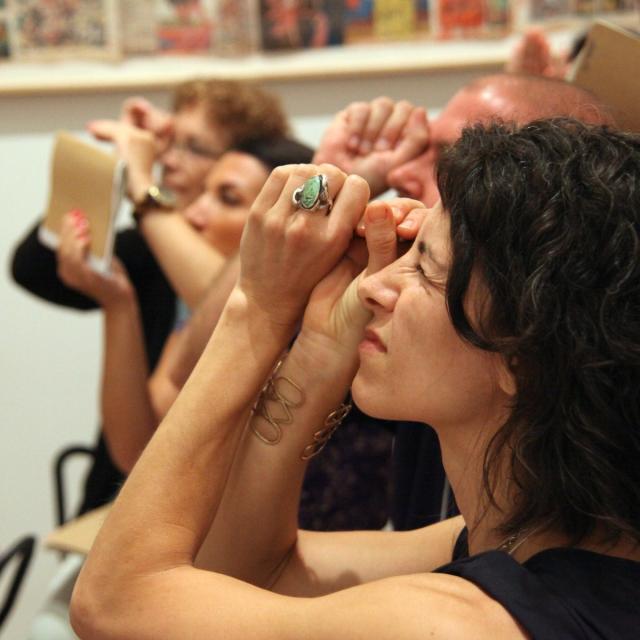
Art can be a powerful catalyst for building skills and understanding a range of subjects. Intended for primary and secondary teachers of all disciplines, Art & Activity builds upon the inquiry-based approaches of Art and Inquiry: Museum Teaching Strategies for Your Classroom, while delving into activity-based strategies that will make your students empowered participants.

Class Deals by MOOC List - Click here and see Coursera's Active Discounts, Deals, and Promo Codes.

Syllabus

WEEK 1
Introduction to Art and Activity
Welcome to Art and Activity: Interactive Strategies for Teaching with Art. Art can be a powerful catalyst for building skills and understanding across a wide range of subjects. Establish your foundation by watching each module's video lectures and reviewing the required readings, artworks, and additional resources. Then, test your knowledge with the quizzes and be sure to comment on videos and post in the discussion forums to share your thoughts.

WEEK 2
Activities for Analyzing and Reflecting
In this module, we’re moving from theory to practice, with videos that discuss drawing, sound, movement, writing, and game-based activities that build skills for analyzing and reflecting about art. Most videos touch upon a variety of methods, while the Take Action segments are in-depth demonstrations of specific activities. You’ll get the most out of these videos by actually doing the activities yourself. We encourage you to snap a photo of something you’ve made in response to a Take Action prompt, and then share it in the discussion forums.

WEEK 3
Activities for Creating, Imagining & Connecting
In this module, we’ll stay active by covering activities that involve drawing, writing, discussion, sound, and movement. We’ll also put on our designer hats, with a Take Action video that presents a cosmic design challenge. You’ll have a chance to test your knowledge with the third and final quiz of the course. Finally, we want you to put all that you’ve learned into practice by using one of the activities with family, friends, or students, and then reflecting on the experience in the discussion forums.

WEEK 4
Assessment Strategies
In this module, we shift the focus from activities to assessment. There are two videos; one that emphasizes self-assessment for you as the facilitator, and a second on assessing student work. Additionally, we have assigned two readings that support the video lectures, which you should complete before stating the final project.
Go to Class
MOOC List is learner-supported. When you buy through links on our site, we may earn an affiliate commission.

Related Courses

Tinkering Fundamentals: Motion and Mechanisms (Coursera) Coursera
Exploratorium

Tinkering Fundamentals: Motion and Mechanisms (Coursera)

The Tinkering Fundamentals course will offer educators and enthusiasts an opportunity to develop a practice of tinkering and making. We see tinkering as a serious endeavor—one that is generalizable across content and especially good at interweaving disciplines in a way that leads to complex projects and individualized learning opportunities.

Sep 14th 2026
5-12 Weeks
Teaching the Violin and Viola: Creating a Healthy Foundation (Coursera) Coursera
Northwestern University

Teaching the Violin and Viola: Creating a Healthy Foundation (Coursera)

Join us as we explore the fundamental principles and early stages of teaching violin and viola through a series of engaging video lectures and lesson demonstrations, including: 1) Master classes with some of the world’s top string pedagogues, 2) Individual lesson demos of teaching violin/viola set up, left and right hand technique and pieces from the early violin/viola repertoire, 3) Group lesson demos of teaching music theory, ear training and fun activities that encourage good playing habits, and 4) A “field trip” to the violin shop, where we will outfit a new beginning student with a proper instrument and bow.

Aug 31st 2026
5-12 Weeks
What Is Contemporary Art? (Coursera) Coursera
The Museum of Modern Art

What Is Contemporary Art? (Coursera)

What is contemporary art? In this course, you’ll consider this question through more than 70 works of art made between 1980 and the present, with a focus on art from the past decade. You’ll hear directly from artists, architects, and designers from around the globe about their creative processes, materials, and inspiration.

Sep 14th 2026
5-12 Weeks
ART of the MOOC: Activismo y Movimientos Sociales (Coursera) Coursera
Duke University,Creative Time

ART of the MOOC: Activismo y Movimientos Sociales (Coursera)

Este curso es para activistas, artistas y pensadores que deseen entender mejor el cambio social y participar en él. El contenido del curso enfoca en la coincidencia prolífica y emocionante entre el arte socialmente comprometido y prácticas culturales generadas por recientes movimientos sociales en todo el mundo. Más que evaluar la eficacia política de actividades como el luto, la escucha, la organización, el baile, o la fiesta, las conferencias examinan tales actividades culturales al lado y dentro de la práctica artística contemporánea.

Sep 14th 2026
5-12 Weeks
Global Diplomacy – Diplomacy in the Modern World (Coursera) Coursera
University of London,SOAS University of London

Global Diplomacy – Diplomacy in the Modern World (Coursera)

The Global Diplomacy course is a unique offering to the MOOC environment. Bringing together cutting edge research in the broad fields of Diplomatic and International Studies, award winning distance learning delivery and the instructors previous experience of delivering a successful MOOC. Please see the volume Global Diplomacy: Theories, Types and Models authored with Dr Alison Holmes, (Westview, 2016), and the Understanding Research Methods MOOC from Coursera.

Sep 7th 2026
5-12 Weeks
Applied Public History: Places, People, Stories (Coursera) Coursera
University of London

Applied Public History: Places, People, Stories (Coursera)

This course introduces learners to applied public history: understanding and interpreting the past today, and engaging diverse communities in the practice of making and sharing histories. The course draws on project case studies, expert insights and diverse perspectives to model exciting approaches to researching and sharing the history of places and people. Learners will develop a toolkit to apply in their own practice, by participating in discussion, quizzes, creative activities and mini masterclasses. What kinds of stories can we discover through research into the history of places and people?

Sep 7th 2026
5-12 Weeks
Understanding the Music Business: What is Music Worth? (Coursera) Coursera
Vanderbilt University

Understanding the Music Business: What is Music Worth? (Coursera)

This course will examine the music industry in the United States, with the unique perspective gained by Vanderbilt University’s location in Nashville, TN. Nashville is a major center of music in the United States, and the music created here has a global reach, particularly in the country, rock, pop, singer-songwriter, and Americana genres. However, students will learn that the basic principles of recording, marketing, copyright, licensing, and live performance are the same, regardless of musical style or genre.

Sep 14th 2026
5-12 Weeks
Words Spun Out of Images: Visual and Literary Culture in Nineteenth Century Japan (Coursera) Coursera
The University of Tokyo

Words Spun Out of Images: Visual and Literary Culture in Nineteenth Century Japan (Coursera)

In their ambition to capture “real life,” Japanese painters, poets, novelists and photographers of the nineteenth century collaborated in ways seldom explored by their European contemporaries. This course offers learners the chance to encounter and appreciate behavior, moral standards and some of the material conditions surrounding Japanese artists in the nineteenth century, in order to renew our assumptions about what artistic “realism” is and what it meant.

Sep 7th 2026
4 Weeks
Story and Narrative Development for Video Games (Coursera) Coursera
California Institute of the Arts

Story and Narrative Development for Video Games (Coursera)

In this course, you will examine how storytelling acts as a vital mechanism for driving video gameplay forward. Looking at several historical and contemporary games, you will be asked to evaluate and interpret different story styles with the goal of identifying themes and procedures for your own game ideas. We'll examine traditional narrative story processes, such as three-act structure, and how they fit into game story flows and the strategic elements of gameplay. Ultimately, you will learn how to define character, setting, and structure to create a compelling game concept.

Aug 31st 2026
4 Weeks
Creative Problem Solving (Coursera) Coursera
University of Minnesota

Creative Problem Solving (Coursera)

This course deals directly with your ability for creativity which is a critical skill in any field. It focuses on divergent thinking, the ability to develop multiple ideas and concepts to solve problems. Through a series of creativity building exercises, short lectures, and readings, learners develop both an understanding of creativity and increase their own ability.

Sep 14th 2026
4 Weeks
ART of the MOOC: Public Art and Pedagogy (Coursera) Coursera
Duke University,Creative Time

ART of the MOOC: Public Art and Pedagogy (Coursera)

Students of this course may try their hand at their own public art interventions, or simply focus on learning from the theory of public practice and its recent history. Designed by artist and Duke professor, Pedro Lasch, and co-taught by Creative Time artistic director, Nato Thompson, this course presents public culture and art in their radically reinenvented contemporary forms. The lectures link major developments of recent decades to wider topics like spatial politics, everyday social structures, and experimental education.

Sep 14th 2026
5-12 Weeks
The Blues: Understanding and Performing an American Art Form (Coursera) Coursera
University of Rochester

The Blues: Understanding and Performing an American Art Form (Coursera)

The blues is an American art form and the most important musical form in jazz. Although there are other formal paradigms of the blues, such as 8-bar or 16-bar, this course focuses on different incarnations of the 12-bar blues. There are considerable differences between Early Jazz blues, Swing blues, Bebop blues, Modal blues, and Post Bop blues.

Sep 7th 2026
5-12 Weeks