Algorithmen und Datenstrukturen mit Detektiv Duke (openHPI)

Algorithmen und Datenstrukturen mit Detektiv Duke (openHPI)

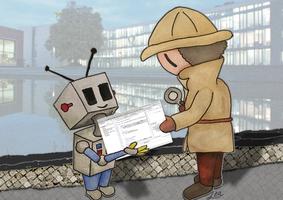
Du hast bereits den Java-Kurs auf openHPI gemacht und die Einführung in Collections war dir zu schnell oder nicht detailliert genug? Du willst Datenstrukturen in Java besser kennenlernen? Du wolltest immer schon mal wissen, was eigentlich Iteratoren sind und welche Vorteile diese gegenüber von Schleifen haben? Welche Datenstrukturen für welche Anwendungsfälle schneller oder besser geeignet sind? Auch Duke und seinen neuen Assistenten Big O beschäftigen diese Fragen in ihrem aktuellen Fall und sie brauchen wieder mal Deine Hilfe! Begleite Duke und seine Freunde auf ihrer spannenden Reise durch die wunderbare Welt der Algorithmen und Datenstrukturen in Java. Spoiler: mehr Drama, mehr Action und höchstens ein Papagei.

Course information
Du hast bereits den Java-Kurs auf openHPI gemacht und die Einführung in Collections war dir zu schnell oder nicht detailliert genug? Du willst Datenstrukturen in Java besser kennenlernen? Du wolltest immer schon mal wissen, was eigentlich Iteratoren sind und welche Vorteile diese gegenüber von Schleifen haben? Welche Datenstrukturen für welche Anwendungsfälle schneller oder besser geeignet sind?
Auch Duke und seinen neuen Assistenten Big O beschäftigen diese Fragen in ihrem aktuellen Fall und sie brauchen wieder mal Deine Hilfe! Begleite Duke und seine Freunde auf ihrer spannenden Reise durch die wunderbare Welt der Algorithmen und Datenstrukturen in Java. Spoiler: mehr Drama, mehr Action und höchstens ein Papagei.
Für die erfolgreiche Teilnahme am Kurs benötigst du etwa 4-6 Stunden Zeit pro Woche und solltest Grundwissen über die Objektorientierte Programmierung in Java mitbringen.
Go to Class
MOOC List is learner-supported. When you buy through links on our site, we may earn an affiliate commission.

Related Courses

Java Workshop - Einführung in die Testgetriebene Entwicklung mit JUnit (openHPI) OpenHPI
Hasso-Plattner-Institut

Java Workshop - Einführung in die Testgetriebene Entwicklung mit JUnit (openHPI)

Probieren ist gut, testen ist besser. In der Regel weiss man, was ein Programm tun soll bevor man es schreibt. Warum nicht gleich die Bedingungen nach denen es funktionieren soll in Code fassen, der überprüft ob die Vorgaben auch erfüllt werden? Um dies zu tun gibt es eine Reihe spezialisierter Frameworks die das auf verschiedene Weisen sicher stellen. In diesem Workshop wollen wir uns auf das Unit Testing mit JUnit konzentrieren. Unter Unit Tests versteht man Tests die kleine abgeschlossene Code-Einheiten, wie z.B. Klassen oder Methoden auf korrekte Funktionalität prüfen.

Self Paced
Self-Paced
Principles of Computing (Part 2) (Coursera) Coursera
Rice University

Principles of Computing (Part 2) (Coursera)

This two-part course introduces the basic mathematical and programming principles that underlie much of Computer Science. Understanding these principles is crucial to the process of creating efficient and well-structured solutions for computational problems. To get hands-on experience working with these concepts, we will use the Python programming language. The main focus of the class will be weekly mini-projects that build upon the mathematical and programming principles that are taught in the class.

Aug 10th 2026
4 Weeks
Programming Languages, Part A (Coursera) Coursera
University of Washington

Programming Languages, Part A (Coursera)

This course is an introduction to the basic concepts of programming languages, with a strong emphasis on functional programming. The course uses the languages ML, Racket, and Ruby as vehicles for teaching the concepts, but the real intent is to teach enough about how any language “fits together” to make you more effective programming in any language -- and in learning new ones.

Aug 10th 2026
5-12 Weeks
Excel/VBA for Creative Problem Solving, Part 2 (Coursera) Coursera
University of Colorado Boulder

Excel/VBA for Creative Problem Solving, Part 2 (Coursera)

Excel/VBA for Creative Problem Solving, Part 2" builds off of knowledge and skills obtained in "Excel/VBA for Creative Problem Solving, Part 1" and is aimed at learners who are seeking to augment, expand, optimize, and increase the efficiency of their Excel spreadsheet skills by tapping into the powerful programming, automation, and customization capabilities available with Visual Basic for Applications (VBA).

Aug 10th 2026
4 Weeks
Algorithmic Thinking (Part 2) (Coursera) Coursera
Rice University

Algorithmic Thinking (Part 2) (Coursera)

Experienced Computer Scientists analyze and solve computational problems at a level of abstraction that is beyond that of any particular programming language. This two-part class is designed to train students in the mathematical concepts and process of "Algorithmic Thinking", allowing them to build simpler, more efficient solutions to computational problems.

Aug 10th 2026
4 Weeks
Computer Science: Programming with a Purpose (Coursera) Coursera
Princeton University

Computer Science: Programming with a Purpose (Coursera)

The basis for education in the last millennium was “reading, writing, and arithmetic;” now it is reading, writing, and computing. Learning to program is an essential part of the education of every student, not just in the sciences and engineering, but in the arts, social sciences, and humanities, as well. Beyond direct applications, it is the first step in understanding the nature of computer science’s undeniable impact on the modern world.

Aug 10th 2026
5-12 Weeks
Data Processing Using Python (Coursera) Coursera
Nanjing University

Data Processing Using Python (Coursera)

This course is mainly for non-computer majors. It starts with the basic syntax of Python, to how to acquire data in Python locally and from network, to how to present data, then to how to conduct basic and advanced statistic analysis and visualization of data, and finally to how to design a simple GUI to present and process data, advancing level by level.

Aug 10th 2026
5-12 Weeks
Introdução à Ciência da Computação com Python Parte 2 (Coursera) Coursera
Universidade de São Paulo, Brasil

Introdução à Ciência da Computação com Python Parte 2 (Coursera)

Bem vindo ao curso de Introdução à Ciência da Computação destinado aos alunos regulares da Universidade de São Paulo! Esta é a segunda parte do Curso, onde você vai continuar a aprender os principais conceitos introdutórios de Ciência da Computação e também aprenderá a desenvolver pequenos programas na linguagem Python.

Aug 10th 2026
5-12 Weeks
Statistical Mechanics: Algorithms and Computations (Coursera) Coursera
École normale supérieure

Statistical Mechanics: Algorithms and Computations (Coursera)

In this course you will learn a whole lot of modern physics (classical and quantum) from basic computer programs that you will download, generalize, or write from scratch, discuss, and then hand in. Join in if you are curious (but not necessarily knowledgeable) about algorithms, and about the deep insights into science that you can obtain by the algorithmic approach.

Aug 3rd 2026
5-12 Weeks