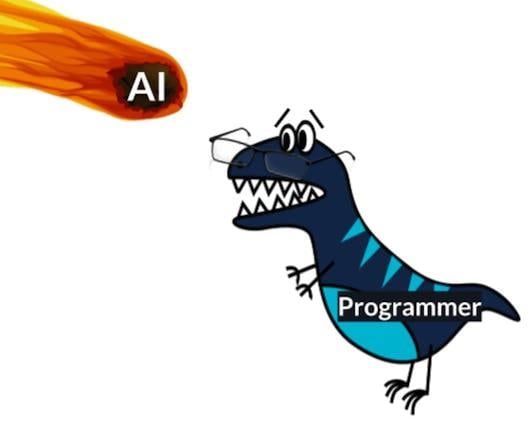
AI for Efficient Programming: Harnessing the Power of LLMs (Coursera)

AI for Efficient Programming: Harnessing the Power of LLMs (Coursera)

This course on Artificial Intelligence (AI) for software development explores the use of AI large language models such as ChatGPT, Bard, and others and their potential benefits and challenges. Through examples and hands-on activities, you will develop an understanding of the ways in which AI can speed up software development tasks and free up time for more creative and strategic work.

Class Deals by MOOC List - Click here and see Coursera's Active Discounts, Deals, and Promo Codes.

Unique Features of this Course

  • Exploration of multiple browser-based AI tools
  • Hands-on, yet simple activities requiring no installations of software
  • Emphasis on responsible and ethical use of AI
  • Beginner friendly for those who want to get started using generative AI tools
  • Useful ideas for how to leverage tools to make your work better and more efficient
  • Tried and tested strategies for using AI tools from practicing data scientists and scientific software developers
  • A fun and playful approach to learning

Intended Audience

  • Professionals looking to improve efficiency
  • Students hoping to learn more about programming
  • Anyone curious about how AI can be harnessed for technology

Note: Those completely new to programming will find using AI tools to create software solutions challenging at this time. It is helpful to have some fundamental knowledge to write appropriate prompts and to discern when code is not working as expected. We advise novices to seek expert review.

Learning Objectives

  • Explain the basics of AI and its potential for improving software development workflows
  • Implement strategies to write and debug code using AI-based tools
  • Describe the benefits of refactoring code using AI-powered techniques, such as making code readable, keeping it brief, and optimizing code
  • Apply best practices for annotating code using AI
  • Recognize strategies for using AI-based tools to understand and analyze code, such as code comprehension of unfamiliar languages or functions
  • Discuss the challenges and ethical implications of using AI for different aspects of software development

What you'll learn
You'll learn the basics of AI's potential for efficient programming, the ethics of AI use, and how different LLMs work for common coding tasks.

Syllabus

Introduction; Ethics of Using AI
This module provides a general overview of AI Large Language Models, how this technology will change software development, and ethical considerations for using LLMs when creating code and software.

Writing Code; Refactoring Code
This module covers using LLMs to write, debug, and plan your coding project, as well as how LLMs can help with common refactoring tasks.

Annotating Your Code; Understanding Unfamiliar Code
This module covers how to use LLMs to properly annotate your code and to understand code and functions that you did not write.

AI for Bioinformatics
This bonus section covers possible uses and caveats for LLMs in bioinformatics, particularly when working with private data.

Go to Class
MOOC List is learner-supported. When you buy through links on our site, we may earn an affiliate commission.

Related Courses

Solving Algorithms for Discrete Optimization (Coursera) Coursera
University of Melbourne,The Chinese University of Hong Kong

Solving Algorithms for Discrete Optimization (Coursera)

Discrete Optimization aims to make good decisions when we have many possibilities to choose from. Its applications are ubiquitous throughout our society. Its applications range from solving Sudoku puzzles to arranging seating in a wedding banquet. The same technology can schedule planes and their crews, coordinate the production of steel, and organize the transportation of iron ore from the mines to the ports.

Nov 2nd 2026
4 Weeks
An Introduction to Interactive Programming in Python (Part 2) (Coursera) Coursera
Rice University

An Introduction to Interactive Programming in Python (Part 2) (Coursera)

This two-part course is designed to help students with very little or no computing background learn the basics of building simple interactive applications. Our language of choice, Python, is an easy-to learn, high-level computer language that is used in many of the computational courses offered on Coursera. To make learning Python easy, we have developed a new browser-based programming environment that makes developing interactive applications in Python simple.

Nov 2nd 2026
4 Weeks
Materials Data Sciences and Informatics (Coursera) Coursera
Georgia Institute of Technology

Materials Data Sciences and Informatics (Coursera)

This course aims to provide a succinct overview of the emerging discipline of Materials Informatics at the intersection of materials science, computational science, and information science. Attention is drawn to specific opportunities afforded by this new field in accelerating materials development and deployment efforts.

Nov 2nd 2026
5-12 Weeks
Introdução ao Teste de Software (Coursera) Coursera
Universidade de São Paulo, Brasil

Introdução ao Teste de Software (Coursera)

A necessidade das empresas em produzir software com qualidade tem aumentado a demanda por profissionais com conhecimentos e habilidades em Teste de Software. Entretanto, existe uma escassez de mão-de-obra especializada nesta área. Considerando essa lacuna, o curso de Introdução ao Teste de Software foi planejado para servir como um guia para pessoas que necessitam de uma fonte de consulta e/ou aprendizado na área.

Nov 2nd 2026
5-12 Weeks
Data Science in Stratified Healthcare and Precision Medicine (Coursera) Coursera
University of Edinburgh

Data Science in Stratified Healthcare and Precision Medicine (Coursera)

An increasing volume of data is becoming available in biomedicine and healthcare, from genomic data, to electronic patient records and data collected by wearable devices. Recent advances in data science are transforming the life sciences, leading to precision medicine and stratified healthcare. In this course, you will learn about some of the different types of data and computational methods involved in stratified healthcare and precision medicine.

Nov 2nd 2026
5-12 Weeks
LangChain Chat with Your Data (Coursera) Coursera
DeepLearning.AI

LangChain Chat with Your Data (Coursera)

LangChain: Chat With Your Data delves into two main topics: (1) Retrieval Augmented Generation (RAG), a common LLM application that retrieves contextual documents from an external dataset, and (2) a guide to building a chatbot that responds to queries based on the content of your documents, rather than the information it has learned in training.

Nov 2nd 2026
1 Week
Machine Teaching for Autonomous AI (Coursera) Coursera
University of Washington

Machine Teaching for Autonomous AI (Coursera)

Just as teachers help students gain new skills, the same is true of artificial intelligence (AI). Machine learning algorithms can adapt and change, much like the learning process itself. Using the machine teaching paradigm, a subject matter expert (SME) can teach AI to improve and optimize a variety of systems and processes. The result is an autonomous AI system.

Nov 2nd 2026
4 Weeks
Artificial Intelligence and legal issues (Coursera) Coursera
Politecnico di Milano

Artificial Intelligence and legal issues (Coursera)

The purpose of the course is to help students understand the legal implications related to the design and use of artificial intelligence systems, providing an overview of the risks and legal protections that can be envisaged and giving an overview of the legislation and legal principles currently applicable on the subject.

Nov 2nd 2026
4 Weeks
AI Materials (Coursera) Coursera
Korea Advanced Institute of Science and Technology - KAIST

AI Materials (Coursera)

Learn about the materials that have advanced the performance of artificial intelligence, and the machine learning models that could help accelerate the design and development of novel materials. This course defines artificial intelligence (AI) as a machine to which some or all of the functions of the human brain have been delegated. It highlights the need, and explains in an easy-to-understand way how machine learning from artificial intelligence can dramatically accelerate the development of new materials.

Nov 2nd 2026
5-12 Weeks