Age of Jefferson (Coursera)

Age of Jefferson (Coursera)

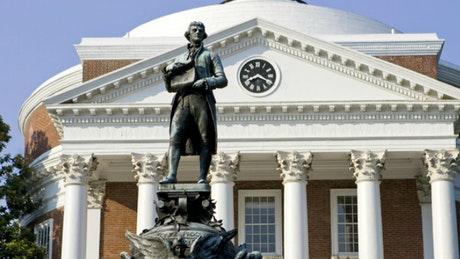
This course provides an overview of Thomas Jefferson's work and perspectives presented by the University of Virginia in partnership with Thomas Jefferson’s Monticello. Together, UVA and Monticello are recognized internationally as a UNESCO World Heritage Site.

Class Deals by MOOC List - Click here and see Coursera's Active Discounts, Deals, and Promo Codes.

Syllabus

WEEK 1
Thomas Jefferson, American Icon
Thomas Jefferson is an American icon. He has also been one of the most polarizing and controversial figures in American history. In this introductory module, we’ll explore how Jefferson’s reputation has changed and evolved over the last two centuries. We’ll discover what Jefferson considered to be his most important contribution to the “Age of Enlightenment” in which he was living. We’ll discuss why some people in both the nineteenth and twentieth centuries have viewed Jefferson and his ideas with skepticism or worse while others have embraced Jefferson. Overall, learning about how people from many different backgrounds and perspectives have interpreted Jefferson throughout history will help us understand why it’s so important to think critically and honestly about Jefferson’s life and legacy today.

WEEK 2
Jefferson’s Declaration of Independence
No document is more closely associated with Jefferson than the Declaration of Independence. Listing it as the first of three achievements on his tombstone, Jefferson clearly believed the Declaration to be of profound importance. Generations of Americans have agreed, constantly quoting its phrases and invoking its ideas. But do we really understand what Jefferson was trying to do when he wrote the Declaration? In this module, we’ll explore the Revolutionary context in which Jefferson lived and worked. We’ll ask why the Declaration takes the form that it does, and also what Jefferson hoped it would accomplish. Surprisingly, the parts of the Declaration that we celebrate most frequently today may not be the ones Jefferson would have understood to be the most important.

WEEK 3
Jefferson and Slavery
The man who wrote in the Declaration of Independence that “all men are created equal” was a lifelong slaveowner whose affluence rested on the exploitation of hundreds of African Americans. In this module, we travel to Montalto, the mountain overlooking Jefferson’s home and plantation on Monticello, to try to gain some perspective on this great tension in Jefferson’s life and thought. Our goal will be neither simply to exonerate nor to castigate Jefferson, but rather to understand how he viewed slavery and his relationship to it. Only by confronting and considering this complicated, frustrating, and tragic chapter in American history can we come to a more complete and nuanced understanding of Thomas Jefferson and his legacy. As students attending the University Jefferson founded, it is especially important to engage this topic.

WEEK 4
Jefferson and Religion
The role of religion in public life continues to be a topic of debate today in both the United States and around the world. Thomas Jefferson was never happier than when his Bill for Religious Freedom was finally enacted in Virginia in 1786. In this module, we’ll try to understand why Jefferson believed freedom of religion to be so essential to the future of the United States. To do this, we’ll explore the historical context in which Jefferson developed his ideas about the proper relationship between religious denominations and the state. We’ll also investigate Jefferson’s own faith—a subject of much controversy from his own day through the present. Considering Jefferson’s serious engagement with questions of religion will help us understand the kinds of communities and society he hoped would take hold and flourish in the new nation.

WEEK 5
Jefferson and Education
Founding the University of Virginia in 1819 was the most obvious example of Jefferson’s interest in education, but it was by no means the first time he considered the subject. Indeed, education was one of Jefferson’s constant preoccupations. In this session, we’ll discuss Jefferson’s ideas about education as they developed over the course of his life, from the ambitious plan for a state-supported system of schools outlined in his “Bill for the More General Diffusion of Knowledge,” to his conclusion in the early nineteenth century that the other institutions of higher learning that existed in the United States just weren’t suited to forming the leaders of a free republic. Throughout the discussion, we’ll try to understand why Jefferson was so focused on education by asking what he believed was at stake if Americans failed in their duty to provide proper instruction for future generations.

WEEK 6
'The earth belongs to the living'
In 1789, Jefferson wrote a letter to James Madison from Paris in which he asserted that “the earth belongs to the living.” Calculating that a single generation could be said to last nineteen years, he proposed that no debts should be incurred that could not be paid off in nineteen years; that all laws should be re-written every nineteen years; and that Americans should re-write even their constitutions every nineteen years. Madison thought the ideas Jefferson outlined in this letter to be wildly impractical, and most commentators since then have come to the same conclusion. In this module, however, we’ll explore what Jefferson was getting at in claiming that “the earth belongs to the living.” In so doing, we’ll discover how this phrase expresses an idea that lies at the very core of Jefferson’s conception of equality, democracy, and the American nation.

WEEK 7
Final Exam

Go to Class
MOOC List is learner-supported. When you buy through links on our site, we may earn an affiliate commission.

Related Courses

Teach English Now! Lesson Design and Assessment (Coursera) Coursera
Arizona State University

Teach English Now! Lesson Design and Assessment (Coursera)

Learners will be introduced to designing lesson plans based on principles and knowledge of learning objectives, assessment plans, methods, materials, and learning activities. Learners will find and prepare appropriate teaching materials through careful analysis, adaptation and creation of professional resources. Learners will also reflect on the cohesion between lesson design and teaching philosophies.

Jun 22nd 2026
5-12 Weeks
Multimodal Literacies: Communication and Learning in the Era of Digital Media (Coursera) Coursera
University of Illinois at Urbana-Champaign

Multimodal Literacies: Communication and Learning in the Era of Digital Media (Coursera)

Whereas the focus of traditional literacy pedagogy has been the written word in its standard and literary forms, this courser expands the scope of literacy learning to encompass contemporary multimodal texts and the wide range of ways of making meaning that occur in different social and cultural contexts. Another course, "Literacy Teaching and Learning: Aims, Approaches and Pedagogies" addresses pedagogical aspects of literacies. This "Multimodal Literacies" learning module does not require or expect that participants will have already completed the "Literacy Teaching and Learning" module.

Jun 22nd 2026
4 Weeks
Training and Learning Programs for Volunteer Community Health Workers (Coursera) Coursera
Johns Hopkins University

Training and Learning Programs for Volunteer Community Health Workers (Coursera)

Volunteer community health workers (CHWs) are a major strategy for increasing access to and coverage of basic health interventions. Our village health worker training course reviews the process of training and continuing education of CHWs as an important component of involving communities in their own health service delivery. Participants will be guided through the steps of planning training and continuing education activities for village volunteers. The course draws on real-life examples from community-directed onchocerciasis control, village health worker programs, community case management efforts, peer educators programs and patent medicine vendor training programs, to name a few.

Jun 22nd 2026
5-12 Weeks
Philosophy, Science and Religion: Philosophy and Religion (Coursera) Coursera
University of Edinburgh

Philosophy, Science and Religion: Philosophy and Religion (Coursera)

Philosophy, Science and Religion mark three of the most fundamental modes of thinking about the world and our place in it. Are these modes incompatible? Put another way: is the intellectually responsible thing to do to ‘pick sides’ and identify with one of these approaches at the exclusion of others? Or, are they complementary or mutually supportive? As is typical of questions of such magnitude, the devil is in the details. For example, it is important to work out what is really distinctive about each of these ways of inquiring about the world. In order to gain some clarity here, we’ll be investigating what some of the current leading thinkers in philosophy, science and religion are actually doing.

Jun 22nd 2026
5-12 Weeks
Magic in the Middle Ages (Coursera) Coursera
University of Barcelona

Magic in the Middle Ages (Coursera)

Magical thought has always attracted human imagination. In this course we will introduce you to the Middle Ages through a wide conception of magic. Students will have an approach to medieval culture, beliefs and practices from the perspective of History and History of Science. Popular magic, as well as learned magic (alchemy, geomancy and necromancy) will be addressed. Moreover, we will also deal with how eastern practices and texts influenced western culture. In July 2016, the course will contain a brand-new module devoted to astrology. Magic in the Middle Ages offers a captivating overview of medieval society and promotes reflection about certain stereotypes associated with this period.

Jun 22nd 2026
5-12 Weeks
Constructivism and Mathematics, Science, and Technology Education (Coursera) Coursera
University of Illinois at Urbana-Champaign

Constructivism and Mathematics, Science, and Technology Education (Coursera)

This course is designed to help participants examine the implications of constructivism for learning and teaching in science, mathematics, and technology focused areas. Course readings, discussions, and assignments will examine constructivist views of learning, research on students' ideas and idea-based interactions, research on instructional approaches taking student ideas into account, and challenges in implementing constructivist perspectives in instruction.

Jun 22nd 2026
5-12 Weeks
The Changing Landscape of Ancient Rome. Archaeology and History of the Palatine Hill (Coursera) Coursera
Sapienza University of Rome

The Changing Landscape of Ancient Rome. Archaeology and History of the Palatine Hill (Coursera)

Studying ancient - as well as medieval or modern - cities basically means telling local urban stories based on the reconstruction of changing landscapes through the centuries. Given the fragmentary nature of archaeological evidence, it is necessary to create new images that would give back the physical aspect of the urban landscape and that would bring it to life again. We are not just content with analyzing the many elements still visible of the ancient city.

Jun 22nd 2026
5-12 Weeks
Copyright for Educators & Librarians (Coursera) Coursera
Duke University,Emory University,University of North Carolina at Chapel Hill

Copyright for Educators & Librarians (Coursera)

Fear and uncertainty about copyright law often plagues educators and sometimes prevents creative teaching. This course is a professional development opportunity designed to provide a basic introduction to US copyright law and to empower teachers and librarians at all grade levels. Course participants will discover that the law is designed to help educators and librarians.

Jun 22nd 2026
5-12 Weeks
Cultural Competence - Aboriginal Sydney (Coursera) Coursera
The University of Sydney

Cultural Competence - Aboriginal Sydney (Coursera)

This course explores some of the key themes and capabilities of cultural competence by exploring Aboriginal experiences and narratives of Sydney. Australia was ‘claimed’ for the British Crown in 1770, by Captain James Cook, but the invasion began in earnest when the First Fleet of British arrived in 1788 and established a penal colony in Sydney.

Jun 22nd 2026
5-12 Weeks
Teach English Now! Foundational Principles (Coursera) Coursera
Arizona State University

Teach English Now! Foundational Principles (Coursera)

Through a series of engaging metaphors and stories, prospective and current EFL/ESL teachers will identify, summarize, and evaluate 7 basic language learning paradigms. Learners will be presented information on such foundational principles as motivation, risk taking, two different modes of learning, and balancing the teacher profession. Learners are also given an understanding of basic techniques founded on those principles, such as teacher talk, looking “ridiculous” in order to lower the affective filter, and networking. With these foundational principles in mind, ESL/EFL teachers will scrutinize common assumptions about language learning by comparing how they stack up to research-based core principles.

Jun 22nd 2026
5-12 Weeks