Adobe Illustrator for Beginners (Coursera)

Adobe Illustrator for Beginners (Coursera)

This course allows you to learn Adobe Illustrator from scratch, step by step. Adobe illustrator is a professional package for creating vector graphics, illustrating, and typesetting for print. The unique feature of the course is that it is practical and has been developed by a designer for designers. All the techniques and methods that are offered to students in the course are the result of hands-on professional experience.

Class Deals by MOOC List - Click here and see Coursera's Active Discounts, Deals, and Promo Codes.

What You Will Learn
You will learn all the basic technical skills needed to use Adobe Illustrator to realise your ideas.

Syllabus

WEEK 1
Raster and vector graphics
The first module gives a basic introduction to vector graphics. What it is, what principles are used to build a vector image in a graphic editor, and what application features it creates. We will discuss the differences between raster and vector image construction and the respective applications of both. We will talk about using vector graphics in design, consider examples of design projects made by means of vector graphics. We will also discuss the stylistics of modern vector and hybrid images.

WEEK 2
Creating and editing objects
In the second module, you will learn how to create objects in Adobe Illustrator. First, we will analyze what the program interface consists of. You will learn how to customize the workspace for yourself, create, copy, and scale artboards. We will talk about what viewing modes are available in Adobe Illustrator and what they are for. Let's look at the auxiliary elements: rulers, guides, grids. Then we will talk about different ways to organize the order of objects. You will learn how to create, transform, and align simple objects. We will study in detail the work with strokes, different ways of creating and editing closed and open paths. And also consider a variety of different tools for cutting and joining shapes.

WEEK 3
Working with colour in Adobe Illustrator
In the third module of our course, we will talk about working with colour. First, we'll explore the two most common colour models and learn the difference between them and what they're used for. We'll analyse the tools for working with colour, you'll learn how to create, edit, and copy colour fills. You'll learn how to organise colour groups and use ready-made colour libraries. Next, we'll explore what colour process and spot are and how these colour systems print the same swatch differently. Next, I'll tell you how to create harmonious colours quickly and easily using the automatic colour matching tools of Adobe Illustrator. At the end of this module, we'll talk about transparencies and gradient fills.

WEEK 4
Working with fonts in Adobe Illustrator
The fourth module focuses on working with fonts. You will learn that text in Adobe Illustrator exists in two states: framed and unframed. We'll go into detail about what both are used for. You will explore the layout and text editing tools. Next, we'll look at how to create text on an open path, inside and outside of a closed path. The second half of this module will focus on digital calligraphy and font drawing tools. I will show basic techniques for creating and editing digital calligraphy.

WEEK 5
Preparing the original layout
The fifth module of our course deals with the preparation of original layouts for submission to a prepress specialist or print shop. It contains several important topics. We'll talk about some useful effects in Adobe Illustrator that will make your graphics even more interesting and diverse. You will learn how to create clipping masks for bitmap and vector images. We'll explain how to insert raster images into a vector document, how to set up links, how to replace them easily, and how to edit them in Adobe Photoshop in parallel. Then we'll cover saving files for different purposes in detail. You'll also learn the basics of prepress. All of this will help you deliver your layouts to the print shop and communicate with the production staff in a professional manner.
Go to Class
MOOC List is learner-supported. When you buy through links on our site, we may earn an affiliate commission.

Related Courses

Enabling Community-Based Leadership in Design: Sustainable Development of Historic Faith Buildings (FutureLearn) FutureLearn
The Open University,UNESCO UNITWIN Complex Systems Digital Campus,The Glass-house

Enabling Community-Based Leadership in Design: Sustainable Development of Historic Faith Buildings (FutureLearn)

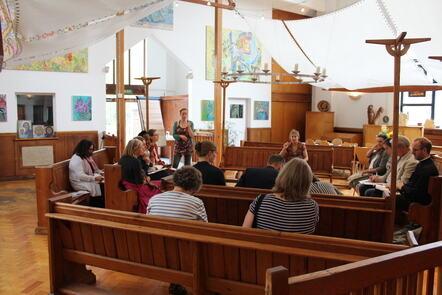
Mobilise the power of communities to re-imagine and shape their place. Learn how to enable communities to lead design initiatives in places of worship. Apart from being special places where people practise their faith, places of worship play an important role for the wider community by providing pastoral care and much-needed local services. Community-based design initiatives can enhance the value of these places as a sustainable resource for multiple communities.

Dec 6th 2021
5-12 Weeks
Create video, audio and infographics for online learning (Coursera) Coursera
Macquarie University

Create video, audio and infographics for online learning (Coursera)

Multimodal texts make learning interesting. Video, podcasts and infographics not only have the capability to excite and engage, but to reach a broader demography of learners who don’t thrive on verbal language knowledge acquisition and exchange alone. Multimodal texts provide a variety of ways in which to communicate and provide information to learners, as well as meet the needs of different learners’ preferences.

Jun 15th 2026
5-12 Weeks
Practicing Collaborative, Continuous Improvement (Coursera) Coursera
University of Michigan

Practicing Collaborative, Continuous Improvement (Coursera)

Practicing Collaborative, Continuous Improvement supports local change agents in developing foundational capabilities for iterative analysis, design, implementation, and evaluation. Learn to address local needs, opportunities, and problems, with a focus on improvement science as a specific approach to collaborative, continuous improvement that is useful in classrooms, communities, schools, and systems.

Jun 22nd 2026
5-12 Weeks
Urban Ecology Design (edX) EdX
Delft University of Technology,DelftX

Urban Ecology Design (edX)

Learn how to contribute to a more biodiverse, nature-inclusive and sustainable built environment by using nature-based solutions in your designs and policies. As our urban habitats become increasingly complex, the need to address the challenges of accommodating a growing human population becomes ever more pressing. These challenges, intricately intertwined with the built environment and its wider surroundings, encompass the perils of heat stress, loss of biodiversity, land degradation, flood risks, and the urgent need to adapt to a changing climate.

May 1st 2024
5-12 Weeks
Introduction to VR Programming, Design, and Unity (FutureLearn) FutureLearn
VR Voom

Introduction to VR Programming, Design, and Unity (FutureLearn)

Step into the world of VR game development, learn the basics of programming language, and even create your own 2D game. Learn how to design, program, and create your very own VR games. The gaming industry has grown exponentially, outperforming both movies and sports combined in 2020. And VR is the newest, exciting innovation taking the industry by storm.

Jun 27th 2022
5-12 Weeks
Design for Recycling of Electronics in a Circular Economy (edX) EdX
Delft University of Technology,DelftX

Design for Recycling of Electronics in a Circular Economy (edX)

Discover the latest developments in Design for Recycling (DfR) of electrical and electronic equipment (EEE) and the application of recycled plastics into new products. Electronic products bring countless benefits to society, but their production and waste treatment also lead to numerous negative environmental and economic impacts. Since E-waste is the world’s fastest growing waste stream, governments are setting ambitious targets to help this industry transition towards a circular economy.

Nov 10th 2021
4 Weeks
Healthy Urban Systems - Part 3 : Design and policies (Coursera) Coursera
University of Lausanne

Healthy Urban Systems - Part 3 : Design and policies (Coursera)

This MOOC is the third part (out of three parts) of the whole MOOC on Healthy Urban Systems. This PART III is very recommended (but not obliged) to take after the PART I and PART II. Once you understood the main concepts and visions of Urban Health, and the best practices of observation in PART I, the theories and models in PART II, you are better prepared to take this PART III on Design and policies.

Jun 22nd 2026
5-12 Weeks
Introduction to 3D Modeling (Coursera) Coursera
University of Michigan

Introduction to 3D Modeling (Coursera)

On this four-week practical course from the University of Michigan, you’ll not only learn how to use the Rhino software to create your 3D models, but you’ll also gain basic design skills to help bring your imagination to life. This course will guide you through 3D modeling within Rhino, so you’ll cover the fundamentals of the software as well as 3D modeling in general. You’ll first look at how to navigate the user interface and the different tools that you’ll be using to create models throughout this course. You’ll familiarize yourself with the 3D space and 3D objects before jumping straight in to create your own objects and building blocks.

Jun 15th 2026
4 Weeks
Web Design: Strategy and Information Architecture (Coursera) Coursera
California Institute of the Arts

Web Design: Strategy and Information Architecture (Coursera)

This course is focused on the early user experience (UX) challenges of research, planning, setting goals, understanding the user, structuring content, and developing interactive sequences. While the concepts covered will translate to many kinds of interactive media (apps, digital kiosks, games), our primary focus will be on designing contemporary, responsive websites. In this course you will complete the first half of a large scale project—developing a comprehensive plan for a complex website—by defining the strategy and scope of the site, as well as developing its information architecture and overall structure.

Jun 15th 2026
4 Weeks