Whole Class with PhET for STEM Education (Coursera)

Whole Class with PhET for STEM Education (Coursera)

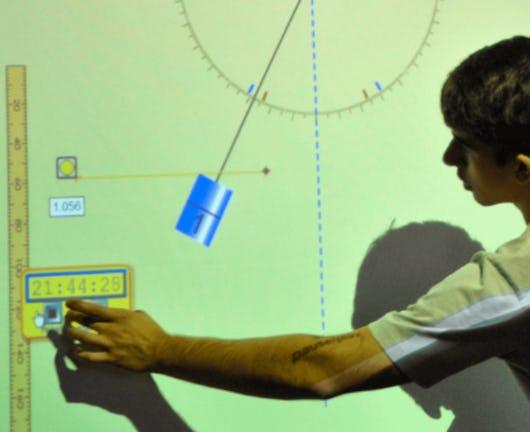
PhET Interactive Simulations, a project of the University of Colorado Boulder, provides fun, free, interactive, research-based science and mathematics simulations for use across, primary, secondary, and higher education levels. We extensively test and evaluate each simulation to ensure educational effectiveness. All simulations are open source and free to all students and teachers.

Class Deals by MOOC List - Click here and see Coursera's Active Discounts, Deals, and Promo Codes.

In this course, you will learn strategies for how to use PhET in circumstances where you are presenting a simulation in front of the whole class using a projector, interactive whiteboard, or while sharing your screen online.
This course is the second in the specialization “Active Learning in STEM with PhET Interactive Simulations,” which includes 4 courses in total.
To finish this course, you need to complete two of three possible assignments with Peer Review: 1) Whole Class Inquiry, 2) Interactive Lecture Demonstrations, 3) Concept Questions.
This course is also available in Spanish as “Clase Entera con PhET para la Educación STEM” and Portuguese as "Classe Entera com PhET para a Educação STEM".
This course is part of the Active Learning in STEM with PhET Interactive Simulations Specialization.

What you'll learn

  • Whole Class Inquiry: Strategies for open-ended discussion.
  • Interactive Lecture Demonstration: Strategies for making predictions.
  • Concept Questions: Strategies for classroom voting and Peer Instruction.

Syllabus

Module 1: PhET in Whole Class Strategies
In this course, we will review strategies for how to use PhET in circumstances where you are presenting a simulation in front of the whole class using a projector, television, interactive whiteboard, or while sharing your screen online.

Module 2: Whole Class Inquiry
This module will introduce you to general strategies for getting students to respond to open-ended questions as a whole class: Whole Class Inquiry. These strategies can help you as a teacher to be more creative in the types of questions you ask, and can help to reveal students’ prior knowledge especially at the introduction of a new topic.

Module 3: Interactive Lecture Demonstrations
In this module, you will learn about how to ask pointed prediction questions, and help scaffold students’ responses through the use of a structured worksheet and discussions in pairs and as a whole class: Interactive Lecture Demonstrations. This strategy is especially effective for focusing students’ thinking on specific concepts and helping them to think about their own thinking.

Module 4: Concept Questions
This module will introduce you to how to effectively write multiple choice questions to promote critical thinking: Concept Questions. These questions may include open-ended predictions, contrasting cases, ordering and ranking cases, and interpreting representations, among others. However, in all cases, these questions are written in such a way that they allow students to vote and engage in peer instruction.

Module 5: Planning to Use Whole Class Strategies
In this module, you will design two activities for a whole class setup using two of the three strategies reviewed in this course: Whole Class Inquiry, Interactive Lecture Demonstrations, and Concept Questions.

Module 6: Conclusion and Next Steps
In this final module, we will ask you to reflect on your achievements and identify room for improvement, provide feedback on this course, and share information about how to download your certificate once you have completed all requirements

Go to Class
MOOC List is learner-supported. When you buy through links on our site, we may earn an affiliate commission.

Related Courses

Teaching Texts and Forms (Coursera) Coursera
Johns Hopkins University

Teaching Texts and Forms (Coursera)

The first job of any writer is to get words down on paper, and teaching writing as process helps students gain the fluency, comfort and confidence they need to succeed at any writing task. But complex, comprehensive writing tasks often bring with them specific expectations and conventions the writer must address to be successful.

Jun 22nd 2026
4 Weeks
Disability Inclusion in Education: Building Systems of Support (Coursera) Coursera
University of Cape Town

Disability Inclusion in Education: Building Systems of Support (Coursera)

Worldwide millions of children are not able to fully participate in schooling, and this is especially a problem for children with disabilities. In this course, we explore the support that teachers need in order to meet the needs of children with severe to profound hearing, visual and intellectual disabilities. We consider how this can be done by talking with a range of experts (from teachers to activists) about inclusive education as well as sharing experiences of education.

Jun 22nd 2026
5-12 Weeks
Current-Mode Control (Coursera) Coursera
University of Colorado Boulder

Current-Mode Control (Coursera)

This is Course #4 in the Modeling and Control of Power Electronics course sequence. The course is focused on current-mode control techniques, which are very frequently applied in practical realizations of switched-mode. Practical advantages of peak current mode control are discussed, including built-in overcurrent protection, simpler and more robust dynamic responses, as well as abilities to ensure current sharing in parallel connected converter modules.

Jun 22nd 2026
4 Weeks
Constructivism and Mathematics, Science, and Technology Education (Coursera) Coursera
University of Illinois at Urbana-Champaign

Constructivism and Mathematics, Science, and Technology Education (Coursera)

This course is designed to help participants examine the implications of constructivism for learning and teaching in science, mathematics, and technology focused areas. Course readings, discussions, and assignments will examine constructivist views of learning, research on students' ideas and idea-based interactions, research on instructional approaches taking student ideas into account, and challenges in implementing constructivist perspectives in instruction.

Jun 22nd 2026
5-12 Weeks
SEL for Students: A Path to Social Emotional Well-Being (Coursera) Coursera
University of Colorado Boulder

SEL for Students: A Path to Social Emotional Well-Being (Coursera)

Social and emotional learning, or SEL, programs have flourished in schools during the last decade. In this course the instructor (Emily Price) introduces you to the history and framings of social and emotional learning preK-12 curricula, as well as various elementary, middle, and high school SEL programs and associated research.

Jun 22nd 2026
5-12 Weeks
Teach English Now! Lesson Design and Assessment (Coursera) Coursera
Arizona State University

Teach English Now! Lesson Design and Assessment (Coursera)

Learners will be introduced to designing lesson plans based on principles and knowledge of learning objectives, assessment plans, methods, materials, and learning activities. Learners will find and prepare appropriate teaching materials through careful analysis, adaptation and creation of professional resources. Learners will also reflect on the cohesion between lesson design and teaching philosophies.

Jun 22nd 2026
5-12 Weeks
Motivating Gen Z Learners: What Parents and Teachers Need to Know (Coursera) Coursera
Nanyang Technological University

Motivating Gen Z Learners: What Parents and Teachers Need to Know (Coursera)

The purpose of this course is to equip parents and educators with the knowledge of motivational theories and their application in real-life contexts. Following the storyline of two children, Bob and Sarah, course participants are presented with a variety of problem scenarios. These depict common motivational issues that the participants can resolve using the motivational principles described in the course.

Jun 26th 2026
4 Weeks
Teach English Now! Theories of Second Language Acquisition (Coursera) Coursera
Arizona State University

Teach English Now! Theories of Second Language Acquisition (Coursera)

In this course learners are introduced to second or foreign language theories and practices for teaching and assessing listening, speaking, and pronunciation. Learners will also be introduced to basic studies in second language acquisition and their pedagogical implications. Teachers will be invited to recognize the importance of grounding their own teaching philosophy through an examination of purpose, content, and technique.

Jun 22nd 2026
5-12 Weeks
Simulation, Algorithm Analysis, and Pointers (Coursera) Coursera
University of Colorado System

Simulation, Algorithm Analysis, and Pointers (Coursera)

This course is the fourth and final course in the specialization exploring both computational thinking and beginning C programming. Rather than trying to define computational thinking, we’ll just say it’s a problem-solving process that includes lots of different components. Most people have a better understanding of what beginning C programming means!

Jun 22nd 2026
4 Weeks
Teach English Now! Foundational Principles (Coursera) Coursera
Arizona State University

Teach English Now! Foundational Principles (Coursera)

Through a series of engaging metaphors and stories, prospective and current EFL/ESL teachers will identify, summarize, and evaluate 7 basic language learning paradigms. Learners will be presented information on such foundational principles as motivation, risk taking, two different modes of learning, and balancing the teacher profession. Learners are also given an understanding of basic techniques founded on those principles, such as teacher talk, looking “ridiculous” in order to lower the affective filter, and networking. With these foundational principles in mind, ESL/EFL teachers will scrutinize common assumptions about language learning by comparing how they stack up to research-based core principles.

Jun 22nd 2026
5-12 Weeks
Communication Skills for University Success (Coursera) Coursera
The University of Sydney

Communication Skills for University Success (Coursera)

This Specialization is aimed at preparing students for undergraduate study in an English-speaking university. The course equips you for full participation and engagement with your studies by building awareness and understanding of the core values and expectations of academic culture, and providing you with practical strategies to apply to your studies. In this course, you will learn how to develop your Communication Skills to help you achieve success in your university studies.

Jun 22nd 2026
5-12 Weeks