Valores Próprios (IST)

Valores Próprios (IST)

Curso sobre valores próprios e vetores próprios que assenta na análise deste conceito de Álgebra Linear no contexto de transformações lineares, sistemas dinâmicos e outros modelos. No curso serão ainda bordados valores singulares. Neste curso sobre valores próprios (va.p) e vetores próprios (ve.p.) damos especial atenção às várias aplicações deste conceito fundamental de Álgebra Linear na ciência e engenharia.

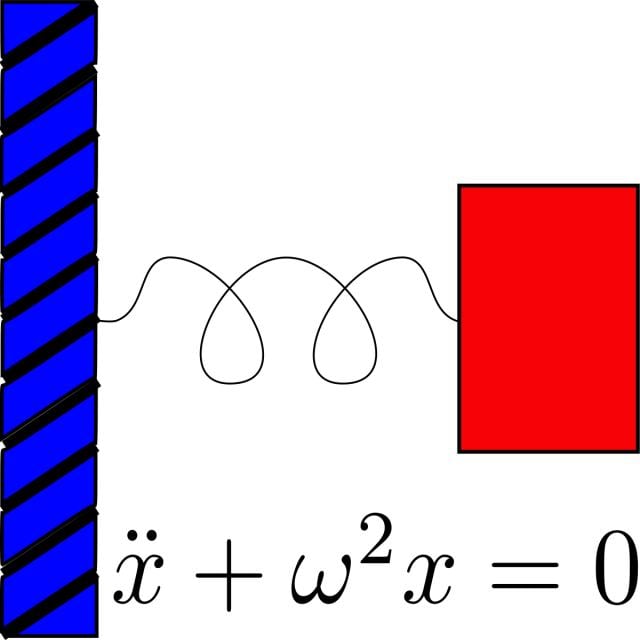
Começamos por analisar o seu papel nas transformações geométricas, para depois os vermos a explicar a evolução de sistemas dinâmicos que incluem modelos predador-presa e modelos de sobrevivência de uma espécie. Também abordamos alguns modelos simples de mecânica clássica e quântica que usam a linguagem dos va.p. e ve.p. A descrição de uma aplicação moderna do processamento de imagens digitais vai permitir abordar o tópico recente dos valores singulares. A decomposição em valores singulares é um tópico, que apesar de não ser geralmente contemplado nos programas curriculares de uma primeira disciplina de Álgebra Linear, tem muito interesse nas aplicações e revela propriedades algébricas e geométricas fundamentais das matrizes e respetivas transformações lineares.

Do ponto de vista matemático, a abordagem dos va.p. e ve.p. neste curso inclui, para além da descrição do procedimento clássico para os calcular, as questões da diagonalização e diagonalização ortogonal de matrizes e a análise do teorema espetral. Mostramos, ainda, alguns resultados sobre aproximações para va.p. e ve.p. quando as matrizes são de grandes dimensões. No caso de matrizes retangulares, introduzimos o conceito de valores singulares que são uma extensão natural das boas propriedades das matrizes simétricas definidas positivas, chamando a atenção para o seu interesse para qualquer matriz diagonalizável, ou não diagonalizável.
No final deste curso, os participantes deverão estar aptos a:

  • calcular manualmente va.p. e ve.p. próprios para matrizes 2x2 e 3x3;
  • calcular, com recurso a software, va.p. e ve.p. próprios para matrizes mais complicadas;
  • interpretar o significado dos va.p e ve.p. no contexto de transformações lineares, sistemas dinâmicos e formas quadráticas;
  • diagonalizar matrizes, classificar formas quadráticas e usar a decomposição espetral em algumas aplicações;
  • aplicar o método numérico da potência para o cálculo aproximado de va.p. e ve.p. dominantes.

Recommended Readings:
D.C. Lay, S.R. Lay & J.J. McDonald (2016). Linear Algebra and Its Applications (4th Edition). Global Edition. Pearson

Pré-requisitos
Ao nível de conhecimentos em matemática:

  • familiaridade com alguns conceitos básicos de Álgebra Linear: operações matriciais, determinantes, independência linear e bases ortonormais;
  • saber encontrar raízes de polinómios e soluções de equações diferenciais simples;
  • manipular algebricamente números complexos.

Ao nível de software de cálculo numérico e simbólico:

  • saber usar um software adequado, como por exemplo o Mathematica, MATLAB ou Maple.

Go to Class
MOOC List is learner-supported. When you buy through links on our site, we may earn an affiliate commission.

Related Courses

Algebra: Elementary to Advanced - Functions & Applications (Coursera) Coursera
Johns Hopkins University

Algebra: Elementary to Advanced - Functions & Applications (Coursera)

After completing this course, students will learn how to successfully apply functions to model different data and real world occurrences. This course reviews the concept of a function and then provide multiple examples of common and uncommon types of functions used in a variety of disciplines. Formulas, domains, ranges, graphs, intercepts, and fundamental behavior are all analyzed using both algebraic and analytic techniques. From this core set of functions, new functions are created by arithmetic operations and function composition.

Oct 26th 2026
3 Weeks
Fibonacci Numbers and the Golden Ratio (Coursera) Coursera
The Hong Kong University of Science and Technology - HKUST

Fibonacci Numbers and the Golden Ratio (Coursera)

Learn the mathematics behind the Fibonacci numbers, the golden ratio, and how they are related. These topics are not usually taught in a typical math curriculum, yet contain many fascinating results that are still accessible to an advanced high school student. The course culminates in an explanation of why the Fibonacci numbers appear unexpectedly in nature, such as the number of spirals in the head of a sunflower.

Oct 26th 2026
3 Weeks
Matrizes de Markov (IST) MOOC Técnico
Instituto Superior Técnico, Universidade de Lisboa

Matrizes de Markov (IST)

Curso sobre a probabilidade de estar sol ou nuvens num determinado dia, a distribuição da população entre a cidade e os arredores ou como funciona o algoritmo de ordenação de páginas web do Google. Neste curso sobre matrizes de Markov o ênfase principal vai ser dado aos modelos de aplicação das cadeias de Markov, em que as matrizes são um dos principais protagonistas. Nota: Esta edição do curso em modo self paced terminará no dia 28 de fevereiro de 2022.

Self Paced
Self-Paced
Jugar y Aprender Matemática en aulas heterogéneas (Coursera) Coursera
Universidad Austral

Jugar y Aprender Matemática en aulas heterogéneas (Coursera)

Cuando se asume la enseñanza de la matemática con el compromiso de la participación de todos los alumnos en una comunidad de producción, en la que se resuelven problemas con distintos procedimientos, se comparan producciones, se analiza la validez de las afirmaciones que se hacen, la tarea resulta todo un desafío. En el caso del plurigrado, el desafío parece aún mayor. ¿Cómo presentar problemas que involucren en este trabajo reflexivo a niños y niñas de distintas edades y con distintos conocimientos?

Oct 26th 2026
4 Weeks
The Finite Element Method for Problems in Physics (Coursera) Coursera
University of Michigan

The Finite Element Method for Problems in Physics (Coursera)

This course is an introduction to the finite element method as applicable to a range of problems in physics and engineering sciences. The treatment is mathematical, but only for the purpose of clarifying the formulation. The emphasis is on coding up the formulations in a modern, open-source environment that can be expanded to other applications, subsequently.

Nov 2nd 2026
13-24 Weeks
Linear Regression and Modeling (Coursera) Coursera
Duke University

Linear Regression and Modeling (Coursera)

This course introduces simple and multiple linear regression models. These models allow you to assess the relationship between variables in a data set and a continuous response variable. Is there a relationship between the physical attractiveness of a professor and their student evaluation scores? Can we predict the test score for a child based on certain characteristics of his or her mother? In this course, you will learn the fundamental theory behind linear regression and, through data examples, learn to fit, examine, and utilize regression models to examine relationships between multiple variables, using the free statistical software R and RStudio.

Oct 26th 2026
4 Weeks
Calculus: Single Variable Part 3 - Integration (Coursera) Coursera
University of Pennsylvania

Calculus: Single Variable Part 3 - Integration (Coursera)

Calculus is one of the grandest achievements of human thought, explaining everything from planetary orbits to the optimal size of a city to the periodicity of a heartbeat. This brisk course covers the core ideas of single-variable Calculus with emphases on conceptual understanding and applications. The course is ideal for students beginning in the engineering, physical, and social sciences.

Oct 26th 2026
4 Weeks
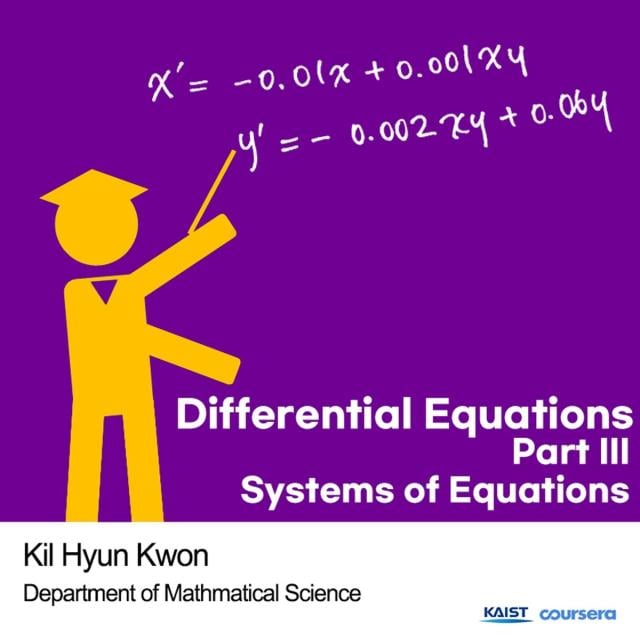
Differential Equations Part III Systems of Equations (Coursera) Coursera
Korea Advanced Institute of Science and Technology - KAIST

Differential Equations Part III Systems of Equations (Coursera)

This introductory courses on (Ordinary) Differential Equations are mainly for the people, who need differential equations mostly for the practical use in their own fields. So we try to provide basic terminologies, concepts, and methods of solving various types of differential equations as well as a rudimentary but indispensable knowledge of the underlying theory and some related applications.

Nov 2nd 2026
5-12 Weeks
Algebra: Elementary to Advanced - Equations & Inequalities (Coursera) Coursera
Johns Hopkins University

Algebra: Elementary to Advanced - Equations & Inequalities (Coursera)

This course is intended for students looking to create a solid algebraic foundation of fundamental mathematical concepts from which to take more advanced courses that use concepts from precalculus, calculus, probability, and statistics. This course will help solidify your computational methods, review algebraic formulas and properties, and apply these concepts model real world situations.

Oct 26th 2026
4 Weeks
Differential Equations for Engineers (Coursera) Coursera
The Hong Kong University of Science and Technology - HKUST

Differential Equations for Engineers (Coursera)

This course is about differential equations and covers material that all engineers should know. Both basic theory and applications are taught. In the first five weeks we will learn about ordinary differential equations, and in the final week, partial differential equations. The course is composed of 56 short lecture videos, with a few simple problems to solve following each lecture. And after each substantial topic, there is a short practice quiz. Solutions to the problems and practice quizzes can be found in instructor-provided lecture notes. There are a total of six weeks in the course, and at the end of each week there is an assessed quiz.

Oct 26th 2026
5-12 Weeks