Teaching in University Science Laboratories (Developing Best Practice) (Coursera)

Teaching in University Science Laboratories (Developing Best Practice) (Coursera)

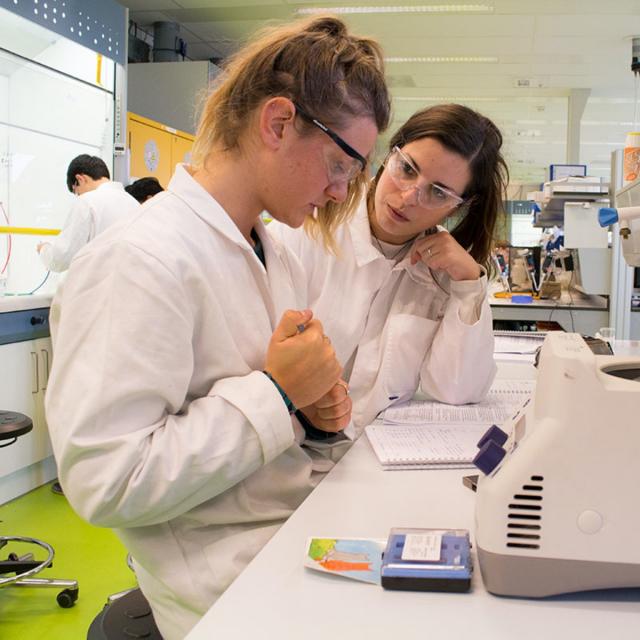
This course is developed to improve the effectiveness of laboratory classes in higher education. It aims to support teachers to improve their teaching skills for active learning in university science laboratory courses. It will show you how laboratory sessions can differ with respect to their aim and expected learning outcomes, how to engage students for learning and how to cope with their different levels of pre-knowledge and experience and probe their understanding. Last but not least it will show how you could assess students in laboratory courses.

Class Deals by MOOC List - Click here and see Coursera's Active Discounts, Deals, and Promo Codes.

This course is developed by ECTN (European Chemistry Thematic Network), Working group Lecturing Qualifications and Innovative Teaching Methods.

What You Will Learn

  • Identify the purposes of implementing laboratory classes in higher education.
  • Provide strategies on how to increase student engagement.
  • Develop effective questions to probe student understanding of laboratory practice.
  • Create a rubric for assessing a student performing a lab activity and subsequent reports.

Syllabus

WEEK 1
Welcome and introduction
In this module you will learn about different types of laboratory sessions and get acquainted with strategies that can improve student’s engagement in lab sessions. You will get an introduction about this course as a whole and set your personal goals for it.

WEEK 2
The Good Laboratory Teacher - Tips and Strategies
This module is about qualities needed to be a good laboratory teacher.

WEEK 3
Learning Theories in Practice
This module is about the learning theories that can be applied to ensure effective teaching of laboratory work.

WEEK 4
Giving Instructions and Questioning Skills
This module is about giving instruction in a lab session. We present different strategies how to support learning by questioning and how to prevent information overload.

WEEK 5
Assessment and Feedback
In this module we present the rubric, a tool which can be used for assessing and giving feedback to students on their learning goals. We also consider the concept of constructive alignment of learning outcomes, teaching and learning activities and assessment.

WEEK 6
Reflection
In this module we ask you to look back on what you have learned in this online course and to make your own plan about the improvements of the laboratory course in which you teach.

WEEK 7
Optional additional week to complete the course
This is an additional week for the ones who need it to finish all the assignments and get the cetificate of the course.
Good luck!
Go to Class
MOOC List is learner-supported. When you buy through links on our site, we may earn an affiliate commission.

Related Courses

Teaching Texts and Forms (Coursera) Coursera
Johns Hopkins University

Teaching Texts and Forms (Coursera)

The first job of any writer is to get words down on paper, and teaching writing as process helps students gain the fluency, comfort and confidence they need to succeed at any writing task. But complex, comprehensive writing tasks often bring with them specific expectations and conventions the writer must address to be successful.

Jun 22nd 2026
4 Weeks
Evaluación para el aprendizaje: Enfoque cualitativo (Coursera) Coursera
Universidad Nacional Autónoma de México

Evaluación para el aprendizaje: Enfoque cualitativo (Coursera)

La formación en educación media superior y superior implica no solamente el aprendizaje de conocimientos, sino también el desarrollo de habilidades y la formación de actitudes y valores, para lo cual es fundamental contar con instrumentos, estrategias y técnicas que le permitan al profesor obtener información sobre el progreso de sus estudiantes y así contribuir a la toma de decisiones para alcanzar el logro de los aprendizajes esperados, para ello el uso sistemático de instrumentos de evaluación de carácter cualitativo es frecuente en educación superior, particularmente en las áreas sociales y de la salud, como por ejemplo en Biología, Trabajo social, Psicología, Medicina, Antropología, entre otras.

Jun 22nd 2026
3 Weeks
Philosophy, Science and Religion: Philosophy and Religion (Coursera) Coursera
University of Edinburgh

Philosophy, Science and Religion: Philosophy and Religion (Coursera)

Philosophy, Science and Religion mark three of the most fundamental modes of thinking about the world and our place in it. Are these modes incompatible? Put another way: is the intellectually responsible thing to do to ‘pick sides’ and identify with one of these approaches at the exclusion of others? Or, are they complementary or mutually supportive? As is typical of questions of such magnitude, the devil is in the details. For example, it is important to work out what is really distinctive about each of these ways of inquiring about the world. In order to gain some clarity here, we’ll be investigating what some of the current leading thinkers in philosophy, science and religion are actually doing.

Jun 22nd 2026
5-12 Weeks
Geodesign: Change Your World (Coursera) Coursera
Pennsylvania State University

Geodesign: Change Your World (Coursera)

What happens when creativity and science come together? The power to design our world is unleashed, providing tools to inform choices about how we live! Geodesign is the glue—it’s a process that deploys creativity to connect information to people, using collaboration to better inform how we design our world.

Jun 22nd 2026
5-12 Weeks
Aprendizaje de las matemáticas de primaria (Coursera) Coursera
Universidad de los Andes

Aprendizaje de las matemáticas de primaria (Coursera)

En este segundo curso de acceso gratuito* del programa especializado Educación Matemática para profesores de primaria, conocerás las cuestiones particulares sobre el aprendizaje de las matemáticas y las dificultades y los errores más frecuentes que tienen que enfrentar los estudiantes al aprenderlas. El curso tiene una duración aproximada de seis semanas, con una dedicación promedio de 4 horas semanales. Todas las evaluaciones tienen retroalimentación y podrás descargar la mayoría de los recursos del curso.

Jun 22nd 2026
5-12 Weeks
Constructivism and Mathematics, Science, and Technology Education (Coursera) Coursera
University of Illinois at Urbana-Champaign

Constructivism and Mathematics, Science, and Technology Education (Coursera)

This course is designed to help participants examine the implications of constructivism for learning and teaching in science, mathematics, and technology focused areas. Course readings, discussions, and assignments will examine constructivist views of learning, research on students' ideas and idea-based interactions, research on instructional approaches taking student ideas into account, and challenges in implementing constructivist perspectives in instruction.

Jun 22nd 2026
5-12 Weeks
Structuring Values in Modern China (Coursera) Coursera
The Chinese University of Hong Kong

Structuring Values in Modern China (Coursera)

This sequence of four courses will propose a multi-disciplinary approach to the study of Chinese cultural history conceived of as a succession of modes of rationality (philosophical, bureaucratic, and economic). The focus will be on the moments of paradigm shift from one mode of rationality to another. For each of these moments, cultural facts and artifacts—thought, literature, ritual—will be examined in relationship to changing social, political, and economic systems.

Jun 22nd 2026
5-12 Weeks
Enseñanza de las matemáticas de primaria (Coursera) Coursera
Universidad de los Andes

Enseñanza de las matemáticas de primaria (Coursera)

En este tercer curso de acceso gratuito* del programa especializado Educación Matemática para profesores de primaria, conocerás los conceptos y técnicas para planificar e implementar tus clases. El curso tiene una duración aproximada de seis semanas, con una dedicación promedio de 4 horas semanales. Todas las evaluaciones tienen retroalimentación y podrás descargar la mayoría de los recursos del curso.

Jun 22nd 2026
5-12 Weeks
What future for education? (Coursera) Coursera
University of London,UCL Institute of Education

What future for education? (Coursera)

Through this course you will start to critically examine your own ideas about education, teaching and learning. The critique will be developed through engagement with theories and ideas developed through educational research. You will be encouraged to use these ideas to challenge or support your own ideas about education. Each week we will focus on one key question, using video lectures, key readings and challenges to explore some commonplace notions about education.

Jun 22nd 2026
5-12 Weeks
Resilient Teaching Through Times of Crisis and Change (Coursera) Coursera
University of Michigan

Resilient Teaching Through Times of Crisis and Change (Coursera)

Resilient teaching is the ability to facilitate learning experiences that are designed to be adaptable to fluctuating conditions and disruptions. This teaching ability can be seen as an outcome of a design approach that attends to the relationship between learning goals and activities, and the environments they are situated in. Resilient teaching approaches take into account how a dynamic learning context may require new forms of interactions between teachers, students, content, and tools. Additionally, they necessitate the capacity to rethink the design of learning experiences based on a nuanced understanding of context.

Jun 22nd 2026
4 Weeks
Educating Deaf Children: Becoming an Empowered Teacher (Coursera) Coursera
University of Cape Town

Educating Deaf Children: Becoming an Empowered Teacher (Coursera)

Many Deaf children around the world still leave school functionally illiterate. In some cases there is no allowance made for education of Deaf children at all. This 4 week course provides you with invaluable knowledge and skills about teaching Deaf children. You will learn about the importance of Deaf culture and community, the need for a language rich environment for the Deaf child from as young as possible, and that having access to sign language can help Deaf children academically, emotionally, and socially.

Jun 22nd 2026
4 Weeks