EdX

Teaching Computational Thinking (edX)

Teaching Computational Thinking (edX)

This course is for educators who are passionate the future of their 7-12+ year old students and want to learn more about teaching computer science in an engaging and meaningful way. This course is designed to show you how to teach computational thinking to children aged 7-12+. The course will be valuable to you, whether you are new to this approach or an enthusiastic practitioner.

Class Deals by MOOC List - Click here and see EdX's Active Discounts, Deals, and Promo Codes.

It offers ways to explore computational thinking using simple tools readily available in classrooms and homes, such as cards, chalk and scales to engage with students.
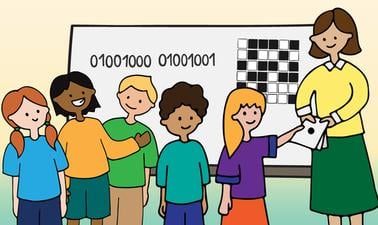
Based on the content in the popular open-source CS Unplugged website (csunplugged.org), this course demonstrates how to teach computational thinking from unplugged to plugging-it-in with programming.
Each module will weave in the following:

  • Connections to apply CS Unplugged into classroom programmes by structuring the modules to have suitable activities that lead on from each other.
  • An explanation of why we value computational thinking in the classroom
  • What is the big picture around computational thinking (especially, what is computation, and how does it fit with all the definitions of computational thinking that teachers may encounter),
  • The “so what” about each concept, how it connects to people, and where you see it in everyday life
  • Stories of history – human connections

What you'll learn

  • Binary basics
  • Text and image representation
  • Error control – how digital devices detect and correct errors in data
  • Human Computer Interaction – how to evaluate and create interfaces that work for people
  • Human capabilities

Syllabus

The aim of this course is to equip you so that you can support your learners in developing student agency while using their creativity and knowledge of computational thinking to potentially influence the future of society.
To achieve the goal of this course of learning the foundational skills, the program learning outcomes are:

  • Know how to engage students with a range of deep ideas from Computational Thinking.
  • Explain how a Parallel Sorting Network can be used to engage students with deep ideas in Computational Thinking.
  • Explain how numbers, letters and images can be represented using just two symbols i.e. binary representation
  • Know how to engage students with examples of error detection and correction to enable them to recognise how data is stored and shared safely in everyday life
  • Explain why interface evaluation is an important skill in Computational Thinking, and be able to support learners to assess interfaces from the user’s point of view.

Go to Class
MOOC List is learner-supported. When you buy through links on our site, we may earn an affiliate commission.

Related Courses

The Postdoc Academy: Building Skills for a Successful Career (edX) EdX
Boston University,BUx

The Postdoc Academy: Building Skills for a Successful Career (edX)

Join other postdocs preparing to transition into their next career step and broaden your skills toward your desired career context. The Postdoc Academy provides skill development for postdocs as they prepare to transition into their next career step. Using inclusive, active-learning approaches, participants will build skills to (1) inform your approach to leadership, (2) build and supervise a team, (3) manage projects, (4) apply teaching skills beyond the classroom, (5) develop strategic communication skills and (6) prepare successful job application materials.

Jun 5th 2023
5-12 Weeks
Science: A Work in Progress (edX) EdX
Smithsonian,SmithsonianX

Science: A Work in Progress (edX)

Science: A Work in Progress - shows how science isn’t produced through one linear method, but through an interconnected set of practices, and examines ways that teachers can make learning science in the classroom more authentic. This online workshop: Science: A Work in Progress, is based on ideas presented in Good Thinking! an original animated series developed by the Smithsonian Science Education Center.

Self Paced
Self-Paced
Computational Thinking and Big Data (edX) EdX
University of Adelaide,AdelaideX

Computational Thinking and Big Data (edX)

Learn the core concepts of computational thinking and how to collect, clean and consolidate large-scale datasets. Computational thinking is an invaluable skill that can be used across every industry, as it allows you to formulate a problem and express a solution in such a way that a computer can effectively carry it out.

Self Paced
Self-Paced
A Better Start to Reading (edX) EdX
University of Canterbury,UCx

A Better Start to Reading (edX)

Learn how to prevent reading problems in children and how to use the shared book reading context in the most effective way to support children’s early reading development. Teaching children to read well results in a lifetime of benefits. The research evidence is very clear about the importance of getting children off to a great start in their early literacy learning.

Self Paced
Self-Paced
The Hook, the Bait, and the Fish: Approaches to Teaching Thinking (edX) EdX
IsraelX

The Hook, the Bait, and the Fish: Approaches to Teaching Thinking (edX)

This course introduces the enormously influential educational movement of teaching thinking in terms of three approaches: the skills approach; the dispositions approach; and the understanding approach. You will learn the key concepts of teaching thinking and how to implement them. The knowledge economy, scientific and technological advances, democratic society, and other factors all exert pressure on education systems to develop students’ ability to think well—to think effectively, critically, and creatively.

Oct 31st 2021
5-12 Weeks
Teaching & Learning in the Diverse Classroom (edX) EdX
CornellX,Cornell University

Teaching & Learning in the Diverse Classroom (edX)

Through real stories, reflection, and key research, learn how to create and sustain inclusive, student-centered learning environments. U.S.-based and higher education-centered, this is a five-week, instructor-paced course that offers an inclusive teaching framework with multiple entry points for reflection and exploration of the research on learning and diversity.

Self Paced
Self-Paced
Advancing Learning Through Evidence-Based STEM Teaching (edX) EdX
CornellX,Cornell University

Advancing Learning Through Evidence-Based STEM Teaching (edX)

Learn effective teaching strategies and research that supports them, and how to collect, analyze, and act upon evidence of student learning. This free online course provides preparation for current and future STEM faculty members in effective teaching strategies and the evidence that supports these strategies.

Jan 29th 2024
5-12 Weeks
Learning and memory in the brain: a guide for teachers (edX) EdX
University of Cambridge

Learning and memory in the brain: a guide for teachers (edX)

This course will help you discover how neuroscience and psychology can help your students learn more effectively. This course provides a guided tour through the brain, looking at the changes that occur on a cellular level when we learn new information or store a memory. Using research from neuroscience and psychology, we will look at the process of storing long-term memories, and how you can help your students do this effectively.

Self Paced
Self-Paced
Fired Up About Energy (edX) EdX
Smithsonian,SmithsonianX

Fired Up About Energy (edX)

Fired Up About Energy – explores common student misconceptions related to the study of energy and suggests methods for effectively representing and discussing the topic in the classroom. This online workshop: “Fired up about Energy ” is based on ideas presented in Good Thinking! an original animated series developed by the Smithsonian Science Education Center (SSEC) and FableVision Studios as a professional development resource for K-12 science educators.

Self Paced
Self-Paced
Blended Learning Toolkit (edX) EdX
Columbia University,ColumbiaX

Blended Learning Toolkit (edX)

This course provides an overview of the history of digital education, as well as practical guides for implementing online tools in your classroom. It draws on the Leveling the Learning Curve book, exclusive interviews from EdTech industry leaders, and best practices taken from Columbia University and peer institutions.

Oct 16th 2023
4 Weeks