SQL for Data Science with R (Coursera)

Offered by IBM,
SQL for Data Science with R (Coursera)

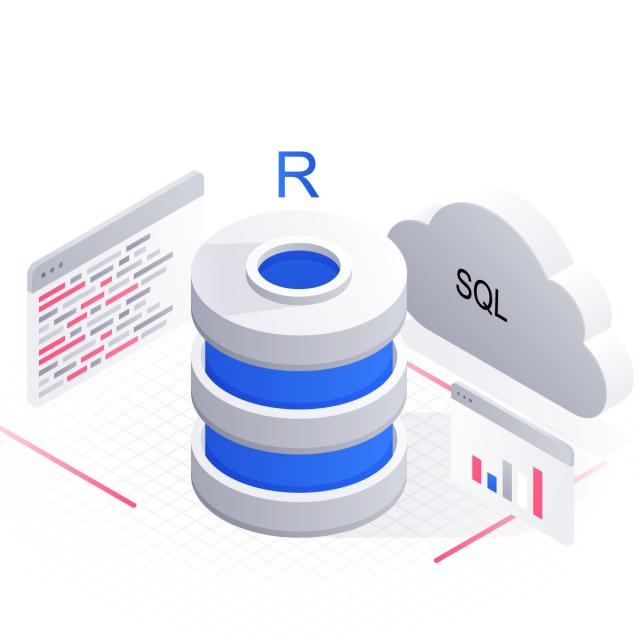
Much of the world's data resides in databases. SQL (or Structured Query Language) is a powerful language which is used for communicating with and extracting data from databases. A working knowledge of databases and SQL is a must if you want to become a data scientist. The purpose of this course is to introduce relational database concepts and help you learn and apply foundational knowledge of the SQL and R languages. It is also intended to get you started with performing SQL access in a data science environment.

Class Deals by MOOC List - Click here and see Coursera's Active Discounts, Deals, and Promo Codes.

The emphasis in this course is on hands-on and practical learning . As such, you will work with real databases, real data science tools, and real-world datasets. You will create a database instance in the cloud. Through a series of hands-on labs you will practice building and running SQL queries. You will also learn how to access databases from Jupyter notebooks using SQL and R.
No prior knowledge of databases, SQL, R, or programming is required.
Anyone can audit this course at no-charge. If you choose to take this course and earn the Coursera course certificate, you can also earn an IBM digital badge upon successful completion of the course.
Course 2 of 5 in the Applied Data Science with R Specialization

What You Will Learn

  • Create and access a database instance on cloud
  • Write basic SQL statements: CREATE, DROP, SELECT, INSERT, UPDATE, DELETE
  • Filter, sort, group results, use built-in functions, compose nested queries, access multiple tables
  • Access databases from Jupyter using R and SQL to query real-world datasets

Syllabus

WEEK 1
Getting Started with SQL
Structured Query Language, or SQL, provides a standard language for selecting and manipulating data in a relational database. Understanding SQL is a foundational skill that you must have when applying data science principles in R because SQL is the key to helping you unlock insights about the information stored deep inside relational databases. In this module, you will learn some basic SQL statements and practice them hands-on on a live database.

WEEK 2
Introduction to Relational Databases and Tables
In this module, you will explore the fundamental concepts behind databases, tables, and the relationships between them. You will then create an instance of a database, discover SQL statements that allow you to create and manipulate tables, and then practice them on your own live database.

WEEK 3
Intermediate SQL
In this module, you will learn how to use string patterns and ranges to search data and how to sort and group data in result sets. You will also practice composing nested queries and execute select statements to access data from multiple tables.

WEEK 4
Getting Started with Databases using R
In this module, you will learn the benefits of using R to connect to relational databases and how to persist R database objects in files. You’ll also learn some of the similarities between R data frames and relational databases, including how data types compare and when you must convert from one type to another to improve the effectiveness of your data analysis. Finally, you’ll learn different methods for connecting to a database from R.

WEEK 5
Working with Database Objects using R
In this module, you will learn the full process of accessing and querying databases using R. You’ll learn how to create the logical and physical model of the database and then implement the model by creating the physical database objects and loading them with data. Finally, you’ll examine an example of accessing and querying the database.

WEEK 6
Course Project
In this assignment, you will be working with multiple real-world datasets for the Canadian Crop Data and Exchange Rates. You will be asked questions that will help you understand the data just as you would in the real world. You will be assessed on the correctness of your SQL queries and results.

Go to Class
MOOC List is learner-supported. When you buy through links on our site, we may earn an affiliate commission.

Related Courses

Foundations: Data, Data, Everywhere (Coursera) Coursera
Google

Foundations: Data, Data, Everywhere (Coursera)

This is the first course in the Google Data Analytics Certificate. These courses will equip you with the skills you need to apply to introductory-level data analyst jobs. Organizations of all kinds need data analysts to help them improve their processes, identify opportunities and trends, launch new products, and make thoughtful decisions. In this course, you’ll be introduced to the world of data analytics through hands-on curriculum developed by Google. The material shared covers plenty of key data analytics topics, and it’s designed to give you an overview of what’s to come in the Google Data Analytics Certificate. Current Google data analysts will instruct and provide you with hands-on ways to accomplish common data analyst tasks with the best tools and resources.

Jun 16th 2026
5-12 Weeks
The Data Scientist's Toolbox (Coursera) Coursera
Johns Hopkins University

The Data Scientist's Toolbox (Coursera)

In this course you will get an introduction to the main tools and ideas in the data scientist's toolbox. The course gives an overview of the data, questions, and tools that data analysts and data scientists work with. There are two components to this course. The first is a conceptual introduction to the ideas behind turning data into actionable knowledge. The second is a practical introduction to the tools that will be used in the program like version control, markdown, git, GitHub, R, and RStudio.

Jun 15th 2026
4 Weeks
Using Databases with Python (Coursera) Coursera
University of Michigan

Using Databases with Python (Coursera)

This course will introduce students to the basics of the Structured Query Language (SQL) as well as basic database design for storing data as part of a multi-step data gathering, analysis, and processing effort. The course will use SQLite3 as its database. We will also build web crawlers and multi-step data gathering and visualization processes. We will use the D3.js library to do basic data visualization.

Jun 15th 2026
5-12 Weeks
Advanced R Programming (Coursera) Coursera
Johns Hopkins University

Advanced R Programming (Coursera)

This course covers advanced topics in R programming that are necessary for developing powerful, robust, and reusable data science tools. Topics covered include functional programming in R, robust error handling, object oriented programming, profiling and benchmarking, debugging, and proper design of functions.

Jun 15th 2026
4 Weeks
Building R Packages (Coursera) Coursera
Johns Hopkins University

Building R Packages (Coursera)

Writing good code for data science is only part of the job. In order to maximizing the usefulness and reusability of data science software, code must be organized and distributed in a manner that adheres to community-based standards and provides a good user experience. This course covers the primary means by which R software is organized and distributed to others.

Jun 15th 2026
4 Weeks
Exploratory Data Analysis (Coursera) Coursera
Johns Hopkins University

Exploratory Data Analysis (Coursera)

This course covers the essential exploratory techniques for summarizing data. These techniques are typically applied before formal modeling commences and can help inform the development of more complex statistical models. Exploratory techniques are also important for eliminating or sharpening potential hypotheses about the world that can be addressed by the data.

Jun 15th 2026
4 Weeks
Bayesian Statistics: Techniques and Models (Coursera) Coursera
University of California, Santa Cruz

Bayesian Statistics: Techniques and Models (Coursera)

This is the second of a two-course sequence introducing the fundamentals of Bayesian statistics. It builds on the course Bayesian Statistics: From Concept to Data Analysis, which introduces Bayesian methods through use of simple conjugate models. Real-world data often require more sophisticated models to reach realistic conclusions. This course aims to expand our “Bayesian toolbox” with more general models, and computational techniques to fit them.

Jun 15th 2026
5-12 Weeks
Statistical Inference (Coursera) Coursera
Johns Hopkins University

Statistical Inference (Coursera)

Statistical inference is the process of drawing conclusions about populations or scientific truths from data. There are many modes of performing inference including statistical modeling, data oriented strategies and explicit use of designs and randomization in analyses. Furthermore, there are broad theories (frequentists, Bayesian, likelihood, design based, …) and numerous complexities (missing data, observed and unobserved confounding, biases) for performing inference.

Jun 15th 2026
4 Weeks
Python Project for Data Science (Coursera) Coursera
IBM

Python Project for Data Science (Coursera)

This mini-course is intended to for you to demonstrate foundational Python skills for working with data. The completion of this course involves working on a hands-on project where you will develop a simple dashboard using Python. This course is part of the IBM Data Science Professional Certificate and the IBM Data Analytics Professional Certificate.

Jun 18th 2026
1 Week
Reproducible Research (Coursera) Coursera
Johns Hopkins University

Reproducible Research (Coursera)

This course focuses on the concepts and tools behind reporting modern data analyses in a reproducible manner. Reproducible research is the idea that data analyses, and more generally, scientific claims, are published with their data and software code so that others may verify the findings and build upon them. The need for reproducibility is increasing dramatically as data analyses become more complex, involving larger datasets and more sophisticated computations.

Jun 15th 2026
4 Weeks