Sports and Building Aerodynamics (Coursera)

Sports and Building Aerodynamics (Coursera)

Have we reached the boundaries of what can be achieved in sports and building design? The answer is definitely “NO”. This course explains basic aspects of bluff body aerodynamics, wind tunnel testing and Computational Fluid Dynamics (CFD) simulations with application to sports and building aerodynamics. It is intended for anyone with a strong interest in these topics. Key fields addressed are urban physics, wind engineering and sports aerodynamics.

Class Deals by MOOC List - Click here and see Coursera's Active Discounts, Deals, and Promo Codes.

Syllabus

WEEK 1
Introduction movies & Basic aspects of fluid flow
This series of lectures outlines some basic aspects of fluid flow. It starts with the fluid properties velocity, pressure, temperature, density and viscosity. It continues with flow properties such as viscous versus inviscid flow, compressible versus incompressible flow, confined versus open flow, steady versus unsteady flow, stationary versus non-stationary flow and laminar versus turbulent flow. It also addresses some basic components of fluid statics, kinematics and dynamics. The last lectures are focused on the important concept of the boundary layer. Laminar versus turbulent boundary layers, boundary layer separation and obstacle form drag versus friction drag are explained. Finally, the module ends with a lecture on a special type of boundary layer: the atmospheric boundary layer, in which sports and building aerodynamics take place.

WEEK 2
Wind-tunnel testing
This series of lectures provides some fundamental aspects of wind-tunnel testing. First, the reasons why wind-tunnel testing is still important are outlined. Next, different types of wind tunnels and applications of wind-tunnel testing are discussed. As a special type of wind tunnel, the atmospheric boundary layer wind tunnel is described. Further lectures focus on the different wind-tunnel components, on measurements and flow visualization, on similarity and flow quality and on important best practice guidelines for high-quality wind-tunnel testing.

WEEK 3
Computational Fluid Dynamics
This series of lectures provides the basics of Computational Fluid Dynamics (CFD) with focus on application to Sports & Building Aerodynamics. First, the possibilities and limitations of CFD are outlined. Next, the main approaches for solving and modeling turbulent flow are explained, after which some basic aspects of discretization and near-wall modeling are described. After that, we focus on the important topics of errors, uncertainties, verification and validation in CFD. The series is concluded with two lectures that provide an overview of the past achievements and future challenges in Computational Wind Engineering.

WEEK 4
Building aerodynamics
The lecture series on Building Aerodynamics consists of 10 lectures. The first two lectures provide basic information about the wind flow around isolated buildings and generic building groups. Three lectures focus on the important problem of pedestrian-level wind discomfort and wind danger around buildings. One lecture addresses natural ventilation of buildings, focused on the ventilation study for a large football stadium in the Netherlands. Two lectures address wind-driven rain on building facades, and the final two lectures are devoted to wind energy in the built environment, where some important misconceptions are highlighted and explained.

WEEK 5
100 m sprint aerodynamics
This short lecture series addresses the aerodynamics of the 100 m sprint, including aerodynamic effects generated by the stadium. The first lecture explains the importance of aerodynamics in the 100 m sprint competition. Next, an existing mathematical-physical model of short-distance running is outlined. Based on this model, further lectures investigate wind effects and altitude effects on 100 m sprint performances and on potential world records. Finally, the potential influence of the geometry of the sports stadium on records established in it is explained, and the lecture series is concluded by an interview with a professional athletics coach.

WEEK 6
Cycling aerodynamics
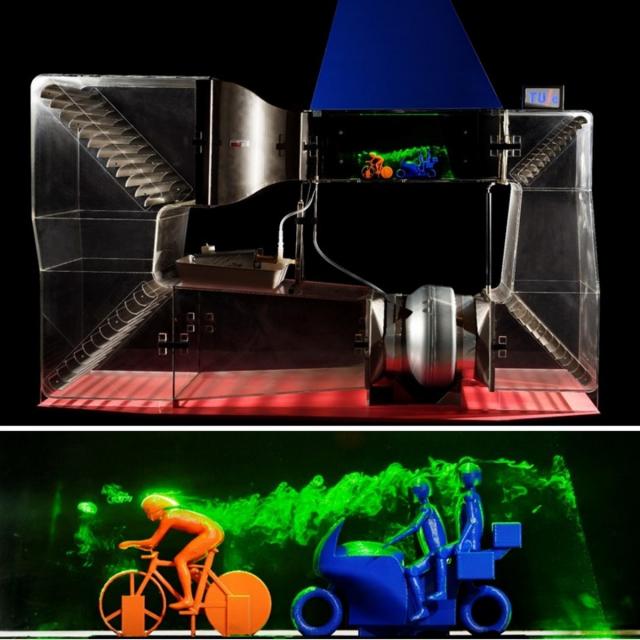
The lecture series on cycling aerodynamics consists of 8 lectures. In the first lecture, the importance of aerodynamics in cycling is outlined. In the next two lectures, wind-tunnel testing of real and dummy cyclists is presented. The next lectures focus on CFD studies of the aerodynamics of a single cyclist, aerodynamics of two drafting cyclists and aerodynamics of drafting cyclist groups. After that, the aerodynamic interaction between a cyclist and a following car is studied. Finally, the series is concluded by an interview with two professional cycling coaches.

WEEK 7
Final quiz
The final quiz contains questions covering all 6 weeks. The minimum score to pass the course is 80%. 3 attempts can be taken. Partial feedback (correct / incorrect) will be given after every attempt. Points for multiple-choice questions with multiple correct answers are only obtained when all correct answers are labeled as such by the student.

WEEK 8
Peer-graded assignment
The peer-graded assignment includes the critical review of a scientific article based on the knowledge gained throughout the MOOC. The review consists of three parts: (1) performing a detailed study of the article; (2) providing a detailed answer to a set of specific questions; (3) grading at least 5 assignments of colleague students / peers.

Go to Class
MOOC List is learner-supported. When you buy through links on our site, we may earn an affiliate commission.

Related Courses

Becoming a Sports Agent (Coursera) Coursera
Case Western Reserve University

Becoming a Sports Agent (Coursera)

An immersive experience in the world of sports that will take students through the four stages of a professional athlete's career. Utilizing lectures, guest speakers, reading assignments and hypothetical walkthroughs, students will learn how the best sports agents manage clients at each of these four stages. This course will provide each student with the skills necessary to guide an athlete through the difficult decisions that can make or lose the athlete millions of dollars, as well as affect their public image and career.

May 25th 2026
5-12 Weeks
MOOC - Avion Introduction à la mécanique du vol (FUN) FUN
ISAE-SUPAERO

MOOC - Avion Introduction à la mécanique du vol (FUN)

Cela fait à peine plus d’un siècle que les avions volent. Et, de fait, le vol défie souvent l’intuition de l’animal terrestre que nous sommes. Comment vole un avion et comment éviter qu’il échappe au contrôle du pilote ? Jusqu’où peut-il s’élever dans le ciel ? Autant de questions auxquelles ce MOOC s’efforcera de répondre avec passion, simplicité et rigueur scientifique, en s’appuyant sur des explications visuelles, des mises en situation réalistes, des simulations et en se limitant au formalisme mathématique accessible à un élève de terminale scientifique.

No sessions available
5-12 Weeks
Moneyball and Globalization (Coursera) Coursera
University of Colorado Boulder

Moneyball and Globalization (Coursera)

This course will explore baseball’s historical connections to money and globalization, two of the most powerful forces in the modern era. Baseball may be a child’s game, but it has been inextricably intertwined with money and profit since its very inception in the late nineteenth century. The Reserve Clause, world tours, collective bargaining, expansion, bringing players from abroad, and realignment have always been driven as much or more by money than anything else.

Jun 1st 2026
4 Weeks
The Science Behind Anti-Doping (FutureLearn) FutureLearn
King's College London

The Science Behind Anti-Doping (FutureLearn)

Discover the life-cycle of a sample collected for anti-doping processes within sport, and the science behind it. Learn the science behind the anti-doping process with King’s College London. This fascinating course will cover the life cycle of a sample (blood and urine) collected for anti-doping purposes within sport and explain the science behind the analytical processes involved.

Jun 24th 2024
4 Weeks
Aviation 101 (Canvas net) Canvas Network
Embry-Riddle Aeronautical University

Aviation 101 (Canvas net)

Aviation 101 is a free online Introduction to Aviation Course. Are you interested in aviation? Have you thought you might like to become a pilot? Proceed at your own pace to learn fundamentals that will give you a head start to your aviation career.

Self Paced
Self-Paced
Math in Sports (edX) EdX
University of Notre Dame,NotreDameX

Math in Sports (edX)

In this course you will learn to use some mathematical tools that can help predict and analyze sporting performances and outcomes. This course will help coaches, players, and enthusiasts to make educated decisions about strategy, training, and execution. We will discuss topics such as the myth of the Hot Hand and the curse of the Sports Illustrated cover; how understanding data can improve athletic performance; and how best to pick your Fantasy Football team.

No sessions available
4 Weeks
Business History of the FIFA World Cup (FutureLearn) FutureLearn
University of York

Business History of the FIFA World Cup (FutureLearn)

Trace the historic development of the FIFA World Cup as a business entity to build expertise in sports business and management. On this three-week course from the University of York, you’ll trace the business history of the FIFA World Cup. Acknowledging the broader cultural, political, economic and social context of the tournament, you’ll examine its status as a business supported by a system of increasingly powerful monopolies.

Jan 29th 2024
3 Weeks
L’entraînement sportif en trail et ultra-trail 2.0 (FUN) FUN
Université Fédérale Toulouse Midi-Pyrénées

L’entraînement sportif en trail et ultra-trail 2.0 (FUN)

Plus de 20 000 apprenants ont suivi le premier chapitre de ce Mooc sur l’entraînement en trail et en ultra-trail qui était très centré sur l’entraînement, la planification et la compétition. Nous n’avions pas l’intention d’être exhaustif sur le sujet bien sûr et les enquêtes de satisfaction menées à la fin du cours ont révélé qu’effectivement plusieurs thèmes restaient en suspens ou n’avaient été que trop partiellement abordés.

No sessions available
5-12 Weeks
Football: More than a Game (Coursera) Coursera
University of Edinburgh

Football: More than a Game (Coursera)

Explore the world of football (soccer), the money, the rivalries, the trends, the past, the present, the men’s game, the women's game and the real issues. Whether you love it, hate it or try to ignore it – join us as we go behind the scenes to examine why football is more than just a game.

Jun 1st 2026
5-12 Weeks
Industrial Fluid systems & Smart Factory Automation (Coursera) Coursera
L&T EduTech

Industrial Fluid systems & Smart Factory Automation (Coursera)

The "Industrial Fluid System & Smart Factory Automation" course represents a pivotal opportunity for individuals seeking to delve into the cutting-edge intersection of fluid dynamics, electrical drives, and smart automation technologies. With three comprehensive modules, participants embark on a transformative journey, exploring the intricacies of fluid and electrical drive systems, fluid circuit design, and the implementation of smart factory automation solutions.

Jun 8th 2026
3 Weeks
Michigan Sport-Related Concussion Training Certification (Coursera) Coursera
University of Michigan

Michigan Sport-Related Concussion Training Certification (Coursera)

Welcome to the Michigan Sport-Related Concussion Training Certification. In this course, you will learn about five key components of sport-related concussions: identify medical emergencies, debrief the Michigan Youth Concussion Legislature, review rest and rehabilitation principles after a concussion occurs, understand the return to learn and return to school progressions, and finally become knowledgeable of the potential long-term consequences of head impact exposure on brain health.

Jun 1st 2026
1 Week