Responsive Website Basics: Code with HTML, CSS, and JavaScript (Coursera)

Responsive Website Basics: Code with HTML, CSS, and JavaScript (Coursera)

In this course you will learn three key website programming and design languages: HTML, CSS and JavaScript. You will create a web page using basic elements to control layout and style. Additionally, your web page will support interactivity.

Class Deals by MOOC List - Click here and see Coursera's Active Discounts, Deals, and Promo Codes.

At the end of the course, you will be able to:

  1. Define the purpose of HTML, CSS and JavaScript
  2. Make a simple web page using HTML
  3. Use CSS to control text styles and layout
  4. Use CSS libraries such as Bootstrap to create responsive layouts
  5. Use JavaScript variables and functions
  6. Manipulate web page content using JavaScript
  7. Respond to user input using JavaScript

In this course, you will complete:
2 assignments writing HTML, CSS and JavaScript, each taking ~1 hour to complete
4 quizzes, each taking ~20 minutes to complete
1 programming exercise~30 minutes to complete
multiple practice quizzes, each taking ~5 minutes to complete
Participation in or completion of this online course will not confer academic credit for University of London programmes.

Course 1 of 6 in the Responsive Website Development and Design Specialization

Syllabus

WEEK 1
Course introduction
HTML
We start the course by looking at how to set up a dev environment, build a HTML navbar and how to embed images and create lists using HTML. Also we'll create properly structured HTML documents and have a look at the world's first web page.

WEEK 2
CSS
In this section of the course we will have a look at linking external CSS files to your HTML documents, controlling fonts with CSS and using CSS to customise hyperlink formatting and to control text layout. We will also install the bootstrap library and implement a responsive grid layout

WEEK 3
Beginning JavaScript
In this module we will write simple JavaScript programs and learn how to write programs that can respond to user input such as clicking on HTML elements. We will also take a look at JavaScript functions and use jQuery to manipulate web pages. Finally, you will learn how to write your own javaScript functions including anonymous functions.

WEEK 4
Going deeper into JavaScript
In this final section of the course we will define JavaScript variables and write simple JavaScript programs that use and change the values of variables. We'll also write if statements to control the flow of a JavaScript program, use boolean variables in conjunction with if statements and write javaScript in the context of moderately complex web applications.
Go to Class
MOOC List is learner-supported. When you buy through links on our site, we may earn an affiliate commission.

Related Courses

Learn Imba (Coursera) Coursera
Scrimba

Learn Imba (Coursera)

In this class, you'll dive into Imba, the programming language used to build scrimba.com. Imba, a compile-to-JavaScript language, packs a punch with nifty features for whipping up web apps, including built-in tags and styles. We'll cover the ABCs of Imba syntax and work on creating a Dopamine Box app. By the finish line, you'll be armed with the skills to construct your very own web app UI using Imba.

Oct 12th 2026
1 Week
Programming Reactive Systems (Scala 2 version) (Coursera) Coursera
École Polytechnique Fédérale de Lausanne

Programming Reactive Systems (Scala 2 version) (Coursera)

Reactive programming is a set of techniques for implementing scalable, resilient and responsive systems as per the Reactive Manifesto. Such systems are based on asynchronous message-passing, and their basic building-blocks are event handlers. This course teaches how to implement reactive systems in Scala and Akka by using high-level abstractions, such as actors, asynchronous computations, and reactive streams.

Oct 5th 2026
5-12 Weeks
Build a Modern Computer from First Principles: Nand to Tetris Part II (project-centered course) (Coursera) Coursera
Hebrew University of Jerusalem

Build a Modern Computer from First Principles: Nand to Tetris Part II (project-centered course) (Coursera)

In this project-centered course you will build a modern software hierarchy, designed to enable the translation and execution of object-based, high-level languages on a bare-bone computer hardware platform. In particular, you will implement a virtual machine and a compiler for a simple, Java-like programming language, and you will develop a basic operating system that closes gaps between the high-level language and the underlying hardware platform.

Oct 12th 2026
5-12 Weeks
Learn JavaScript (Coursera) Coursera
Scrimba

Learn JavaScript (Coursera)

This is perhaps the most interactive JavaScript course ever recorded. It contains 140+ coding challenges, meaning that you will finally build that ever-so-important JavaScript muscle memory. You will solve the challenges directly in the browser thanks to Scrimba's interactive video technology, so there's not setup needed. Say goodbye to "tutorial hell" and get ready to start feeling your JavaScript superpowers grow exponentially.

Oct 12th 2026
4 Weeks
Problem Solving Using Computational Thinking (Coursera) Coursera
University of Michigan

Problem Solving Using Computational Thinking (Coursera)

Have you ever heard that computers "think"? Believe it or not, computers really do not think. Instead, they do exactly what we tell them to do. Programming is, "telling the computer what to do and how to do it." Before you can think about programming a computer, you need to work out exactly what it is you want to tell the computer to do. Thinking through problems this way is Computational Thinking. Computational Thinking allows us to take complex problems, understand what the problem is, and develop solutions. We can present these solutions in a way that both computers and people can understand.

Oct 12th 2026
5-12 Weeks
Persistent Memory Technology - Introduction and Deployment (Coursera) Coursera
EDUCBA

Persistent Memory Technology - Introduction and Deployment (Coursera)

Embark on a dynamic learning journey through this course. In the first module, explore the intricacies of Persistent Memory (PMEM), unraveling its fundamental concepts, characteristics, and operating system support. Transition seamlessly into the second module, mastering transactional concepts, optimizing hardware configurations, and discerning between volatile and persistent libraries. In the final module, dive into advanced programming with libpmemobj, overcoming C++ Standard limitations, and applying insights to real-world scenarios like building a phonebook.

Oct 12th 2026
3 Weeks
Laboratório de Programação Orientada a Objetos - Parte 2 (Coursera) Coursera
Universidade de São Paulo, Brasil

Laboratório de Programação Orientada a Objetos - Parte 2 (Coursera)

Esta é a segunda parte do curso avançado de Programação Orientada a Objetos oferecido pelo Departamento de Ciência da Computação do IME-USP. O curso é voltado para profissionais ou estudantes interessados em Desenvolvimento de Software Avançado e que já dominam uma linguagem de programação e já conhecem os fundamentos básicos da orientação a objetos.

Oct 12th 2026
5-12 Weeks
Learn HTML and CSS (Coursera) Coursera
Scrimba

Learn HTML and CSS (Coursera)

This course is perfect if you want to learn how to code websites from scratch. You will learn the basics of HTML and CSS through interactive challenges. Along the way, you will build multiple projects, like a Google.com clone, a Space Exploration page, and a fun birthday site filled with GIFs. While most of the challenges are done in Scrimba's interactive editor, you will also learn how to use professional tools like VS Code for code editing, GitHub for hosting your code, and Netlify for deploying your projects to the world wide web.

Oct 12th 2026
5-12 Weeks
Programming Languages, Part A (Coursera) Coursera
University of Washington

Programming Languages, Part A (Coursera)

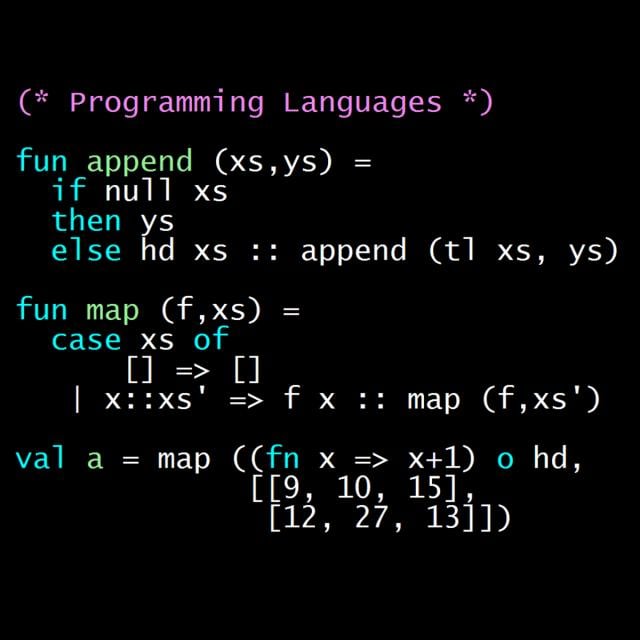
This course is an introduction to the basic concepts of programming languages, with a strong emphasis on functional programming. The course uses the languages ML, Racket, and Ruby as vehicles for teaching the concepts, but the real intent is to teach enough about how any language “fits together” to make you more effective programming in any language -- and in learning new ones.

Oct 5th 2026
5-12 Weeks
Uso de bases de datos con Python (Coursera) Coursera
University of Michigan

Uso de bases de datos con Python (Coursera)

Este curso presentará a los estudiantes los conceptos básicos del lenguaje de consulta estructurado (Structured Query Language, SQL), así como el diseño básico de bases de datos para almacenar datos como parte de una iniciativa de varios pasos para recopilar, analizar y procesar datos. El curso utilizará SQLite3 como base de datos. También crearemos rastreadores web y procesos de visualización y recopilación de datos de varios pasos. Utilizaremos la biblioteca D3.js para realizar la visualización básica de datos.

Oct 12th 2026
5-12 Weeks