Parallel programming (Coursera)

Parallel programming (Coursera)

With every smartphone and computer now boasting multiple processors, the use of functional ideas to facilitate parallel programming is becoming increasingly widespread. In this course, you'll learn the fundamentals of parallel programming, from task parallelism to data parallelism. In particular, you'll see how many familiar ideas from functional programming map perfectly to to the data parallel paradigm.

Class Deals by MOOC List - Click here and see Coursera's Active Discounts, Deals, and Promo Codes.

We'll start the nuts and bolts how to effectively parallelize familiar collections operations, and we'll build up to parallel collections, a production-ready data parallel collections library available in the Scala standard library. Throughout, we'll apply these concepts through several hands-on examples that analyze real-world data, such as popular algorithms like k-means clustering.
Learning Outcomes. By the end of this course you will be able to:

  • reason about task and data parallel programs,
  • express common algorithms in a functional style and solve them in parallel,
  • competently microbenchmark parallel code,
  • write programs that effectively use parallel collections to achieve performance

Recommended background: You should have at least one year programming experience. Proficiency with Java or C# is ideal, but experience with other languages such as C/C++, Python, Javascript or Ruby is also sufficient. You should have some familiarity using the command line. This course is intended to be taken after Functional Program Design in Scala.

Course 3 of 5 in theFunctional Programming in Scala Specialization.

Syllabus

WEEK 1
Parallel Programming
We motivate parallel programming and introduce the basic constructs for building parallel programs on JVM and Scala. Examples such as array norm and Monte Carlo computations illustrate these concepts. We show how to estimate work and depth of parallel programs as well as how to benchmark the implementations.

WEEK 2
Basic Task Parallel Algorithms
We continue with examples of parallel algorithms by presenting a parallel merge sort. We then explain how operations such as map, reduce, and scan can be computed in parallel. We present associativity as the key condition enabling parallel implementation of reduce and scan.

WEEK 3
Data-Parallelism
We show how data parallel operations enable the development of elegant data-parallel code in Scala. We give an overview of the parallel collections hierarchy, including the traits of splitters and combiners that complement iterators and builders from the sequential case.

WEEK 4
Data Structures for Parallel Computing
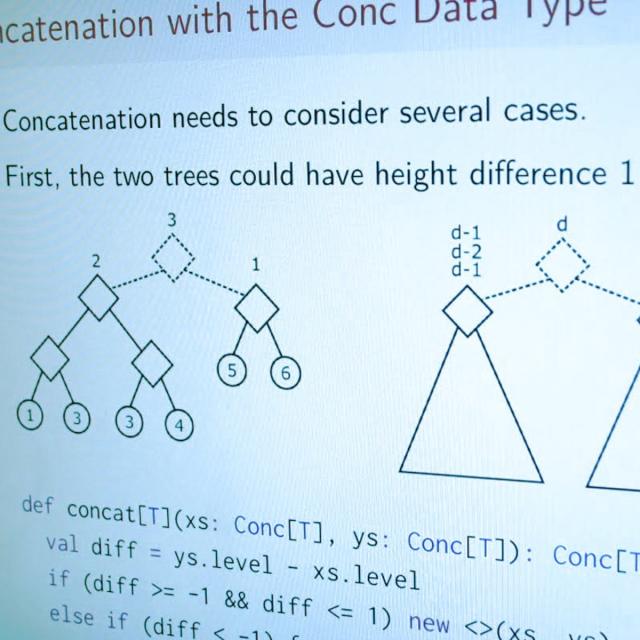
We give a glimpse of the internals of data structures for parallel computing, which helps us understand what is happening under the hood of parallel collections.


Go to Class
MOOC List is learner-supported. When you buy through links on our site, we may earn an affiliate commission.

Related Courses

Introduction to Graph Theory (Coursera) Coursera
University of California, San Diego,Higher School of Economics - HSE University

Introduction to Graph Theory (Coursera)

We invite you to a fascinating journey into Graph Theory — an area which connects the elegance of painting and the rigor of mathematics; is simple, but not unsophisticated. Graph Theory gives us, both an easy way to pictorially represent many major mathematical results, and insights into the deep theories behind them. In this course, among other intriguing applications, we will see how GPS systems find shortest routes, how engineers design integrated circuits, how biologists assemble genomes, why a political map can always be colored using a few colors. We will study Ramsey Theory which proves that in a large system, complete disorder is impossible!

Jun 15th 2026
5-12 Weeks
Ordered Data Structures (Coursera) Coursera
University of Illinois at Urbana-Champaign

Ordered Data Structures (Coursera)

In this course, you will learn new data structures for efficiently storing and retrieving data that is structured in an ordered sequence. Such data includes an alphabetical list of names, a family tree, a calendar of events or an inventory organized by part numbers. The specific data structures covered by this course include arrays, linked lists, queues, stacks, trees, binary trees, AVL trees, B-trees and heaps. This course also shows, through algorithm complexity analysis, how these structures enable the fastest algorithms to search and sort data.

Jun 17th 2026
4 Weeks
Cloud Computing Concepts: Part 2 (Coursera) Coursera
University of Illinois at Urbana-Champaign

Cloud Computing Concepts: Part 2 (Coursera)

Cloud computing systems today, whether open-source or used inside companies, are built using a common set of core techniques, algorithms, and design philosophies—all centered around distributed systems. Learn about such fundamental distributed computing "concepts" for cloud computing. Some of these concepts include: Clouds, MapReduce, key-value stores, Classical precursors, Widely-used algorithms, Classical algorithms, Scalability, Trending areas, And more!

Jun 15th 2026
5-12 Weeks
Practical Machine Learning (Coursera) Coursera
Johns Hopkins University

Practical Machine Learning (Coursera)

One of the most common tasks performed by data scientists and data analysts are prediction and machine learning. This course will cover the basic components of building and applying prediction functions with an emphasis on practical applications. The course will provide basic grounding in concepts such as training and tests sets, overfitting, and error rates.

Jun 15th 2026
4 Weeks
Machine Learning: Regression (Coursera) Coursera
University of Washington

Machine Learning: Regression (Coursera)

Case Study - Predicting Housing Prices. In our first case study, predicting house prices, you will create models that predict a continuous value (price) from input features (square footage, number of bedrooms and bathrooms,...). This is just one of the many places where regression can be applied. Other applications range from predicting health outcomes in medicine, stock prices in finance, and power usage in high-performance computing, to analyzing which regulators are important for gene expression.

Jun 15th 2026
5-12 Weeks
Algorithms on Graphs (Coursera) Coursera
University of California, San Diego,Higher School of Economics - HSE University

Algorithms on Graphs (Coursera)

If you have ever used a navigation service to find optimal route and estimate time to destination, you've used algorithms on graphs. Graphs arise in various real-world situations as there are road networks, computer networks and, most recently, social networks! If you're looking for the fastest time to get to work, cheapest way to connect set of computers into a network or efficient algorithm to automatically find communities and opinion leaders in Facebook, you're going to work with graphs and algorithms on graphs.

Jun 15th 2026
5-12 Weeks
Python Data Structures (Coursera) Coursera
University of Michigan

Python Data Structures (Coursera)

This course will introduce the core data structures of the Python programming language. We will move past the basics of procedural programming and explore how we can use the Python built-in data structures such as lists, dictionaries, and tuples to perform increasingly complex data analysis. This course will cover Chapters 6-10 of the textbook “Python for Everybody”. This course covers Python 3.

Jun 15th 2026
5-12 Weeks
Shortest Paths Revisited, NP-Complete Problems and What To Do About Them (Coursera) Coursera
Stanford University

Shortest Paths Revisited, NP-Complete Problems and What To Do About Them (Coursera)

The primary topics in this part of the specialization are: shortest paths (Bellman-Ford, Floyd-Warshall, Johnson), NP-completeness and what it means for the algorithm designer, and strategies for coping with computationally intractable problems (analysis of heuristics, local search).

Jun 15th 2026
4 Weeks
Information Theory (Coursera) Coursera
The Chinese University of Hong Kong

Information Theory (Coursera)

At the completion of this course, the student should be able to: demonstrate knowledge and understanding of the fundamentals of information theory; appreciate the notion of fundamental limits in communication systems and more generally all systems; develop deeper understanding of communication systems; apply the concepts of information theory to various disciplines in information science.

Jun 15th 2026
13-24 Weeks
Programming Foundations with JavaScript, HTML and CSS (Coursera) Coursera
Duke University

Programming Foundations with JavaScript, HTML and CSS (Coursera)

Learn foundational programming concepts (e.g., functions, for loops, conditional statements) and how to solve problems like a programmer. In addition, learn basic web development as you build web pages using HTML, CSS, JavaScript. By the end of the course, will create a web page where others can upload their images and apply image filters that you create.

Jun 15th 2026
4 Weeks
Text Mining and Analytics (Coursera) Coursera
University of Illinois at Urbana-Champaign

Text Mining and Analytics (Coursera)

This course will cover the major techniques for mining and analyzing text data to discover interesting patterns, extract useful knowledge, and support decision making, with an emphasis on statistical approaches that can be generally applied to arbitrary text data in any natural language with no or minimum human effort.

Jun 15th 2026
5-12 Weeks