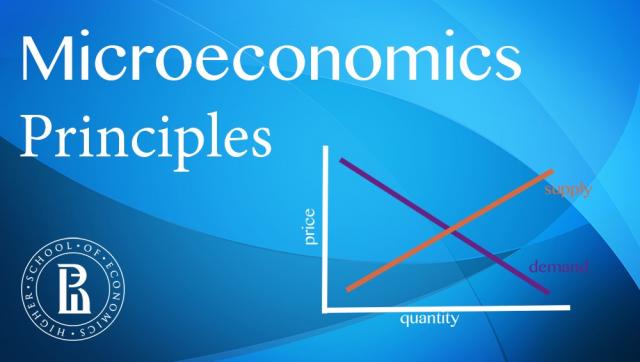
Основы микроэкономики (Microeconomics Principles) (Coursera)

Основы микроэкономики (Microeconomics Principles) (Coursera)

Самое сложное экономическое событие сводится, в конечном счёте, к действиям отдельных людей и фирм. Микроэкономика показывает, как можно эти действия анализировать – как люди выбирают, что потреблять, а фирмы – что производить.

Class Deals by MOOC List - Click here and see Coursera's Active Discounts, Deals, and Promo Codes.

В базовом курсе микроэкономики рассказывается об основных инструментах экономического анализа, которые позволяют изучать наиболее важные закономерности в поведении людей и фирм. У людей есть предпочтения относительно товаров и бюджетные ограничения, у фирм – производственные возможности и спрос на их продукцию со стороны людей. В результате взаимодействия людей и фирм складываются рынки, на которых определяется цена – важнейший канал передачи информации.
Чтобы информации было больше, существуют рынки, на которых продаются и покупаются товары и услуги. Потребитель никогда не купит нужный ему товар, если не узнает, где и как его можно купить. Производитель не станет его изготавливать, если не будет уверен, что найдется покупатель, который его приобретет. Каждый человек и каждая фирма обладает какими-то сведениями – прежде всего о себе самом, о своих вкусах, интересах, потребностях и возможностях. Однако информации у всех становится во много раз больше, когда субъекты начинают взаимодействовать – производят и потребляют, продают, покупают и меняются. Поведение людей и фирм на рынках – основной предмет изучения в курсе микроэкономики.
Go to Class
MOOC List is learner-supported. When you buy through links on our site, we may earn an affiliate commission.

Related Courses

Firm Level Economics: Markets and Allocations (Coursera) Coursera
University of Illinois at Urbana-Champaign

Firm Level Economics: Markets and Allocations (Coursera)

In this class, we will derive equilibrium outcomes across a variety of market structures. We will begin by understanding equilibrium under a market structure called Perfect Competition, a benchmark construction. Economists have tools to measure the efficiency of market outcomes. We next consider the polar extreme of a competitive market: a monopoly market. We will determine the monopoly equilibrium price and quantity and efficiency properties. Much economic activity takes place in markets with just a handful of very large producers.

Jun 22nd 2026
4 Weeks
實驗經濟學 (Experimental Economics: Behavioral Game Theory) (Coursera) Coursera
National Taiwan University

實驗經濟學 (Experimental Economics: Behavioral Game Theory) (Coursera)

人是否會如同理論經濟學的預測進行決策?這門課將透過每週的課程影片以及課後作業帶你了解實驗經濟學的基本概念。每週將會有習題練習以及指定閱讀的期刊論文。你將會參與一些線上的實驗、報告論文並且互評其他同學的報告。

Jun 10th 2026
5-12 Weeks
Narrative Economics (Coursera) Coursera
Yale University

Narrative Economics (Coursera)

This course, Narrative Economics, is relatively short and proposes a simple concept: we need to incorporate the contagion of narratives into our economic theory. You can think of narratives as stories that shape public beliefs, which in turn influence our decision making. Understanding how people arrived at certain decisions in the past can aid our understanding of the economy today and improve our forecasts of the future.

Jun 15th 2026
4 Weeks
Earth Economics (Coursera) Coursera
Erasmus University Rotterdam

Earth Economics (Coursera)

After this course you will be an Earth Economist that can provide evidence-based advise on the best global policy. As an Earth Economist you will better understand the behavior and advice of economists, have become a better economist yourself and know where to find Earth's data and how to analyze these world observations. Our planet is too important: we need you to get engaged!

Jun 22nd 2026
5-12 Weeks
Principles of Economics: Microeconomics - Down to Business (Coursera) Coursera
Rice University

Principles of Economics: Microeconomics - Down to Business (Coursera)

In this second portion of the three-course specialization covering economics, we're going to be focusing on Microeconomics or the business side of things. This course is also based heavily on my ECON 100 course that I teach here at Rice University. Through lectures, short quizzes, problem sets, and discussions we're going to take a look at subjects such as, costs of production, perfect competition, monopolies, monopolistic competition, oligopolies, and household choices. And you'll still get all the unsolicited food and cooking advice sprinkled in there too :)

Jun 22nd 2026
5-12 Weeks
The Economics of Health Care Delivery (Coursera) Coursera
University of Pennsylvania

The Economics of Health Care Delivery (Coursera)

In this course, you’ll learn about the key components of health care, and the economics behind their principles and pricing strategies. Professors Ezekiel Emanuel of Penn Medicine and Guy David of the Wharton School have designed this course to help you understand the complex structure of the health care system and health insurance. Through study and analysis of providers and insurance through an economic lens, you’ll learn how basic economic principles apply to both principles and payment methods.

Jun 15th 2026
4 Weeks
Inequality and Democracy (Coursera) Coursera
Universiteit Utrecht

Inequality and Democracy (Coursera)

Most countries are getting more and more unequal. But the core of democracy is political equality: that everyone should have an equal say in how their country is run. Can we really expect these things to go together? Can people have equal political power while economic inequality grows and grows? Take this course and decide for yourself.

Jun 22nd 2026
5-12 Weeks
Chinese Politics Part 1 - China and Political Science (Coursera) Coursera
The Hong Kong University of Science and Technology - HKUST

Chinese Politics Part 1 - China and Political Science (Coursera)

This course offers a conceptual framework for understanding China that highlights the intersection of politics and economics. It shows that rather than develop into a full blown market economy, state and party officials at all levels of the political system maintain significant influence in economic development. Such a “political” economy has had both positive and negative outcomes, which we will assess in detail.

Jun 22nd 2026
5-12 Weeks
Principles of Economics: Macroeconomics - The Big Picture (Coursera) Coursera
Rice University

Principles of Economics: Macroeconomics - The Big Picture (Coursera)

Take a trip with me in this the third and final course of this Economics 100 Specialization which is a direct adaptation from one of my courses I teach at Rice University. Specifically, in this course we're going to be focusing on Macroeconomics. What is Macroeconomics you might be asking? Well, you've come to the right place! We're going to be going over the big picture of economics- which is examining the measures we use to gauge the health of national economies and study the theories and policies aimed at improving economic health. In a nutshell, how can we use economics to make the world a better place?

Jun 22nd 2026
5-12 Weeks
Game Theory (Coursera) Coursera
Stanford University,The University of British Columbia

Game Theory (Coursera)

Popularized by movies such as "A Beautiful Mind," game theory is the mathematical modeling of strategic interaction among rational (and irrational) agents. Beyond what we call `games' in common language, such as chess, poker, soccer, etc., it includes the modeling of conflict among nations, political campaigns, competition among firms, and trading behavior in markets such as the NYSE.

Jun 8th 2026
5-12 Weeks
Principles of Economics: Introduction - Getting to Know You (Coursera) Coursera
Rice University

Principles of Economics: Introduction - Getting to Know You (Coursera)

Economics and economic theory is fundamental to decision making in business, policy, and everyday life. If you're interested in a career in business, law, accounting, or investment then studying economics is a great foundation of knowledge. In this first course of a three course Specialization adapted from my ECON 100 course taught at Rice University, we'll cover the introduction to the basic concepts of microeconomics and macroeconomics.

Jun 22nd 2026
5-12 Weeks