EdX

Media LIT: Overcoming Information Overload (edX)

Media LIT: Overcoming Information Overload (edX)

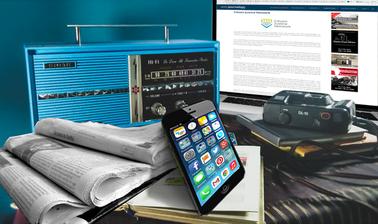
Media literacy helps us understand, analyze and create media. While we rely on good journalism to provide accurate information, we also have responsibilities of our own in this media-saturated environment. We can no longer be passive consumers of media. We need to be active users of media, as readers, listeners, viewers and creators, so we are all better informed. Our goal is to help you do just that.

Class Deals by MOOC List - Click here and see EdX's Active Discounts, Deals, and Promo Codes.

In this course, you'll hear from some amazing folks who are part, or keen observers, of the news industry—including, among many others, Wikipedia's Jimmy Wales, craigslist founder Craig Newmark, New York Times Public Editor Margaret Sullivan, and Buzzfeed editor Ben Smith.

You'll learn to:

  • Describe the changes that have transformed the way we create and consume media
  • List essential principles for being an active media consumer
  • Evaluate the tools and techniques of media creation
  • Employ a “slow news” approach, especially as a consumer of news

Syllabus

Week 1 – How media have changed; key principles for becoming an active user of media; and why media/news literacy is so important in a data-saturated environment. What it means to be a critical thinker.
Week 2 – Be skeptical of everything, but not equally skeptical of everything. Why judgement is so important. More on why we all need a personal credibility scale. We’ll look at the two-sides fallacy, understanding risk (statistical), social media and the velocity of information.
Week 3 – BS detection with Howard Rheingold. Slant vs. opinion; astroturfing and native advertising, where to find credible information.
Week 4 – Opening our minds: Escaping echo chambers and filter bubbles. Recognizing “confirmation bias” in ourselves, not just others. Seeking out opposing views and other cultural worldviews.
Week 5 – Literacy is also creation: Principles of creating media with integrity: Ownership of media, tools for creating media, legal and ethical issues in media creation, integrity in creating media.
Week 6 – Trust and reputation in a saturated media landscape. How media providers engender trust (or mistrust), fact-checking, transparency, community. How we in the audience can help our information providers be more trustworthy. Why we – audiences and information providers alike – need to adopt a “slow news” approach.
Week 7 - Next steps: How you can put all of this into long-term action; why you should be a media literacy advocate (and how to do it). Plus: resources for parents and teachers.
Go to Class
MOOC List is learner-supported. When you buy through links on our site, we may earn an affiliate commission.

Related Courses

Understanding the Music Business: What is Music Worth? (Coursera) Coursera
Vanderbilt University

Understanding the Music Business: What is Music Worth? (Coursera)

This course will examine the music industry in the United States, with the unique perspective gained by Vanderbilt University’s location in Nashville, TN. Nashville is a major center of music in the United States, and the music created here has a global reach, particularly in the country, rock, pop, singer-songwriter, and Americana genres. However, students will learn that the basic principles of recording, marketing, copyright, licensing, and live performance are the same, regardless of musical style or genre.

Sep 14th 2026
5-12 Weeks
Education aux médias et à l'information à l'ère du numérique (eFAN) (FUN) FUN
ENS Cachan,ENS de Lyon

Education aux médias et à l'information à l'ère du numérique (eFAN) (FUN)

L’objectif de ce cours est de faire le point sur les questions d’éducation aux médias et à l’information dans le contexte actuel du déploiement d’Internet et des réseaux sociaux et de l’utilisation généralisée de dispositifs numériques d’accès et de traitement de l’information. Comment décrypter et comprendre les transformations en cours, mettre en place des formations sur ces questions et aider des apprenants à développer des capacités d’action ?

No sessions available
5-12 Weeks
Games, Sensors and Media (Coursera) Coursera
University of California, Irvine

Games, Sensors and Media (Coursera)

You will learn to make fluid digital interactive experiences that are suitable for gaming and use the advanced sensor hardware built into the iPhone and iPad. This includes drawing 2D graphics, playing sounds and music, integrating with Game Center, the iOS physics engine and detecting device orientation and location.

Aug 31st 2026
4 Weeks
Media and Society (saylor.org) Saylor Academy
Saylor.org

Media and Society (saylor.org)

Do you know what you’re watching? What you’re reading? You might think that what comes across your television or web browser, in your newspaper or magazine, or on your movie screen is pretty much the whole message; what you see is what you get. But the content we see, read, and hear is the product of complex forces − economic, governmental, historical, and technological.

Legacy Course
Self-Paced
Introduction to Digital Journalism (Canvas.net) Canvas Network
University of California, Irvine

Introduction to Digital Journalism (Canvas.net)

Digital technology is revolutionizing news delivery and the information demands of today’s audience are redefining the meaning of the word “news.” Get an overview of how to report the news and create digital content for an online publication. Explore the options journalists have to deliver news in a world where people control their news choices and can make their own media.

Nov 3rd 2014
4 Weeks
Why Does Media Matter for Development? (FutureLearn) FutureLearn
University of East Anglia

Why Does Media Matter for Development? (FutureLearn)

Explore how the media can help to tackle poverty and inequality all around the world. Learn why the media matters for international development. This comprehensive four-week course will show you the ways that international development is conceptualised, imagined and communicated as an area of study. You’ll decipher the ways in which these understandings impact individuals living in different parts of the world, and how the media can shape, address and enhance key ideas and debates.

Jun 20th 2022
4 Weeks
Traitement médiatique du changement climatique : le niveau des mers (FUN) FUN
Université de Versailles Saint-Quentin-en-Yvelines - UVSQ

Traitement médiatique du changement climatique : le niveau des mers (FUN)

L’impact du changement climatique sur les écosystèmes, l’économie, l’énergie, la santé et la société rend cruciale sa compréhension par le grand public. Par ailleurs, les décisions politiques, de l’échelle locale au niveau international, peuvent dépendre des questions climatiques et environnementales et les impacter également. Force est de constater que le niveau de compréhension des enjeux autour du climat est toujours mal appréhendé par les citoyens et de les décideurs, mais aussi par les "relais" chargés de leur transmettre les informations scientifiques, que sont les journalistes et les communicants.

No sessions available
5-12 Weeks
Secure Passwords (Totem) Totem
Totem project

Secure Passwords (Totem)

Pa$$word123, really? Follow your guide to good password management. By this point in the evolution of technology, most of us have a fairly large number of online accounts to keep track of, and to keep safe. It seems like we need multiple accounts for everything - email, messaging, social media, shopping, banking, project-managing, file-sharing, etc, etc - it’s all a bit endless.

Self Paced
Self-Paced
Psychologie de la négociation (edX) EdX
LouvainX,Université Catholique de Louvain - UCL

Psychologie de la négociation (edX)

Plongez au cœur des mécanismes psychologiques qui entrent en jeu dans les situations de négociation. Dive into the heart of the psychological mechanisms at play in negotiations. Souvent confinée à l’étude des techniques permettant de vendre une encyclopédie en 24 volumes à une octogénaire récalcitrante ou à l’art de marchander son salaire, la négociation est souvent abordée sous un angle exclusivement utilitariste. Mais négocier ce n’est pas se limiter à la recherche du bénéfice maximum. La négociation traverse toutes les dimensions de la vie humaine. Nous négocions tous les jours, dans toutes les sphères de notre existence : au travail, avec la famille, les amis… Dès qu’il s’agit de partager des biens matériels mais aussi de résoudre une divergence d’intérêts, de concilier différentes envies, rêves, goûts, couleurs…

Self Paced
Self-Paced