EdX

Math in Sports (edX)

Math in Sports (edX)

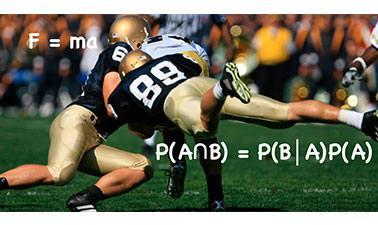
In this course you will learn to use some mathematical tools that can help predict and analyze sporting performances and outcomes. This course will help coaches, players, and enthusiasts to make educated decisions about strategy, training, and execution. We will discuss topics such as the myth of the Hot Hand and the curse of the Sports Illustrated cover; how understanding data can improve athletic performance; and how best to pick your Fantasy Football team.

Class Deals by MOOC List - Click here and see EdX's Active Discounts, Deals, and Promo Codes.

We will also see how elementary Calculus provides insight into the biomechanics of sports and how game theory can help improve an athlete’s strategy on the field.

In this course you will learn:

  • How a basic understanding of probability and statistics can be used to analyze sports and other real life situations.
  • How to model physical systems, such as a golf swing or a high jump, using basic equations of motion.
  • How to best pick your Fantasy Football, March Madness, and World Cup winners by using ranking theory to help you determine athletic and team performance.

By the end of the course, you will have a better understanding of math, how math is used in the sports we love, and in our everyday lives.

What you'll learn
Draw conclusions from mathematical analysis using inductive reasoning
Evaluate data using principles of probability
Assess risk and develop strategies that drive event outcomes
Model physical processes in order to predict (or change) outcomes
Show less


Go to Class
MOOC List is learner-supported. When you buy through links on our site, we may earn an affiliate commission.

Related Courses

Global Warming Science (edX) EdX
MIT,MITx

Global Warming Science (edX)

Learn about the physics, chemistry, biology, and geology of the earth’s climate system. Global Warming Science teaches you about the risks and uncertainties of future climate change by examining the science behind the earth’s climate. You will be able to answer such questions as, “What is the Greenhouse Effect?” and “How and why has earth’s climate changed through geologic history?”

No sessions available
13-24 Weeks
Quantum Mechanics for Everyone (edX) EdX
Georgetown University,GeorgetownX

Quantum Mechanics for Everyone (edX)

Learn the fundamental notions of quantum mechanics at a level that is accessible to everyone. Quantum Mechanics for Everyone is a six-week long MOOC that teaches the basic ideas of quantum mechanics with a method that requires no complicated math beyond taking square roots (and you can use a calculator for that).

Jun 8th 2023
5-12 Weeks
Semiconductor Fundamentals (edX) EdX
Purdue University,PurdueX

Semiconductor Fundamentals (edX)

From smartphones to satellites, semiconductors are everywhere. Tying together physics, chemistry, and electrical engineering, this easy-to-follow introduction provides the background needed to understand devices such as transistors and solar cells. This course provides the essential foundations required to understand the operation of semiconductor devices such as transistors, diodes, solar cells, light-emitting devices, and more.

Jan 9th 2023
5-12 Weeks
Introduction to Statistics: Descriptive Statistics (edX) EdX
University of California, Berkeley,BerkeleyX

Introduction to Statistics: Descriptive Statistics (edX)

An introduction to descriptive statistics, emphasizing critical thinking and clear communication. We are surrounded by information, much of it numerical, and it is important to know how to make sense of it. Stat2x is an introduction to the fundamental concepts and methods of statistics, the science of drawing conclusions from data.

No sessions available
4 Weeks
Is this Physics or Magic? Learning Physics through Minds-on Science Demonstration (edX) EdX
National University of Singapore,NUS

Is this Physics or Magic? Learning Physics through Minds-on Science Demonstration (edX)

Is this MOOC an introduction to Physics or Magic? Here's calling all curious minds from every corner of the globe to join us to learn physics via science demonstrations which are exciting, visually appealing and thought provoking. In this MOOC, you'll get to witness how demonstrations can add reality and vividness to the process of concept formation, and pick up one or two scientific nuggets along the way.

Sep 5th 2023
5-12 Weeks
Effective Thinking Through Mathematics (edX) EdX
University of Texas at Austin,UTAustinX

Effective Thinking Through Mathematics (edX)

Learn tools of effective thinking through puzzles and mathematics in this fun and fascinating course. A wondrously romantic belief is that brilliant thinkers magically produce brilliant ideas: Einstein jostles his hair and relativity falls out. We can enjoy these fanciful visions of leaps of genius, but we should not be fooled into believing that they’re reality.

Self Paced
Self-Paced
Differential Equations: Fourier Series and Partial Differential Equations (edX) EdX
MIT,MITx

Differential Equations: Fourier Series and Partial Differential Equations (edX)

Learn to use Fourier series to solve differential equations with periodic input signals and to solve boundary value problems involving the heat equation and wave equation. Differential equations are the mathematical language we use to describe the world around us. Many phenomena are not modeled by differential equations, but by partial differential equations depending on more than one independent variable.

Mar 22nd 2023
5-12 Weeks
Valoración de futbolistas con el método AHP (edX) EdX
Universitat Politècnica de València,UPValenciaX

Valoración de futbolistas con el método AHP (edX)

Aprenderás a utilizar el método AHP para seleccionar de forma objetiva el mejor jugador para una posición o estimar el valor de su traspaso. ¿Quieres ser capaz de valorar de forma analítica a Cristiano Ronaldo o a Fernando Torres usando el Proceso Analítico Jerárquico (AHP), método empleado a nivel mundial para la valoración de todo tipo de activos?

Self Paced
Self-Paced
Calculus 1C: Coordinate Systems & Infinite Series (edX) EdX
MIT,MITx

Calculus 1C: Coordinate Systems & Infinite Series (edX)

Master the calculus of curves and coordinate systems; approximate functions with polynomials and infinite series. Part 3 of 3. How did Newton describe the orbits of the planets? To do this, he created calculus. But he used a different coordinate system more appropriate for planetary motion. We will learn to shift our perspective to do calculus with parameterized curves and polar coordinates. And then we will dive deep into exploring the infinite to gain a deeper understanding and powerful descriptions of functions.

Feb 15th 2023
13-24 Weeks