EdX

Make Your Own App (edX)

Make Your Own App (edX)

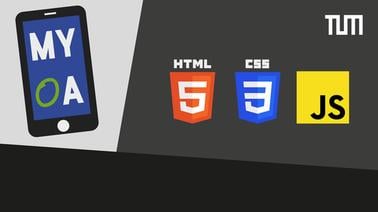
Over 6 modules you will interactively learn the basics of web programming (HTML, CSS, JavaScript, jQuery, ...) and how to utilize these techniques to build your own software applications for mobile or desktop devices (exemplified with a chat app).

Class Deals by MOOC List - Click here and see EdX's Active Discounts, Deals, and Promo Codes.

Using motivational videos, introductory sections, an interactive code editor, challenges and peer review throughout this course you will develop a working chat app. While doing so you can earn credits and points, receive badges and fulfill achievements in order to be able to see and compare your progress with other students. Starting with simple HTML content and ordinary CSS rules you will gradually improve your app and add increasing interaction within every week using JavaScript and JQuery. After completing this course you’ll be able to tackle almost any idea you might have and build an app that fulfills your needs.

What you'll learn

  • HTML, CSS and JavaScript basics
  • How to structure HTML code, including media elements, referencing external resources and separate CSS styles from HTML code
  • How to make web apps interactive
  • How to use advanced CSS properties to create captivating apps and understand and apply basic programming concepts like loops and arrays
  • Advanced JavaScript concepts and a basic introduction to web-APIs, JSON and AJAX

Course Syllabus

Topics

· HTML
o Notation, concept, structure
o Best practices, coding conventions
o Input, media, content elements
o Classes, IDs, addressing elements

· CSS
o Notation, concept, structure
o Best practices, coding conventions
o Inline styles
o Separate style sheets
o Key-value pairs
o Colors, backgrounds, fonts, shadows, borders…
o Box model, different box-styles and their properties
o Positioning, aligning
o Pseudo-Elements

· JavaScript
o Notation, concept, structure
o Best practices, coding conventions
o Manipulate HTML
o JQuery
o Functions, variables, operators
o Constructors
o Data-Structures
o Conditional expressions, loops
o This, callbacks, event methods

Week 1
We provide an instruction to the notation and concept of the Hyper-Text-Markup-Language (HTML) and teach you the basics of CSS allowing you to adapt the style and appearance of your HTML code.

Week 2
We educate you on structuring HTML code, including media elements, referencing external resources and teach you how to separate CSS styles from HTML code, continue styling your code and learn more about the box model, since your code has become more mature.

Week 3
We deepen your understanding of HTML and CSS by applying advanced properties and lay the foundation for the following sections by introducing JavaScript.

Week 4
We will teach you how to make web apps interactive. We will dive deeper into JavaScript and its mechanisms and introduce advanced debugging tools as well as JQuery.

Week 5
This week you will learn how to use advanced CSS properties to let the application appear captivating and get to understand and apply basic programming concepts like loops and arrays.

Week 6
We will improve the apps performance by applying advanced JavaScript concepts and give you a basic introduction to web-APIs, JSON and AJAX.

Exercises
Each week includes several problems that you should solve, including quizzes as well as a peer review challenge you should solve and will then grade four of your fellow learners.
Additionally, you will have to write source code in the three languages covered in an interactive code editor that provides you with instant feedback and enables you to earn several badges and achievements.

Go to Class
MOOC List is learner-supported. When you buy through links on our site, we may earn an affiliate commission.

Related Courses

Full Stack Application Development Project (edX) EdX
IBM

Full Stack Application Development Project (edX)

For this project you will apply your knowledge of front end and back end development gained from previous courses and build and deploy a full stack real-world web application on the cloud. Your project will showcase your understanding of the user experience and user interface design process, and your skills and technologies with Django, Python, Node.JS and Containers.

Self Paced
Self-Paced
MATLAB et Octave pour débutants (edX) EdX
École Polytechnique Fédérale de Lausanne,EPFLx

MATLAB et Octave pour débutants (edX)

Premiers pas dans MATLAB et Octave avec un regard vers le calcul scientifique. Commencer à utiliser un logiciel est toujours délicat, on ne sait jamais par où commencer. Dans ce cours nous allons nous concentrer sur la maîtrise d’Octave et MATLAB, de façon à pouvoir par la suite continuer à apprendre de manière indépendante.

Self Paced
Self-Paced
Introduction to the Internet of Things (edX) EdX
Universitat Politècnica de València,UPValenciaX

Introduction to the Internet of Things (edX)

This is a preliminary course in which we deal with the basics of electronics and programming using Arduino and ESP boards. Internet of Things (IoT) is the present and the future of technology. Either, if you have none, few or some experience with electronics and you want to develop it projects this course will give you the necessary kick start to start creating amazing devices capable of sensing, controlling physical signals.

Self Paced
Self-Paced
How to Code: Complex Data (edX) EdX
The University of British Columbia,UBCx

How to Code: Complex Data (edX)

Learn how to design more complex programs, using new data structures, abstraction, and generative recursion. As your program requirements get more complex, you will find that simple additions to the design method make it easy to write well-structured and well-tested code that is easy to maintain. By learning how to capture common data and control structures using abstraction, your programs will get shorter and better tested.

Self Paced
Self-Paced
Python Data Structures (edX) EdX
University of Michigan,MichiganX

Python Data Structures (edX)

The second course in Python for Everybody explores variables that contain collections of data like string, lists, dictionaries, and tuples. Learning how to store and represent and manipulate data collections while a program is running is an important part of learning how to program.

Self Paced
Self-Paced
Fundamentos TIC para profesionales de negocios: Programación (edX) EdX
Universitat Politècnica de València,UPValenciaX

Fundamentos TIC para profesionales de negocios: Programación (edX)

¿Tienes que trabajar con las Tecnologías de la Información y te faltan conocimientos? Conoce los fundamentos de la programación software. Este curso forma parte de una serie de 5 cursos de introducción al uso de sistemas de información en las empresas que te introducirá en el apasionante mundo de las TIC.

Self Paced
Self-Paced
HTML5 Apps and Games (edX) EdX
World Wide Web Consortium - W3C,W3Cx

HTML5 Apps and Games (edX)

Today, developers are increasingly moving from native to HTML5-based apps. Increase your ability to design and deliver innovative services on the Web! Want to learn advanced HTML5 tips and techniques? This is the course for you! Find out more about the powerful Web features that will help you create great content and apps.

Self Paced
Self-Paced
Probability and Statistics in Data Science using Python (edX) EdX
University of California, San Diego,UC San DiegoX

Probability and Statistics in Data Science using Python (edX)

Using Python, learn statistical and probabilistic approaches to understand and gain insights from data. The job of a data scientist is to glean knowledge from complex and noisy datasets. Reasoning about uncertainty is inherent in the analysis of noisy data. Probability and Statistics provide the mathematical foundation for such reasoning.

Self Paced
Self-Paced
Introduction to Object-Oriented Programming with Java III: Exceptions, Data Structures, Recursion, and GUIs (edX) EdX
Georgia Institute of Technology,GTx

Introduction to Object-Oriented Programming with Java III: Exceptions, Data Structures, Recursion, and GUIs (edX)

Learn how to create and use exceptions, data structures, recursion, and graphical user-interfaces (GUIs). This course provides students with the knowledge to handle and even create exceptions to achieve graceful error handling in programs. They will also create and utilize data structures, including lists and files. Students will also learn about recursion and how it can be a useful approach to repetition in a program. Finally, students will learn how to develop basic graphical user interfaces (GUIs) using JavaFX.

Self Paced
Self-Paced