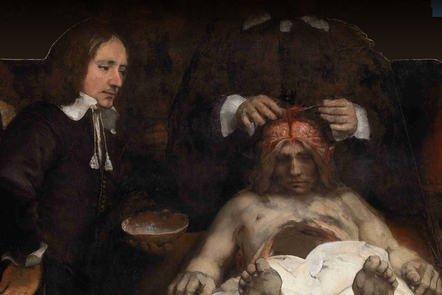
Language Testing During Awake Brain Surgery (FutureLearn)

Language Testing During Awake Brain Surgery (FutureLearn)

Discover the importance and the process of language testing during awake brain surgery. Language representation in the brain can be studied by testing language during awake brain surgery. In this course, you will get to know the importance of neurolinguistics and awake brain surgery by seeing the collaboration between surgical staff and neurolinguists before, during and after the operation.

Class Deals by MOOC List - Click here and see FutureLearn's Active Discounts, Deals, and Promo Codes.

You will also learn how to develop appropriate language tests for use during awake brain surgery and explore some of the latest developments in this field.

What topics will you cover?

  • Neuroatonomy of the brain
  • Language representation in the brain
  • Brain tumors
  • Awake brain surgery
  • Tailor-made language tests
  • Language testing during awake brain surgery
  • Neurotechnology

What will you achieve?
By the end of the course, you'll be able to...

  • Identify the complexity of the language representation in the brain
  • Explain the necessity of awake brain surgery
  • Describe the procedure including direct electrical stimulation (DES)
  • Identify the prerequisites of a good language test
  • Describe the complexity of developing a language test battery for LTABS
  • Evaluate the developments of the field

Who is the course for?
The course has been created for healthcare professionals involved in the procedure of awake surgery, including neurosurgeons and neurosurgical teams but also neurolinguists and clinical linguists who wish to start developing language tests.
Equally, it will be relevant for anyone involved in the procedure before, during and after awake brain surgery including neuro-anaesthesiologists, neuropsychologists, nursing staff and neurologists.
It also delivers useful information for patients with brain tumours and their proxies, to inform them about the surgical procedure they are about to undergo as well as anyone else intrigued by the topic.


Go to Class
MOOC List is learner-supported. When you buy through links on our site, we may earn an affiliate commission.

Related Courses

A Beginners' Guide to Writing in English for University Study (FutureLearn) FutureLearn
University of Reading

A Beginners' Guide to Writing in English for University Study (FutureLearn)

Learn how to use English for study at university or college and develop your writing skills, vocabulary and grammar. Academic writing can be very different from other types of written English. This course has been developed to help you learn the basics of academic writing and develop your English language skills.

Self Paced
5-12 Weeks
Moi, prof de FLE (FUN) FUN
Université de Liège

Moi, prof de FLE (FUN)

Le MOOC « Moi, prof de FLE » est le fruit d’une collaboration entre l’Institut Supérieur des Langues Vivantes et le Département de Langues et Littératures françaises et romanes de l’Université de Liège. Il s’articule autour des grandes questions que se pose un enseignant de français langue étrangère et seconde : quelles sont les caractéristiques d’une classe de FLE et les motivations de ses participants ? Comment gérer une classe de FLE et y organiser des leçons stimulantes pour encourager la participation des apprenants ?

No session available
5-12 Weeks
AP® Psychology - Course 3: How the Mind Works (edX) EdX
The University of British Columbia,UBCx

AP® Psychology - Course 3: How the Mind Works (edX)

Learn about the neuroscience and psychology of the mind including memory, thinking, reasoning, and language. In this psychology course, you will learn about the mind and the psychology of learning, including coverage of classical conditioning, operant conditioning, and social learning. We will look at the psychology and neuroscience of cognition — including memory, thinking and reasoning. The course will conclude with the coverage of language.

Self Paced
Self-Paced
Latino: forme e circolazione nella pars Orientis dell’Impero (Federica Web Learning) Federica Web Learning
University of Naples Federico II

Latino: forme e circolazione nella pars Orientis dell’Impero (Federica Web Learning)

Se per l’Occidente mancano testimonianze che non siano quelle indirette di trattazioni specifiche come l’Institutio oratoria di Quintiliano, l’Oriente ha restituito una serie di testimoni diretti delle forme dell’insegnamento del latino,tra I a.C. e VI d.C.: favorita fondamentalmente dall’occupazione militare e dai bisogni dell’amministrazione per tutta la prima età imperiale, nelle province eccentriche dell’Impero, la circolazione del latino venne ulteriormente incentivata da una politica che lo identificava con la lingua dell’amministrazione (e del diritto) a partire dal III secolo. Continuo, infatti, è il contatto dei latinofoni con allofoni che, spesso, si misero alla prova con l’apprendimento della lingua di Roma.

Apr 12th 2017
5-12 Weeks
Business English: Finance and Economics (Coursera) Coursera
Arizona State University

Business English: Finance and Economics (Coursera)

Do you work in finance or interact with finance professionals? Is it necessary to speak, write or understand English in your career? Follow the authentic characters in this course as they work through common business situations in finance and economics. Learn from your successes and failure, and think critically about your own communication options.

Oct 12th 2026
5-12 Weeks
Towards language universals through lexical semantics: introduction to lexical and semantic typology (Coursera) Coursera
Higher School of Economics - HSE University

Towards language universals through lexical semantics: introduction to lexical and semantic typology (Coursera)

The aim of the course is to obtain the idea of the lexicon as a complex system and to get the methodology of the typological approach to the lexicon cross-linguistically, as well as to learn about the general mechanisms of semantic shift and their typological relevance. By the end of the course the students should know the basic principles of lexical organization, the main parameters of semantic variations in lexicon, and be able to apply the basic methods of the analysis of lexical meaning to different lexical domains.

Aug 8th 2022
5-12 Weeks
Adventures in Writing (Stanford Online) Lagunita Stanford Online
Stanford University

Adventures in Writing (Stanford Online)

Welcome to Adventures in Writing, a series of graphic-novel style learning modules designed to help you learn more about and practice a range of effective written communication skills. You’ll immerse yourself in the adventures of Maya and Chris, using each module’s interactive exercises to apply what you’ve learned.

Self Paced
Self-Paced
Neurosciences : audition, langage et musique (FUN) FUN
Université libre de Bruxelles

Neurosciences : audition, langage et musique (FUN)

De la berceuse chantée au bébé jusqu’au discours enflammé du politicien et ses intonations, du chanteur sous la douche au pianiste virtuose, le langage et la musique font partie de notre vie sociale, intellectuelle et affective tout au long de notre vie. Comment ces informations sont-elles traitées par le cerveau ? Comment est-on capable de déduire l’état émotionnel d’autrui à partir de la mélodie de sa voix, sa prosodie ? Comment la voix est-elle modifiée pendant un épisode émotionnel, quels sont les mécanismes cérébraux à l’œuvre ? Est-ce que l’apprentissage de la musique modifie la structure du cerveau ?

No sessions available
5-12 Weeks
Easy Way to Technical Writing (Stepik) Stepik
Instructor Made Course

Easy Way to Technical Writing (Stepik)

The course is aimed at simplifying your approach to technical writing in English as well as explaining some grammar, vocabulary, and punctuation typical of this genre. It summarizes the main points of successful and up-to-date technical writing and reading process. Feel free to enroll and enjoy these clear, practical, easy-to-access and inspiring materials.

Self-paced
Self-Paced