Java Programming Basics (Udacity)

Offered by Udacity,
Java Programming Basics (Udacity)

Take your first steps towards becoming a Java developer! Learn Java syntax and create conditional statements, loops, and functions. Taking this course will provide you with a basic foundation in Java syntax, which is the first step towards becoming a successful Java developer. You’ll learn how computers make decisions and how Java keeps track of information through variables and data types.

Class Deals by MOOC List - Click here and see Udacity's Active Discounts, Deals, and Promo Codes.

You’ll learn to create conditional statements, functions, and loops to process information and solve problems. You’ll even learn to use IntelliJ, a Java IDE (Integrated Development Environment) that professional developers use, to build, compile, and debug your code. These are foundational programming skills, and mastering them is a must for all aspiring programmers. This course is the first in our Java Programming course series. After you complete this course, you'll be ready to take Object Oriented Programming in Java.

Syllabus

Lesson 1
How to write Java syntax and create variables

  • Discover the basic idea behind programing.
  • Write your first Java program.
  • Use variables to store and retrieve information.

Lesson 2
Using Methods and Conditional Statements

  • Use if-else statements and switch-case statements.
  • Write Java programs to tackle any decision making scenario.

Lesson 3
How to create functions

  • Create functions in Java.
  • Declare methods with input arguments and return types.
  • Call the functions you create.

Lesson 4
How to Create Loops

  • Use for and while loops to iterate over a block of code.
  • Learn how to write nested loops.
  • Use 2D arrays to store and retrieve information.

Lesson 5
IntelliJ and Debugging

  • Learn how to install and use the IntelliJ Integrated Development Environment (IDE).
  • Use the IDE to find and solve problems in code.

Go to Class
MOOC List is learner-supported. When you buy through links on our site, we may earn an affiliate commission.

Related Courses

Intro to AJAX (Udacity) Udacity
Udacity

Intro to AJAX (Udacity)

Making Asynchronous Requests with jQuery. In this course you will learn how to make asynchronous requests with JavaScript (using jQuery’s AJAX functionality), and gain a better understanding of what’s actually happening when you do so. You will also learn how to use data APIs so you can take advantage of freely accessible data in your applications, including photo results, news articles and up-to-date data about the world around us.

Self Paced
Self-Paced
Software Analysis & Testing (Udacity) Udacity
Georgia Institute of Technology,Udacity

Software Analysis & Testing (Udacity)

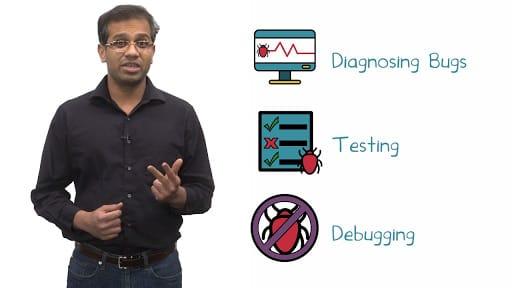
This course covers the theory and practice of software analysis, which lies at the heart of many software development processes such as diagnosing bugs, testing, debugging, and more. It presents diverse techniques, each with their own strengths and limitations, for automating tasks such as testing, debugging, and finding bugs in complex real-world programs. These techniques include dataflow analysis, constraint-based analysis, type systems, model checking, symbolic execution, and more. The course teaches the principles underlying these techniques as well as imparts hands-on experience with using and implementing tools based on these techniques.

Self Paced
Self-Paced
Responsive Images (Udacity) Udacity
Udacity,Google

Responsive Images (Udacity)

Fewer Bytes, Faster Loads. Did you know that images account for more than 60% of the bytes on average needed to load a web page? In this course you will learn how to work with images on the modern web, so that your images look great and load quickly on any device. Along the way, you will pick up a range of skills and techniques to smoothly integrate responsive images into your development workflow. By the end of the course, you will be developing with images that adapt and respond to different viewport sizes and usage scenarios.

Self Paced
Self-Paced
Learn Swift Programming Syntax (Udacity) Udacity
Udacity

Learn Swift Programming Syntax (Udacity)

From Optionals to Closure Expressions. Swift is a language created by Apple specifically for iOS and OS X development. It’s fast, concise, and comes with tools which make it easier than ever to visualize one's code. This course focuses on the syntax of the Swift programming language. By the end of the course, students should be able to apply Swift essentials to building iOS apps and employ Swift's more unique elements, like optional types and switch statements, with confidence.

Self Paced
Self-Paced
Data Wrangling with MongoDB (Udacity) Udacity
Udacity,MongoDB University

Data Wrangling with MongoDB (Udacity)

In this course, we will explore how to wrangle data from diverse sources and shape it to enable data-driven applications. Some data scientists spend the bulk of their time doing this! Students will learn how to gather and extract data from widely used data formats. They will learn how to assess the quality of data and explore best practices for data cleaning. We will also introduce students to MongoDB, covering the essentials of storing data and the MongoDB query language together with exploratory analysis using the MongoDB aggregation framework.

Self Paced
Self-Paced
Intro to JavaScript (Udacity) Udacity
Udacity

Intro to JavaScript (Udacity)

Learn the fundamentals of JavaScript, the most popular programming language in web development. JavaScript is the most popular programming language for both front-end and back-end web development. Applications for JavaScript span from interactive websites to the Internet of Things, making it a great choice for beginners and experienced developers looking to learn a new programming language.

Self Paced
Self-Paced
JavaScript and the DOM (Udacity) Udacity
Udacity

JavaScript and the DOM (Udacity)

Dynamically control the browser. JavaScript is an extremely powerful programming language. One place where its power truly shines is using it to control a web page. Through this course, you'll learn about the Document Object Model (DOM), how it's created, and what capabilities it provides. Then you'll use JavaScript and the DOM to add, delete, or alter page content; control page styling, and respond to user actions.

Self Paced
Self-Paced
Intro to jQuery (Udacity) Udacity
Udacity

Intro to jQuery (Udacity)

Manipulating Websites with Ease. jQuery is the most popular JavaScript library today, in use by over 60% of the top 100,000 most visited websites. This course will teach you how to use jQuery’s core features - DOM element selections, traversal and manipulation. You'll also learn how to read and make sense of jQuery's documentation, making it easy for you to go beyond the methods taught in this class and take advantage of jQuery's full array of features!

Self Paced
Self-Paced