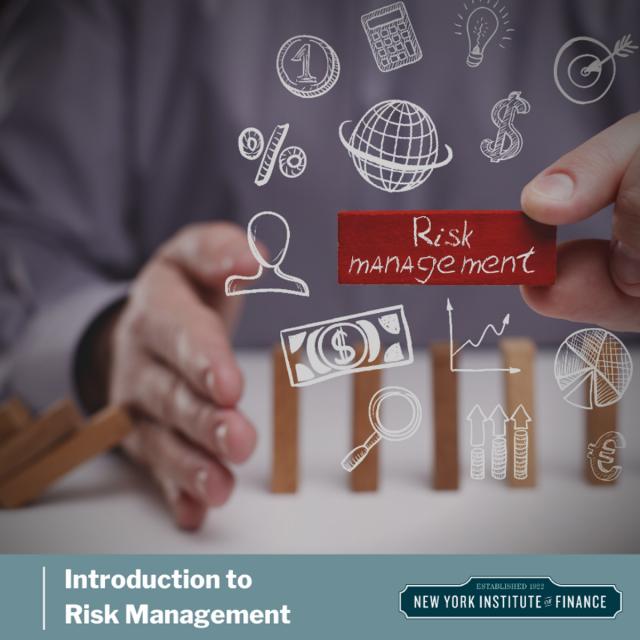
Introduction to Risk Management (Coursera)

Introduction to Risk Management (Coursera)

What is risk? Why do firms manage risk? In this course, you will be introduced to the different types of business and financial risks, their sources, and best practice methods for measuring risk. This course will help you gauge different risk types and set risk limits, describe the key factors that drive each type of risk, and identify the steps needed to choose probability distributions to estimate risk.

Class Deals by MOOC List - Click here and see Coursera's Active Discounts, Deals, and Promo Codes.

You will explore the history and development of risk management as a science, and financial and business trends that have shaped the practice of risk management. By the end of the course, you will have the essential knowledge to measure, assess, and manage risk in your organization.
To be successful in this course, you should have a basic knowledge of statistics and probability and familiarity with financial instruments (stocks, bonds, foreign exchange, etc). Experience with MS Excel and Python recommended.

What You Will Learn

  • Differentiate between financial and business risks
  • Examine the key concepts and factors of risk measurement
  • Understand the application of risk modeling
  • Understand the principles of risk management

Syllabus

WEEK 1
Getting Started
This course will introduce you to different types of business and financial risk. You will learn how these risks are measured and also gain an understanding of the goals and benefits of risk management. The skills that you will gain by the end of this course will enable you to measure and manage risk in your organization.

WEEK 2
Overview of Risk Management
In this module, you will learn about financial and business risks. You will also get introduced to the various types of financial risks and learn about their sources and how firms manage risks. We'll also look at the difference between risk measurement and risk management. Let's get started.

WEEK 3
Types of Business and Financial Risks
In this module, you will learn about the four main types of financial risk. You will then learn about the best measures to use to gauge different risk types and set risk limits. You will also learn how investment managers maximize portfolio returns while keeping risk within their tolerances and then apply these techniques to a portfolio you will construct.

WEEK 4
Module 03: Money & Capital Markets and Regulatory
In this module, you will learn the difference between Money and Capital markets. You will also learn to differentiate among the 3 regulatory structures - US, UK, and EU and understand how regulatory structures impact your firm.

WEEK 5
Module 04: Introduction to Risk Modeling
In this module, you will learn about the factors that drive each type of risk and then use these factors to create distributions (density functions). You will explore non-parametric measures of loss distributions such as scenario analysis and stress testing.

WEEK 6
End of Course
You've come to the end of the course. Let's wrap up with a quick summary of the key takeaways of this course.

Go to Class
MOOC List is learner-supported. When you buy through links on our site, we may earn an affiliate commission.

Related Courses

Firm Level Economics: Consumer and Producer Behavior (Coursera) Coursera
University of Illinois at Urbana-Champaign

Firm Level Economics: Consumer and Producer Behavior (Coursera)

All goods and services are subject to scarcity at some level. Scarcity means that society must develop some allocation mechanism – rules to determine who gets what. Over recorded history, these allocation rules were usually command based – the king or the emperor would decide. In contemporary times, most countries have turned to market based allocation systems. In markets, prices act as rationing devices, encouraging or discouraging production and encouraging or discouraging consumption in such a way as to find an equilibrium allocation of resources.

Jun 29th 2026
4 Weeks
Accounting: Principles of Financial Accounting (Coursera) Coursera
IESE Business School

Accounting: Principles of Financial Accounting (Coursera)

Financial Accounting is often called the language of business; it is the language that managers use to communicate the firm's financial and economic information to external parties such as shareholders and creditors. Nobody working in business can afford financial illiteracy. Whether you run your own business, work as a manager or are just starting your career, you want to understand financial information and be able to interact with accountants, controllers, and financial managers. You want to talk business!

Jun 29th 2026
4 Weeks
European Business Law: Doing Business in Europe (Coursera) Coursera
Lund University

European Business Law: Doing Business in Europe (Coursera)

This six-week course titled Doing Business in Europe is the second in a series of three exploring some of the main business aspects of European Union law. Besides providing learners with a sound knowledge base of European laws and regulations relevant to establishing and managing a company within the European Union, the course also explores business considerations within a broader perspective by including inputs from leading law practitioners in the field.

Jun 29th 2026
5-12 Weeks
Gestión de marca y producto (Coursera) Coursera
IE Business School

Gestión de marca y producto (Coursera)

Luego de tomar este curso será capaz de identificar la información crítica que se necesita para desarrollar estrategias de marca y de producto que logren resultados inmediatos y también generen valor en el largo plazo. Estará en capacidad de crear un plan de actividades para hacer que su estrategia de marca se haga realidad (tanto externamente para los consumidores como internamente para los empleados).

Jun 29th 2026
4 Weeks
Negocios Internacionales II (Coursera) Coursera
University of New Mexico

Negocios Internacionales II (Coursera)

Vivimos en un mundo cada vez mas globalizado, en el cual el éxito en los negocios internacionales se ha convertido en el factor determinante del desarrollo económico y la prosperidad. Esta materia, Entorno Global de Negocios, Parte II, sigue a la primera materia (Entorno Global de Negocios, Parte I) e introduce al alumno a una comprensión fundamental de como administrar una organización o empresa internacional.

Jun 29th 2026
5-12 Weeks
Influencing People (Coursera) Coursera
University of Michigan

Influencing People (Coursera)

This course will improve your ability to influence people in situations where you cannot use formal authority. You will learn about effective ways to build, develop, and sustain a power base in your organization. You will also learn influence tactics that enable you to be more persuasive and influential in working with your superiors, peers, and even subordinates. In addition, you will learn how to build and maintain high-quality relationships to further maximize your informal power and ability to influence others. Importantly, you will distinguish between influence and manipulation and learn how to protect yourself from the unwanted influence of others.

Jun 29th 2026
4 Weeks
Strategic Planning and Execution (Coursera) Coursera
University of Virginia

Strategic Planning and Execution (Coursera)

Avoid the pitfalls of strategy planning and execution with the tools and skills from this course. You'll learn the pillars of strategy execution--analysis, formulation, and implementation--and how to use the 4A model to effectively approach strategy execution. Finally, a panel of leaders from entrepreneurs, nonprofits, and industry, share their expertise gleaned from years of successful strategy planning and execution.

Jun 29th 2026
4 Weeks