EdX

Interdisciplinary Teaching with Museum Objects (edX)

Offered by Smithsonian, SmithsonianX,
Interdisciplinary Teaching with Museum Objects (edX)

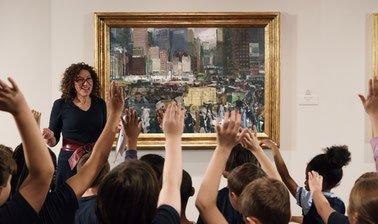
Educators from four Smithsonian museums will explore connections among their collections and model teaching strategies that participants can implement with their students, whether online or in the classroom. Teachers, don't miss this special opportunity to learn with four Smithsonian museums from home!

Class Deals by MOOC List - Click here and see EdX's Active Discounts, Deals, and Promo Codes.

Register for this 14-week course and join an online community of educators for an immersive exploration of teaching with museum objects and works of art. Museum educators will explore connections among their collections and model teaching strategies that participants can implement with their students, whether online or in the classroom. Participants will discover how to teach with museum resources to engage students in deeper thinking and support content learning across disciplines. They'll learn to use the Smithsonian Learning Lab to curate digital resource collections, and share lesson ideas among a new network of colleagues.
Which Smithsonian Museums Will You Learn From?

  • National Museum of African American History and Culture
  • National Museum of American History
  • National Portrait Gallery
  • Smithsonian American Art Museum

Who Should Enroll?
Teachers of all subjects and grades are welcome to register. The program content will be most readily applicable to humanities teachers.
What is Required of Participants?
The course is self-paced, designed to be taken over the course of 14 weeks, with one to two hours of content assigned per week. Participants are expected to view all recorded video sessions and respond to reflection prompts using a discussion board.
Participants will also be expected to create a digital resource collection using the Smithsonian Learning Lab.

What you'll learn

  • Gain expertise from educators from multiple Smithsonian museums through recorded video sessions
  • Reflect and share ideas with a community of educators via discussion forums
  • Explore inquiry-based strategies for integrating museum objects and works of art into your teaching, whether in the classroom or online
  • Learn to use the Smithsonian Learning Lab to curate digital resource collections and share lesson ideas.
Go to Class
MOOC List is learner-supported. When you buy through links on our site, we may earn an affiliate commission.

Related Courses

That's So Meta(cognitive)! (edX) EdX
Smithsonian,SmithsonianX

That's So Meta(cognitive)! (edX)

That’s so Meta(cognitive)! — investigates how explicitly teaching students metacognitive strategies helps them become more effective learners, able to integrate knowledge rather than just memorize isolated science facts and definitions.

Self Paced
Self-Paced
Teaching Computational Thinking (edX) EdX
University of Canterbury,UCx

Teaching Computational Thinking (edX)

This course is for educators who are passionate the future of their 7-12+ year old students and want to learn more about teaching computer science in an engaging and meaningful way. This course is designed to show you how to teach computational thinking to children aged 7-12+. The course will be valuable to you, whether you are new to this approach or an enthusiastic practitioner.

Self Paced
Self-Paced
Teaching with Physical Computing: Practical application and classroom strategies for PBL (edX) EdX
Arm Education,ArmEducationX

Teaching with Physical Computing: Practical application and classroom strategies for PBL (edX)

This course guides you in using real-world problems to spark your learners’ creativity and empower them to develop their own solutions using Physical Computing. Brought to you by Arm, this course guides you through the practical application of Project-Based Learning (PBL) theory using a range of tools and techniques.

Self Paced
Self-Paced
Teaching Critical Thinking through Art with the National Gallery of Art (edX) EdX
Smithsonian,SmithsonianX

Teaching Critical Thinking through Art with the National Gallery of Art (edX)

Learn how to integrate works of art using Artful Thinking routines, effective strategies from Project Zero at Harvard University, in this online course for teachers of all levels and subjects. Based on the National Gallery of Art’s popular Art Around the Corner professional development program for teachers in Washington, D.C., this five-part online course provides everything you need to begin creating a culture of critical thinking and collaboration for any classroom, subject, or level.

Self Paced
Self-Paced
Teaching with Physical Computing: Soft skills, teamwork and the wider curriculum (edX) EdX
Arm Education,ArmEducationX

Teaching with Physical Computing: Soft skills, teamwork and the wider curriculum (edX)

Gain a comprehensive understanding of the ‘non-technical’ elements that make Project-Based Learning an important addition to STEM & Computing classrooms, and how to integrate them into your teaching. Brought to you by Arm, this course covers all the non-technological elements of Project-Based Learning. This includes soft skills such as gracious professionalism, teamwork, communication and collaboration.

Self Paced
Self-Paced
Classroom Strategies for Inquiry-Based Learning (edX) EdX
University of Texas at Austin,UTAustinX

Classroom Strategies for Inquiry-Based Learning (edX)

Learn inquiry-based classroom practices to engage students in education through exploration. Inquiry-based learning aims to increase student engagement by helping learners develop hands-on, minds-on skills. This education and teacher training course explores the 5E instructional model and its uses in the classroom. You will have the opportunity to learn from videos of classroom teachers modeling a 5E lesson and access teacher commentary as they use inquiry-based strategies with their students. As a result, you will develop the skills and strategies needed to implement inquiry-based instruction in your own classroom.

Self Paced
Self-Paced
Tangible Things: Discovering History Through Artworks, Artifacts, Scientific Specimens, and the Stuff Around You (edX) EdX
HarvardX,Harvard University

Tangible Things: Discovering History Through Artworks, Artifacts, Scientific Specimens, and the Stuff Around You (edX)

Gain an understanding of history, museum studies, and curation by looking at, organizing, and interpreting art, artifacts, scientific curiosities, and the stuff of everyday life. Have you ever wondered about how museum, library, and other kinds of historical or scientific collections all come together? Or how and why curators, historians, archivists, and preservationists do what they do?

Self Paced
Self-Paced
Sign Language Science: Factors Contributing to Natural Learning (edX) EdX
Georgetown University,GeorgetownX

Sign Language Science: Factors Contributing to Natural Learning (edX)

This course promotes a better understanding of the factors that may affect how people learn signed language. In this course, we will look at how multiple, varying factors can account for language-learning patterns. Age, for example, is a key factor that predicts fluency. Another topic of particular importance to signed languages is the mind.

Self Paced
Self-Paced
What Works in Education: Evidence-Based Education Policies (edX) EdX
Inter-American Development Bank - IDB,IDBx

What Works in Education: Evidence-Based Education Policies (edX)

Learn what works in education and how to identify, analyze and implement evidence-based education policies that improve learning. This course summarizes the main theoretical and practical research surrounding evidence-based education policies and delves into the key improvements and challenges observed in education systems in Latin America and the Caribbean.

Self Paced
Self-Paced