Inequality and Democracy (Coursera)

Offered by Universiteit Utrecht,
Inequality and Democracy (Coursera)

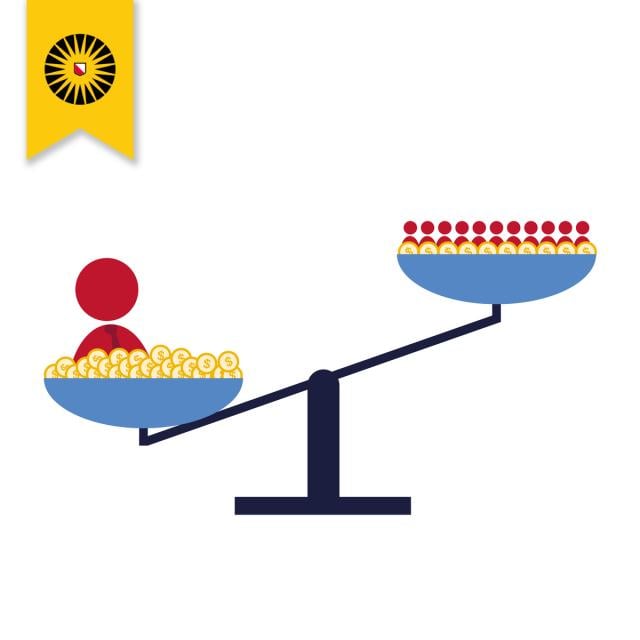
Most countries are getting more and more unequal. But the core of democracy is political equality: that everyone should have an equal say in how their country is run. Can we really expect these things to go together? Can people have equal political power while economic inequality grows and grows? Take this course and decide for yourself.

Class Deals by MOOC List - Click here and see Coursera's Active Discounts, Deals, and Promo Codes.

You’ll learn about:
• The rise of economic inequality
• Property rights and the corporation
• Democracy: Its value and history
• Campaign finance and lobbying
• Tax avoidance and capital flight
• Alternatives to our economic system
This is an interdisciplinary course combining:
• Politics
• Philosophy
• Economics
• History
• Law
Our course is for anyone looking for an accessible introduction to these topics. You might a concerned citizen, or someone who works in a field like politics, media, education, government or law. The difficulty level is similar to the first-year of an undergraduate degree. No prior knowledge is assumed.

Syllabus

WEEK 1: Economic inequality
WEEK 2: Property and corporations
WEEK 3: Democracy
WEEK 4: Lobbying and campaign finance
WEEK 5: Capital flight and tax avoidance
WEEK 6: Alternative economic institutions
Go to Class
MOOC List is learner-supported. When you buy through links on our site, we may earn an affiliate commission.

Related Courses

Structuring Values in Modern China (Coursera) Coursera
The Chinese University of Hong Kong

Structuring Values in Modern China (Coursera)

This sequence of four courses will propose a multi-disciplinary approach to the study of Chinese cultural history conceived of as a succession of modes of rationality (philosophical, bureaucratic, and economic). The focus will be on the moments of paradigm shift from one mode of rationality to another. For each of these moments, cultural facts and artifacts—thought, literature, ritual—will be examined in relationship to changing social, political, and economic systems.

Jun 22nd 2026
5-12 Weeks
Chinese Politics Part 1 - China and Political Science (Coursera) Coursera
The Hong Kong University of Science and Technology - HKUST

Chinese Politics Part 1 - China and Political Science (Coursera)

This course offers a conceptual framework for understanding China that highlights the intersection of politics and economics. It shows that rather than develop into a full blown market economy, state and party officials at all levels of the political system maintain significant influence in economic development. Such a “political” economy has had both positive and negative outcomes, which we will assess in detail.

Jun 22nd 2026
5-12 Weeks
Beyond the Sustainable Development Goals (SDGs): Addressing Sustainability and Development (Coursera) Coursera
University of Michigan

Beyond the Sustainable Development Goals (SDGs): Addressing Sustainability and Development (Coursera)

We’re excited you’re here! This course, “Beyond the Sustainable Development Goals (SDGs): Addressing Sustainability and Development,” is the first course in the upcoming Sustainability and Development MasterTrack Certificate program (Fall 2020), but you can also take this course as a stand-alone learning opportunity.

Jul 1st 2026
5-12 Weeks
Game Theory II: Advanced Applications (Coursera) Coursera
Stanford University,The University of British Columbia

Game Theory II: Advanced Applications (Coursera)

Popularized by movies such as "A Beautiful Mind", game theory is the mathematical modeling of strategic interaction among rational (and irrational) agents. Over four weeks of lectures, this advanced course considers how to design interactions between agents in order to achieve good social outcomes. Three main topics are covered: social choice theory (i.e., collective decision making and voting systems), mechanism design, and auctions.

Jun 22nd 2026
5-12 Weeks
The Holocaust - An Introduction (I): Nazi Germany: Ideology, The Jews and the World (Coursera) Coursera
Tel Aviv University,Yad Vashem

The Holocaust - An Introduction (I): Nazi Germany: Ideology, The Jews and the World (Coursera)

The Holocaust was an inconceivable historical event, which forever robbed Western culture of its innocence. As civilized human beings, we fail to understand how events of such horror could have taken place, and how an idea so inhumanly warped could have spread like wildfire through an entire continent, instigating the systematic annihilation of millions of Jews. This free online course was produced jointly by Tel Aviv University and Yad Vashem – the World Holocaust Remembrance Center. The course tracks the history of the Holocaust and has two parts.

Jun 29th 2026
3 Weeks
Financial Markets (Coursera) Coursera
Yale University

Financial Markets (Coursera)

An overview of the ideas, methods, and institutions that permit human society to manage risks and foster enterprise. Emphasis on financially-savvy leadership skills. Description of practices today and analysis of prospects for the future. Introduction to risk management and behavioral finance principles to understand the real-world functioning of securities, insurance, and banking industries. The ultimate goal of this course is using such industries effectively and towards a better society.

Jun 22nd 2026
5-12 Weeks
Paradoxes of War (Coursera) Coursera
Princeton University

Paradoxes of War (Coursera)

The Paradoxes of War teaches us to understand that war is not only a normal part of human existence, but is arguably one of the most important factors in making us who we are. Through this course, I hope that you will come to appreciate that war is both a natural expression of common human emotions and interactions and a constitutive part of how we cohere as groups. That is, war is paradoxically an expression of our basest animal nature and the exemplar of our most vaunted and valued civilized virtues.

Jun 29th 2026
13-24 Weeks
The Economics of AI (Coursera) Coursera
University of Virginia

The Economics of AI (Coursera)

The course introduces you to cutting-edge research in the economics of AI and the implications for economic growth and labor markets. We start by analyzing the nature of intelligence and information theory. Then we connect our analysis to modeling production and technological change in economics, and how these processes are affected by AI. Next we turn to how technological change drives aggregate economic growth, covering a range of scenarios including a potential growth singularity.

Jun 30th 2026
5-12 Weeks
Quantitative Foundations for International Business (Coursera) Coursera
University of London

Quantitative Foundations for International Business (Coursera)

This course provides the essential mathematics required to succeed in the finance and economics related modules of the Global MBA, including equations, functions, derivatives, and matrices. You can test your understanding with quizzes and worksheets, while more advanced content will be available if you want to push yourself. This course forms part of a specialisation from the University of London designed to help you develop and build the essential business, academic, and cultural skills necessary to succeed in international business, or in further study.

Jun 29th 2026
4 Weeks
Data Literacy Capstone – Evaluating Research (Coursera) Coursera
Johns Hopkins University

Data Literacy Capstone – Evaluating Research (Coursera)

This is the final course in the Data Literacy Specialization. In this capstone course, you'll apply the skills and knowledge you have acquired in the specialization to the critical evaluation of an original quantitative analysis. The project will first require you to identify and read a piece of high-quality, original, quantitative research on a topic of your choosing. You’ll then interpret and evaluate the findings as well as the methodological approach. As part of the project, you’ll also review other students’ submissions. By the end of the project, you should be empowered to be a critical consumer and user of quantitative research.

Jun 29th 2026
3 Weeks