EdX

Generative Modelling (edX)

Generative Modelling (edX)

This course focuses on generating spatial information models capturing various relationships and constraints. You will learn a set of advanced modelling techniques for generating spatial models. You will create multiple procedures that annotate and query your models using attribute data. By the end of the course, you will be able to create your own scripts consisting of multiple procedures working together to generate complex spatial information models.

Class Deals by MOOC List - Click here and see EdX's Active Discounts, Deals, and Promo Codes.

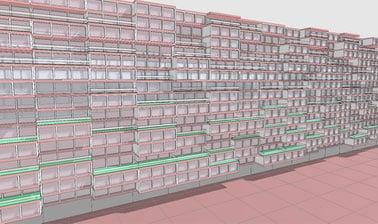
As part of our “Spatial Computational Thinking” program, this “Generative Modelling” course focuses on the generation of complex spatial information models capturing various relationships and constraints. You will learn how to tackle challenging problems by integrating multiple procedures that work together to generate spatial information models.
This course will build on the previous procedural modelling course. In this course, the complexity of the spatial information modelling tasks will increase, requiring a more advanced type of generative modelling approach. You will learn advanced generative modelling techniques, such as using law curves and resolving spatial constraints by implementing your own solvers. You will learn skeletal modelling strategies that make it easier to control the complexity of the generative process.
You will also learn a range of general mathematic techniques that are critical to basic types of spatial reasoning, including working with vectors, rays, and planes, and using various mathematical functions such as periodic functions, and dot product and cross product functions. You will also revisit the debugging process, learning how flowcharts can be used to isolate errors.
In the process, you will also further develop your coding skills. You will revisit the loops and conditional and discover how these can be nested to create more complex control flows. You will also discover how list and dictionary data structures can be nested to create more complex types of data structures.
The modelling exercises and assignments during this course will also become more advanced. The spatial information models will now represent complex buildings with a range of different types of components and parts, tagged with attributes and grouped into collections.
The course prepares you for the next and final course in the "Spatial Computational Thinking” program , focusing on performative modelling.

What you'll learn

Learning algorithmic thinking:

  • How parameters define a search space of possible configurations
  • How to decompose a problem by breaking it down into smaller sub-problems
  • Recognise underlying algorithmic principles within spatial configurations

Learning generative modelling:

  • Using skeletal modelling strategies to control model complexity
  • Modelling spatial relationships using law curves
  • Modelling with spatial constraints, for example, Floor-Area Ratio
  • Strategies for solving constraints
  • Creating simple constraint solvers using ‘for loops’
  • Pushing attributes through the topological hierarchy
  • Visualizing models with colour and materials
  • Understanding polygon normals and their impact on light
  • Importing and exporting geometric and geospatial data models

Learning coding:

  • Spatial reasoning with vector mathematics
  • Working with infinite planes and infinite rays
  • Modelling with periodic functions: sin(), cos(), tan()
  • Spatial reasoning using the dot product and cross product functions
  • Optimizing code to improve execution speed
  • Developing complex data structures using nested lists and dictionaries
  • Using nested loops and nested conditionals
  • Strategies for looping: using a counter or iterating over a list?
  • How to avoid deep nesting of loops using data structures

Learning Möbius Modeller:

  • Strategies for creating and debugging flowcharts
  • Documenting flowcharts and parameters
  • Publishing flowcharts online for others to interact with and explore
  • The Möbius Spatial Information data model
  • Interrogating models in the 3D viewer
  • Difference between local and global functions
  • Creating flowcharts that can be imported as global functions

Prerequisites:
Completion of Course-1: Procedural modellingof 'Spatial Computational Thinking'Professional Certificate program.

Go to Class
MOOC List is learner-supported. When you buy through links on our site, we may earn an affiliate commission.

Related Courses

Calculus through Data & Modelling: Techniques of Integration (Coursera) Coursera
Johns Hopkins University

Calculus through Data & Modelling: Techniques of Integration (Coursera)

In this course, we build on previously defined notions of the integral of a single-variable function over an interval. Now, we will extend our understanding of integrals to work with functions of more than one variable. First, we will learn how to integrate a real-valued multivariable function over different regions in the plane. Then, we will introduce vector functions, which assigns a point to a vector. This will prepare us for our final course in the specialization on vector calculus. Finally, we will introduce techniques to approximate definite integrals when working with discrete data and through a peer reviewed project on, apply these techniques real world problems.

Jun 8th 2026
4 Weeks
Calculus through Data & Modelling: Vector Calculus (Coursera) Coursera
Johns Hopkins University

Calculus through Data & Modelling: Vector Calculus (Coursera)

This course continues your study of calculus by focusing on the applications of integration to vector valued functions, or vector fields. These are functions that assign vectors to points in space, allowing us to develop advanced theories to then apply to real-world problems. We define line integrals, which can be used to fund the work done by a vector field. We culminate this course with Green's Theorem, which describes the relationship between certain kinds of line integrals on closed paths and double integrals.

Jun 8th 2026
3 Weeks
Introduction to Java Programming: Writing Good Code (edX) EdX
Universidad Carlos III de Madrid - UC3M,UC3Mx

Introduction to Java Programming: Writing Good Code (edX)

Learn to program in an easy and interactive way and enter the fascinating world of computer science. This is an introductory course to learn programming with Java designed to teach how to code good programs in Java, understanding “good” as both correct and efficient. Basic principles of software engineering will be introduced to make it easier for our future self and others to reuse code. Ethical issues and the intellectual property of our programs will also be addressed in the last part of this course. Examples and case studies will be provided, so that learners can implement simple but increasingly complex programs in Java.

Self Paced
Self-Paced
Dynamic Energy Modelling of Buildings: Thermal Simulation (edX) EdX
Delft University of Technology,DelftX

Dynamic Energy Modelling of Buildings: Thermal Simulation (edX)

Understand the dynamics of buildings’ thermal behavior and learn how to optimize their design and operation through thermal modeling. Many engineers are puzzled by questions such as: how to shift or reduce peak heating demand to obtain a better match with a smart grid or renewable energy system? What is thermally more efficient: a heavy concrete building or a light timber-frame building? How effective is night ventilation in warm periods? This course will provide you with the answers to these and many other questions related to dynamic thermal behavior in buildings.

Future dates to be announced
5-12 Weeks
Advanced Styling with Responsive Design (Coursera) Coursera
University of Michigan

Advanced Styling with Responsive Design (Coursera)

It used to be the case that everyone viewed webpages on about the same size screen. But with the explosion of the use of smartphones to access the Internet, the landscape of design has completely changed. People viewing your site will now expect that it will perform regardless of the platform (smartphone, tablet, laptop, or desktop computer). This ability to respond to any platform is called responsive design.

Jun 8th 2026
4 Weeks
Python Basics: Selection and Iteration (Coursera) Coursera
Codio

Python Basics: Selection and Iteration (Coursera)

Code and run your first python program in minutes without installing anything! This course is designed for learners with no coding experience, providing a solid foundation of not just python, but core Computer Science topics that can be transferred to other languages. The modules in this course cover printing, operators, iteration (i.e., loops), and selection (i.e., conditionals).

Jun 8th 2026
4 Weeks
HTML5 Coding Essentials and Best Practices (edX) EdX
World Wide Web Consortium - W3C,W3Cx

HTML5 Coding Essentials and Best Practices (edX)

Learn how to write Web pages and Web sites by mastering HTML5 coding techniques and best practices. HTML5 is the standard language of the Web, developed by W3C. For application developers and industry, HTML5 represents a set of features that people will be able to rely on for years to come. HTML5 is supported on a wide variety of devices, lowering the cost of creating rich applications to reach users everywhere.

Self Paced
Self-Paced
Statistics for Business Analytics: Modelling and Forecasting (edX) EdX
University of Queensland,UQx

Statistics for Business Analytics: Modelling and Forecasting (edX)

This is a great course for anyone who wants to gain foundational and critical analysis and statistics skills with no prior background. In this course, we explore statistical methods for examining the relationships between variables. We also consider how data from the past can be used to make forecasts about likely future trends.

Apr 7th 2023
4 Weeks
How to Win Coding Competitions: Secrets of Champions (edX) EdX
ITMO University,ITMOx

How to Win Coding Competitions: Secrets of Champions (edX)

Enhance programming skills to boost your career and win prizes led by ITMO University, the only 6-time winner of the world’s top coding cup. Want to be the programmer hot tech companies are looking for? Take your programming skills to the next level and prove your excellence by learning how to succeed in programming competitions.

No sessions available
5-12 Weeks