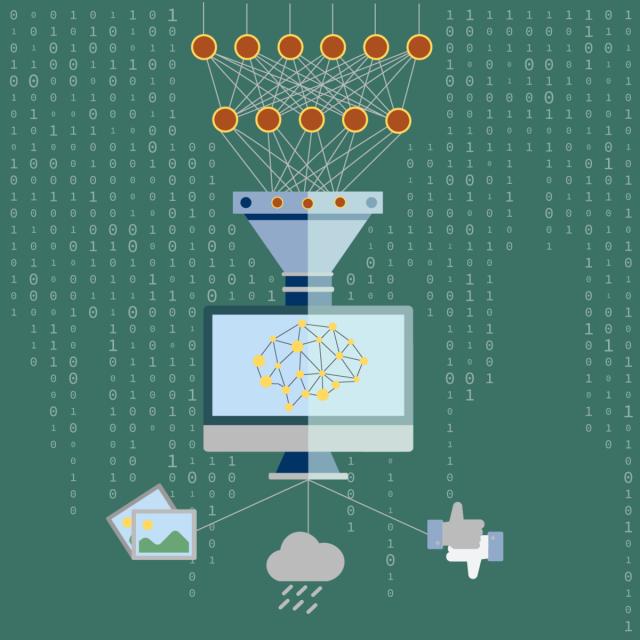
Elements of Artificial Intelligence (Reaktor)

Elements of Artificial Intelligence (Reaktor)

The elements of AI is a free online course for everyone interested in learning what AI is — with no complicated math or programming required.

The goal of this course is to demystify AI
The elements of AI is a free online course for everyone interested in learning what AI is, what is possible (and not possible) with AI, and how it affects our lives – with no complicated math or programming required. By completing the course you can earn a LinkedIn certificate. People in Finland can also earn 2 ECTS credits through the Open University.

After taking the course, you will be able to:

  • Understand some of the major implications of AI
  • Think critically about AI news and claims
  • Define and discuss what AI is
  • Explain the methods that make AI possible
Go to Class
MOOC List is learner-supported. When you buy through links on our site, we may earn an affiliate commission.
Related Courses

Responsible AI - Principles and Ethical Considerations (Coursera) Coursera
Fractal Analytics

Responsible AI - Principles and Ethical Considerations (Coursera)

Welcome to "Responsible AI – Principles and Ethical Considerations"! Dive deep into the very essence of Responsible AI with us. Uncover the significance of key principles shaping technology's future. From ethical considerations to fairness, transparency, and accountability, we discuss these principles with real-world examples, putting them into the context of data science.

Aug 10th 2026
5-12 Weeks
Probabilistic Graphical Models 1: Representation (Coursera) Coursera
Stanford University

Probabilistic Graphical Models 1: Representation (Coursera)

Probabilistic graphical models (PGMs) are a rich framework for encoding probability distributions over complex domains: joint (multivariate) distributions over large numbers of random variables that interact with each other. These representations sit at the intersection of statistics and computer science, relying on concepts from probability theory, graph algorithms, machine learning, and more. They are the basis for the state-of-the-art methods in a wide variety of applications, such as medical diagnosis, image understanding, speech recognition, natural language processing, and many, many more. They are also a foundational tool in formulating many machine learning problems.

Aug 3rd 2026
5-12 Weeks
Artificial Intelligence for Breast Cancer Detection (Coursera) Coursera
Johns Hopkins University

Artificial Intelligence for Breast Cancer Detection (Coursera)

Through interactive lectures and module exercises, this course illustrates the potential of artificial intelligence in breast imaging. Topics include an introduction of breast cancer and breast imaging, introduction to artificial intelligence in image analysis and computer image processing of cancer detection. The course intends to provide students basic understanding of artificial intelligence approaches to breast cancer detection.

Aug 10th 2026
4 Weeks
Probabilistic Graphical Models 3: Learning (Coursera) Coursera
Stanford University

Probabilistic Graphical Models 3: Learning (Coursera)

Probabilistic graphical models (PGMs) are a rich framework for encoding probability distributions over complex domains: joint (multivariate) distributions over large numbers of random variables that interact with each other. These representations sit at the intersection of statistics and computer science, relying on concepts from probability theory, graph algorithms, machine learning, and more. They are the basis for the state-of-the-art methods in a wide variety of applications, such as medical diagnosis, image understanding, speech recognition, natural language processing, and many, many more. They are also a foundational tool in formulating many machine learning problems.

Aug 3rd 2026
5-12 Weeks
Leveraging AI for Enhanced Content Creation (Coursera) Coursera
Coursera Instructor Network

Leveraging AI for Enhanced Content Creation (Coursera)

This course provides a foundation to assess, and apply, a series of Generative Artificial Intelligence (AI) tools, such as ChatGPT, Bing Chat, Google Bard, Midjourney, Runway, and Eleven Labs. This learning opportunity offers a hands-on experience through ideating, creating, and finalizing a mock advertising campaign using the combined strengths of these AI tools.

Aug 10th 2026
1 Week
AI Materials (Coursera) Coursera
Korea Advanced Institute of Science and Technology - KAIST

AI Materials (Coursera)

Learn about the materials that have advanced the performance of artificial intelligence, and the machine learning models that could help accelerate the design and development of novel materials. This course defines artificial intelligence (AI) as a machine to which some or all of the functions of the human brain have been delegated. It highlights the need, and explains in an easy-to-understand way how machine learning from artificial intelligence can dramatically accelerate the development of new materials.

Aug 10th 2026
5-12 Weeks
ChatGPT Prompt Engineering for Developers (DeepLearning.AI) Other Providers
DeepLearning.AI,OpenAI

ChatGPT Prompt Engineering for Developers (DeepLearning.AI)

Go beyond the chat box. Use API access to leverage LLMs into your own applications, and learn to build a custom chatbot. In ChatGPT Prompt Engineering for Developers, you will learn how to use a large language model (LLM) to quickly build new and powerful applications. Using the OpenAI API, you’ll be able to quickly build capabilities that learn to innovate and create value in ways that were cost-prohibitive, highly technical, or simply impossible before now.

Self Paced
Self-Paced