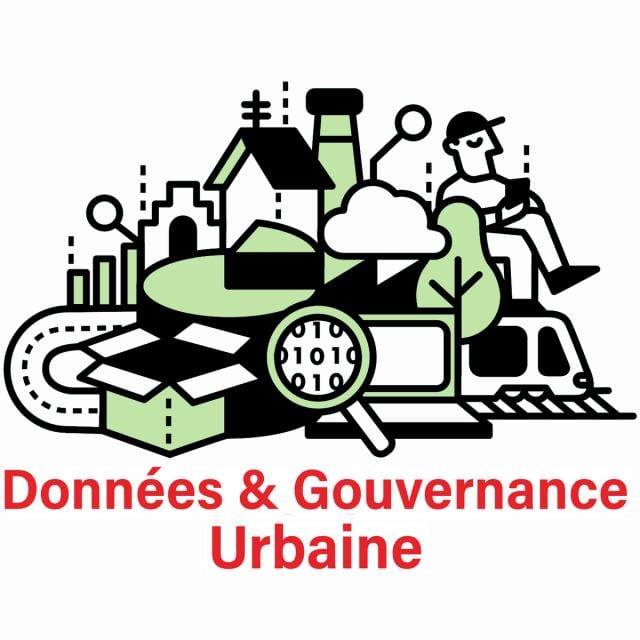
Données et Gouvernance Urbaine (Coursera)

Offered by Sciences Po,
Données et Gouvernance Urbaine (Coursera)

Depuis le milieu des années 2000, les données ont fait une entrée fracassante dans le champ urbain, transformant les manières dont les villes sont gouvernées à l’ère du numérique. Que ce soit au niveau des coalitions d’acteurs, des instruments, des politiques ou des modes de régulation, la donnée impacte la façon dont la vie urbaine se trouve ordonnée.

Class Deals by MOOC List - Click here and see Coursera's Active Discounts, Deals, and Promo Codes.

En 4 séances, ce mooc explore les transformations de la gouvernance urbaine à l’ère du numérique et des données. Qu’est-ce que la donnée fait à la gouvernance urbaine ? Qui gouverne dans une ville investie par le big data ? Les plateformes sont-elles ingouvernables ? Comment gouverne-t-on avec des algorithmes ? Quelle place revient aux citoyens dans cette ville numérique ? Peut-on encore être anonyme en ville ?
Ce cours vous permettra de vous repérer parmi l’archipel d’acteurs et d’outils qui font le gouvernement urbain à l’ère du numérique et des données ; de décrypter les ressorts des transformations à l’oeuvre dans l’organisation et les pratiques des administrations territoriales; d’analyser les évolutions contemporaines des marchés de service urbain ; et de comprendre les enjeux qui affectent la fabrique et la mise en oeuvre des politiques urbaines lorsque la donnée arrive en ville.
Ce MOOC est proposé par la chaire Villes et numérique de l'Ecole urbaine de SciencesPo, soutenue par La Poste, RTE et la Caisse des Dépôts.

Syllabus

WEEK 1: Quand la donnée arrive en ville
WEEK 2: Données et capitalisme urbain
WEEK 3: Données et administration territoriale
WEEK 4: Données et Gouvernementalité algorithmique

Go to Class
MOOC List is learner-supported. When you buy through links on our site, we may earn an affiliate commission.

Related Courses

Chinese Politics Part 1 - China and Political Science (Coursera) Coursera
The Hong Kong University of Science and Technology - HKUST

Chinese Politics Part 1 - China and Political Science (Coursera)

This course offers a conceptual framework for understanding China that highlights the intersection of politics and economics. It shows that rather than develop into a full blown market economy, state and party officials at all levels of the political system maintain significant influence in economic development. Such a “political” economy has had both positive and negative outcomes, which we will assess in detail.

Aug 17th 2026
5-12 Weeks
The GRC Approach to Managing Cybersecurity (Coursera) Coursera
University System of Georgia

The GRC Approach to Managing Cybersecurity (Coursera)

Managing cybersecurity is about managing risk, specifically the risk to information assets of valued by an organization. This course examines the role of Governance, Risk Management, and Compliance (GRC) as part of the Cybersecurity management process, including key functions of planning, policies, and the administration of technologies to support the protection of critical information assets.

Jul 27th 2026
5-12 Weeks
Global Health Policy (Coursera) Coursera
The University of Tokyo

Global Health Policy (Coursera)

In this course, learners will become familiar with principles and theories of global health problems, and major challenges and controversies in improving global population health as well as practical applications of quantitative methods to analyze and interpret issues and challenges for policy. Topics will include health and foreign policy, health governance, acute disease surveillance, non-communicable diseases, burden of disease, universal health coverage, health systems strengthening, health financing, and human resources for health and ageing.

Aug 10th 2026
4 Weeks
Data and Urban Governance (Coursera) Coursera
Sciences Po

Data and Urban Governance (Coursera)

Since the beginning of the 2000s, cities have witnessed a massive influx of data, transforming how cities are governed. Data has an impact on how city life is structured, as it influences coalitions, actors, instruments, policies, and forms of regulation. In this MOOC, we will look at this shift more closely: what has the advent of big data done to urban governance? Have platforms disrupted local authorities? How has big data changed local politics? How do we govern using algorithms? What is the place of citizens in the digital city? Is it still possible to be anonymous in the city?

Aug 17th 2026
4 Weeks
Political Economy of Institutions and Development (Coursera) Coursera
Leiden University

Political Economy of Institutions and Development (Coursera)

This course is part of the SDG initiative addressing the UN Sustainable Development Goals, specifically for the following SDGs [1, 8, 10 and 16]. We hope you will join in our efforts to reach the SDG’s in small but measurable and actionable ways, cooperating with Development Done Differently. Expand your impact. You can create a better world. In today’s world, politics and economics are interconnected, but what is the nature of this connectivity?

Aug 10th 2026
5-12 Weeks
Introduction to the Nonprofit Sector, Nonprofit Organizations, Nonprofit Leadership and Governance (Coursera) Coursera
The State University of New York

Introduction to the Nonprofit Sector, Nonprofit Organizations, Nonprofit Leadership and Governance (Coursera)

This course introduces you to the nonprofit sector, nonprofit organizations, and the concepts of leadership and governance. While this course has been developed with North American culture in mind, we do appreciate that in other parts of the world the nature of the nonprofit sector, nonprofit organizations, nonprofit leadership and governance may not be the same. Nevertheless, it is our hope that much of the course content will still be of value to those in other parts of the world.

Aug 17th 2026
5-12 Weeks
The Roles and Responsibilities of Nonprofit Boards of Directors within the Governance Process (Coursera) Coursera
University at Buffalo,The State University of New York

The Roles and Responsibilities of Nonprofit Boards of Directors within the Governance Process (Coursera)

This course provides a more in-depth look at the roles and responsibilities of boards of directors in the governance of nonprofit organizations. While the course has been developed with North American culture in mind, we do appreciate that in other parts of the world, the nature of the roles and responsibilities of boards of directors may not be the same. Nevertheless,it is our hope that much of the course content will still be of value to those in other parts of the world.

Jul 29th 2026
5-12 Weeks
Linguistic Diversity, What for? (Coursera) Coursera
Universitat Autònoma de Barcelona

Linguistic Diversity, What for? (Coursera)

What is linguistic diversity? What are its implications and opportunities? How is diversity around the world? How is it experienced, understood and managed in different contexts? What is your knowledge and experience about languages and diversity? In this course we approach linguistic diversity and multilingualism not only from a theoretical point of view, but also from a perspective oriented to help understand and manage various contexts that emerge from diversity in different environments of social interaction.

Aug 3rd 2026
5-12 Weeks
IBM Data Privacy for Information Architecture (Coursera) Coursera
IBM

IBM Data Privacy for Information Architecture (Coursera)

Data privacy controls how information is collected, used, shared, and disposed of, in accordance with policies or external laws and regulations. In this course, students will gain an understanding of what data privacy is along with how to identify and understand typical data protection and privatization objectives that an enterprise may have, and how to choose a data protection approach.

Aug 17th 2026
5-12 Weeks
Data intelligence for businesses and managers (Coursera) Coursera
Institut Mines-Telecom

Data intelligence for businesses and managers (Coursera)

With the proliferation of connected objects (computers, tablets, watches, etc.), huge masses of data are generated every second. This Big Data has led to the emergence of a data economy, where data is the main source of competitive advantage for companies. In this sense, data and its processing tools have become a strategic priority for companies, and the main gas pedal of their digital transformation.

Aug 10th 2026
5-12 Weeks