EdX

Deploying TinyML (edX)

Deploying TinyML (edX)

Learn to program in TensorFlow Lite for microcontrollers so that you can write the code, and deploy your model to your very own tiny microcontroller. Before you know it, you’ll be implementing an entire TinyML application. Have you wanted to build a TinyML device? In Deploying TinyML, you will learn the software, write the code, and deploy the model to your own tiny microcontroller-based device. Before you know it, you’ll be implementing an entire TinyML application.

Class Deals by MOOC List - Click here and see EdX's Active Discounts, Deals, and Promo Codes.

A one-of-a-kind course, Deploying TinyML is a mix of computer science and electrical engineering. Gain hands-on experience with embedded systems, machine learning training, and machine learning deployment using TensorFlow Lite for Microcontrollers, to make your own microcontroller operational for implementing applications such as voice recognition, sound detection, and gesture detection.
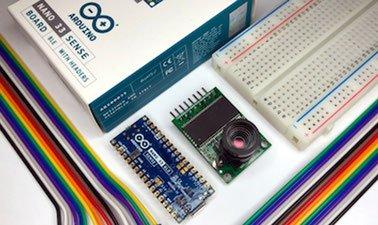
The course features projects based on a TinyML Program Kit that includes an Arduino board with onboard sensors and an ARM Cortex-M4 microcontroller. The kit has everything you need to build applications around image recognition, audio processing, and gesture detection. Before you know it, you’ll be implementing an entire tiny machine learning application.
Tiny Machine Learning (TinyML) is one of the fastest-growing areas of deep learning and is rapidly becoming more accessible. The third course in the TinyML Professional Certificate program, Deploying TinyML provides hands-on experience with deploying TinyML to a physical device.

What you'll learn

  • An understanding of the hardware of a microcontroller-based device
  • A review of the software behind a microcontroller-based device
  • How to program your own TinyML device
  • How to write your code for a microcontroller-based device
  • How to deploy your code to a microcontroller-based device
  • How to train a microcontroller-based device
  • Responsible AI Deployment

Syllabus

  • Introduction to the TinyML Kit
  • Deploying TinyML Applications on Embedded Devices
  • Collecting a Custom TinyML Dataset
  • Pre and Post Processing for Keyword Spotting, Visual Wake Words, and Gesturing a Magic Wand
  • Profiling and Optimization of TinyML Applications

Go to Class
MOOC List is learner-supported. When you buy through links on our site, we may earn an affiliate commission.

Related Courses

IoT System Design: Software and Hardware Integration (edX) EdX
Waseda University,WasedaX

IoT System Design: Software and Hardware Integration (edX)

Start developing your own Internet of Things (IoT) system with this exploration of the interaction between software and hardware. This course is designed to teach you how systems are developed using IoT technology. Many engineers and developers tend to focus on a single discipline - either software or hardware. However, in today’s connected age it's critical to have a comprehensive understanding of both disciplines and how they are intertwined.

Self Paced
Self-Paced
HTML5 Coding Essentials and Best Practices (edX) EdX
World Wide Web Consortium - W3C,W3Cx

HTML5 Coding Essentials and Best Practices (edX)

Learn how to write Web pages and Web sites by mastering HTML5 coding techniques and best practices. HTML5 is the standard language of the Web, developed by W3C. For application developers and industry, HTML5 represents a set of features that people will be able to rely on for years to come. HTML5 is supported on a wide variety of devices, lowering the cost of creating rich applications to reach users everywhere.

Self Paced
Self-Paced
Introduction to Computer Science and Programming (edX) EdX
Tokyo Institute of Technology,TokyoTechX

Introduction to Computer Science and Programming (edX)

The term “Computation” refers to the action performed by a computer. A computation can be a basic operation and it can also be a sophisticated computer simultation requiring a large amount of data and substantial resources. This course aims at introducing learners with no prior knowledge to basics and key concepts of computer science. By following the lectures and exercises of this course you will have an understanding of algorithms and you will get a real experience of programming using the language Ruby.

Self Paced
Self-Paced
How to Code: Complex Data (edX) EdX
The University of British Columbia,UBCx

How to Code: Complex Data (edX)

Learn how to design more complex programs, using new data structures, abstraction, and generative recursion. As your program requirements get more complex, you will find that simple additions to the design method make it easy to write well-structured and well-tested code that is easy to maintain. By learning how to capture common data and control structures using abstraction, your programs will get shorter and better tested.

Self Paced
Self-Paced
Programming for Data Science (edX) EdX
University of Adelaide,AdelaideX

Programming for Data Science (edX)

Learn how to apply fundamental programming concepts, computational thinking and data analysis techniques to solve real-world data science problems. There is a rising demand for people with the skills to work with Big Data sets and this course can start you on your journey through our Big Data MicroMasters program towards a recognised credential in this highly competitive area. Using practical activities you will learn how digital technologies work and will develop your coding skills through engaging and collaborative assignments.

Self Paced
Self-Paced
AI Chatbots without Programming (edX) EdX
IBM

AI Chatbots without Programming (edX)

Chatbots are increasingly in demand among global businesses. This course will teach you how to build, analyze, deploy and monetize chatbots - with the help of IBM Watson and the power of AI. Please Note: Learners who successfully complete this IBM course can earn a skill badge — a detailed, verifiable and digital credential that profiles the knowledge and skills you’ve acquired in this course. Enroll to learn more, complete the course and claim your badge!

Self Paced
Self-Paced
HTML5 Apps and Games (edX) EdX
World Wide Web Consortium - W3C,W3Cx

HTML5 Apps and Games (edX)

Today, developers are increasingly moving from native to HTML5-based apps. Increase your ability to design and deliver innovative services on the Web! Want to learn advanced HTML5 tips and techniques? This is the course for you! Find out more about the powerful Web features that will help you create great content and apps.

Self Paced
Self-Paced
Introduction to Object-Oriented Programming with Java II: Object-Oriented Programming and Algorithms (edX) EdX
Georgia Institute of Technology,GTx

Introduction to Object-Oriented Programming with Java II: Object-Oriented Programming and Algorithms (edX)

Learn the basics of object-oriented programming and algorithms. Students will build on the skills learned from “Introduction to Object-Oriented Programming with Java I: Foundations and Syntax Basics” and learn the basics of writing classes that serve as blueprints of concepts or objects that are represented in a programming problem. Students will leverage the concepts of inheritance, interfaces, and polymorphism to program reusability and flexibility in classes. Finally, students will gain experience walking through and analyzing algorithms that are applied on data (including objects) in many object-oriented programs.

Self Paced
Self-Paced
JavaScript Introduction (edX) EdX
World Wide Web Consortium - W3C,W3Cx

JavaScript Introduction (edX)

Learn JavaScript, a Web development programming language, to add interactivity to your Web pages, and become an expert Web developer. This computer science course is an initiation to JavaScript programming and has been designed to help Web developers have an understanding of the basic concepts of the language. This course was developed in partnership between W3C and University Côte d'Azur.

Self Paced
Self-Paced
Introduction to the Internet of Things (edX) EdX
Universitat Politècnica de València,UPValenciaX

Introduction to the Internet of Things (edX)

This is a preliminary course in which we deal with the basics of electronics and programming using Arduino and ESP boards. Internet of Things (IoT) is the present and the future of technology. Either, if you have none, few or some experience with electronics and you want to develop it projects this course will give you the necessary kick start to start creating amazing devices capable of sensing, controlling physical signals.

Self Paced
Self-Paced