EdX

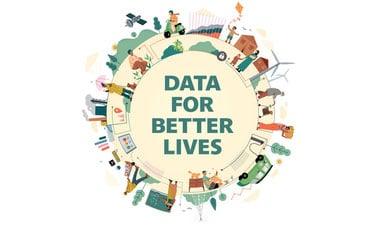
Data for Better Lives: A New Social Contract (edX)

Offered by World Bank Group, WBGx,
Data for Better Lives: A New Social Contract (edX)

With this course, explore the 2021 World Development Report (WDR) and how data can be used for advancing development outcomes. Learn about the principles of a new social contract for data and data governance needed to transform lives for the poor.

Class Deals by MOOC List - Click here and see EdX's Active Discounts, Deals, and Promo Codes.

The data revolution is transforming the world; and yet much of the value of data remains untapped. This course, based on the World Development Report 2021: Data for Better Lives , explores the tremendous potential of the changing data landscape to improve the lives of poor people, while also acknowledging its potential to open back doors that can harm individuals, businesses, and societies.
To address this tension between the helpful and harmful potential of data, it details a new social contract that enables the use and reuse of data to create economic and social value, ensures equitable access to that value, and fosters trust that data will not be misused in harmful ways.
Based on the WDR 2021 report, the course provides an overview of the recommendations on where public and private sector investments are the most critical, defines a rich program for policy reform and technical assistance, and highlights areas where global initiatives and partnerships can help to convene and facilitate cooperation at regional, bilateral and international levels.

Therefore, it elaborates on the following:

  • Conceptual framework through three pathways
  • Potential of data from public sector, private sector and civil society organizations
  • Creative reuses and data synergies
  • Data governance in the area of infrastructure, laws and regulations, economic policies in the area of competition, trade and tax
  • Policy recommendations using a maturity model approach
  • Integrated national data system

The course is open to anyone who has an interest in the subject and participants will be able to choose their own learning paths.

What you'll learn

  • How data can better advance development objectives
  • Creating economic and social value from data
  • Using data in the public and the private sector
  • Creative reuses of data for greater value
  • Data governance in the area of infrastructure, laws and regulations, and economic policies in the area of competition, trade and tax.
  • Policy recommendations using a maturity model approach
  • Creating an integrated national data system

Syllabus

Week 1: Module I — Advancing development objectives through data
Introduction to harnessing the value of data for better lives for the poor through the three pathways set out in a conceptual framework, economics and politics of data, and overview of a data governance framework to realize the development impact.

Week 2: Module II — Data in the public sector, the private sector, and civil society
Illustration of how data can be used as a force for public good, as a resource for the private sector, and to inform civil society and empower individuals, using several real-life examples.

Week 3: Module III — Creative reuses of data for greater value
Overview of how innovations in repurposing and combining public intent and private intent data are opening doors to development impacts previously unimaginable. Introduction to the potential and limitations of reuse, interoperability, and synergies of public intent and private intent data.

Week 4: Module IV — Aligning data governance with the new social contract
Introduction to critical data infrastructure policies to ensure equitable access for poor people in poor countries; and introduction to data policies, laws and regulations, using a safeguards and enablers framework, to create a trust environment to meet the needs of the rapidly evolving data economy.

Week 5: Module V — Creating value in the data economy: The role of competition, trade, and tax policy
Overview of how the expanding role of data in ubiquitous platform business models is reshaping competition, trade, and taxation in the real economy and posing pertinent risks for low- and middle-income countries. Introduction to the policy challenges and responses arising from competition, trade and taxation, and the linkages with the design of data regulations.

Week 6: Module VI — Moving toward an integrated national data system
Introduction to understanding how institutional ecosystems can help govern data through collective action, and furthermore, the steps for creating an aspirational integrated national data system, using a maturity model approach, and the tools for measuring performance of data systems.


Go to Class
MOOC List is learner-supported. When you buy through links on our site, we may earn an affiliate commission.

Related Courses

Analyzing Data with Excel (edX) EdX
IBM

Analyzing Data with Excel (edX)

Build the fundamental knowledge required to use Excel spreadsheets to perform basic data analysis. The course covers the basic workings and key features of Excel to help students analyze their data. This course provides students with the fundamental knowledge required to use Excel spreadsheets to perform basic data analysis.The course consists of several videos, demos, examples, and hands-on labs to help you learn, and ends with a final assignment project which will help you put what you have learned into practice.

Self Paced
Self-Paced
Data Management for Clinical Research (Coursera) Coursera
Vanderbilt University

Data Management for Clinical Research (Coursera)

This course presents critical concepts and practical methods to support planning, collection, storage, and dissemination of data in clinical research. Understanding and implementing solid data management principles is critical for any scientific domain. Regardless of your current (or anticipated) role in the research enterprise, a strong working knowledge and skill set in data management principles and practice will increase your productivity and improve your science. Our goal is to use these modules to help you learn and practice this skill set.

Aug 17th 2026
5-12 Weeks
Data Literacy – What is it and why does it matter? (Coursera) Coursera
University of Copenhagen,Sorbonne University,University of Warsaw,University of Milan,Charles University,4EU+ Alliance

Data Literacy – What is it and why does it matter? (Coursera)

You might already know that data is not neutral. Our values and assumptions are influenced by the data surrounding us - the data we create, the data we collect, and the data we share with each other. Economic needs, social structures, or algorithmic biases can have profound consequences for the way we collect and use data. Most often, the result is an increase of inequity in the world. Data also changes the way we interact. It shapes our thoughts, our feelings, our preferences and actions.

Aug 17th 2026
3 Weeks
Take Your Medicine: Developing New Drug Products (edX) EdX
University of Texas at Austin,UTAustinX

Take Your Medicine: Developing New Drug Products (edX)

Discover how new drugs are developed, tested, approved and marketed. Medicine has eradicated or eased the symptoms of many diseases. This course reveals how new drugs go from research innovation to a medicine that can be prescribed to patients. You’ll learn the process, challenges and issues in developing pharmaceutical products.

No sessions available
4 Weeks
Feature Engineering for Improving Learning Environments (edX) EdX
University of Texas at Arlington,UTArlingtonX

Feature Engineering for Improving Learning Environments (edX)

Every model used to predict a future outcome depends upon the quality of features used. This course focuses on developing better features to create better models. How can data-intensive research methods be used to create more equitable and effective learning environments? In this course, you will learn how data from digital learning environments and administrative data systems can be used to help better understand relevant learning environments, identify students in need of support, and assess changes made to learning environments.

No sessions available
3 Weeks
Data to Advance Population Health: Global Perspectives (Coursera) Coursera
Johns Hopkins University

Data to Advance Population Health: Global Perspectives (Coursera)

In this course, you will learn about methodologies that support the successful data use to strengthen public health programs and policies. Experts from around the world will define and explain what population-level data is, introduce the data-generation-to-use cycle, and explain other considerations for successful data use for population health. You will also learn about how health services data can be used to inform population-level decision-making, and the application of a gender and equity lens towards these data systems to ensure they are responsive to the needs of populations. Our overarching goal for this course is to support and improve the use of data to inform policy.

Aug 17th 2026
4 Weeks
Using Data to Provide Personalized Student Support (edX) EdX
University of Texas at Arlington,UTArlingtonX

Using Data to Provide Personalized Student Support (edX)

Learn how data is captured in learning experiences and how it is processed and analyzed to inform student support actions. This course will benefit educational designers, learning technology managers, and academics that are interested in how to use data to guide the design and improvements of a learning experience.

No sessions available
3 Weeks
Datos para la efectividad de las políticas públicas (edX) EdX
Inter-American Development Bank - IDB,IDBx

Datos para la efectividad de las políticas públicas (edX)

Este curso te ayudará a tomar el control de los datos y familiarizarte con las herramientas para utilizarlos en la planificación, gestión y evaluación de políticas publicas. En esta era de la información, los datos están disponibles en todos lados y crecen a una tasa exponencial. ¿Cómo podemos darles sentido a todos los datos y aprovecharlos en el momento de tomar decisiones?, ¿cómo los utilizamos para que nos ayuden a guiar la gestión y planificación de nuestras políticas? Tanto si eres ciudadano como planificador de políticas, deberías poder responder a estas preguntas.

Self Paced
Self-Paced
Data, Analytics and Learning (edX) EdX
University of Texas at Arlington,UTArlingtonX

Data, Analytics and Learning (edX)

An introduction to the logic and methods of analysis of data to improve teaching and learning. Capturing and analyzing data has changed how decisions are made and resources are allocated in businesses, journalism, government, and military and intelligence fields. Through better use of data, leaders are able to plan and enact strategies with greater clarity and confidence.

No sessions available
4 Weeks
IBM Data Privacy for Information Architecture (Coursera) Coursera
IBM

IBM Data Privacy for Information Architecture (Coursera)

Data privacy controls how information is collected, used, shared, and disposed of, in accordance with policies or external laws and regulations. In this course, students will gain an understanding of what data privacy is along with how to identify and understand typical data protection and privatization objectives that an enterprise may have, and how to choose a data protection approach.

Aug 17th 2026
5-12 Weeks
Data Analytics and Visualization Capstone Project (edX) EdX
IBM

Data Analytics and Visualization Capstone Project (edX)

Accelerate the knowledge you gain from previous courses in the IBM Data Analyst Professional Certificate program. Assume the role of an Associate Data Analyst and use various skills and techniques on real-world datasets to accomplish a task. This course provides students with the opportunity to assume the role of an Associate Data Analyst who has recently joined an organization. In this role, you will use Data Analytics skills and techniques on real-world datasets to complete a business task.

Self Paced
Self-Paced
Introduction to Probability (edX) EdX
HarvardX,Harvard University

Introduction to Probability (edX)

Learn probability, an essential language and set of tools for understanding data, randomness, and uncertainty. Probability and statistics help to bring logic to a world replete with randomness and uncertainty. This course will give you tools needed to understand data, science, philosophy, engineering, economics, and finance.

Self Paced
Self-Paced