Creating an Analytical Dataset (Udacity)

Offered by Udacity, Alteryx,
Creating an Analytical Dataset (Udacity)

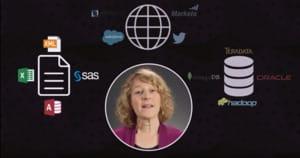
Prepare data for analysis and modeling. The Creating an Analytical Dataset course provides students with foundational knowledge to input, clean, blend, and format data in preparation for analysis.

Class Deals by MOOC List - Click here and see Udacity's Active Discounts, Deals, and Promo Codes.

You will learn:

  • The common sources and types of data
  • To identify and correct common issues with data
  • To format data in useful ways for analysis
  • To blend data from multiple sources together

Throughout this course you’ll also learn the techniques to apply your knowledge in a data analytics program called Alteryx. At the end of the course, you’ll complete a project based on the principles in the course..
Udacity's Intro to Programming is your first step towards careers in Web and App Development, Machine Learning, Data Science, AI, and more! This program is perfect for beginners.
Ever heard of the term garbage in, garbage out? This is as true in analytics as it is anywhere else. In this course, you’ll learn how to prepare data to ensure the efficacy of your analysis, a foundational skill for anyone using advanced analytics. You'll learn this through improving your fluency in Alteryx, a data analytics tool that enables you prepare, blend, and analyze data quickly. This course is ideal for anyone who is interested in pursuing a career in business analysis, but lacks programming experience.
This course is part of the Business Analyst Nanodegree Program.

What You Will Learn

Lesson 1
Understanding Data

  • Learn to identify structured, unstructured, and semistructured data.
  • Get an introduction to the most common data types.
  • Learn about the most common sources of data.

Lesson 2
Data Issues

  • Learn to clean dirty data.
  • Learn to how to adjust for missing data.
  • Be able to identify and correct outliers.

Lesson 3
Data Formatting

  • Learn about the importance of data format for analysis.
  • Transpose, aggregate, and cross tabulate data.
  • Learn how to use parse data.

Lesson 4
Data Blending

  • Learn how to merge data from multiple sources.
  • Learn to use common data blending techniques.
  • Explore fuzzy matching and spatial analysis

Prerequisites and Requirements

  • No programming experience required
  • Interested in using data to make better business decisions
  • Alteryx license (provided to nanodegree students at no cost, compatible with Windows only)
Go to Class
MOOC List is learner-supported. When you buy through links on our site, we may earn an affiliate commission.

Related Courses

Social Network Analysis (Coursera) Coursera
University of California, Davis

Social Network Analysis (Coursera)

This course is designed to quite literally ‘make a science’ out of something at the heart of society: social networks. Humans are natural network scientists, as we compute new network configurations all the time, almost unaware, when thinking about friends and family (which are particular forms of social networks), about colleagues and organizational relations (other, overlapping network structures), and about how to navigate delicate or opportunistic network configurations to save guard or advance in our social standing (with society being one big social network itself).

Jun 8th 2026
5-12 Weeks
Data Analysis and Visualization (Udacity) Udacity
Georgia Institute of Technology,Udacity

Data Analysis and Visualization (Udacity)

Data and visual analytics is an emerging field concerned with analyzing, modeling, and visualizing complex high dimensional data. This course will introduce students to the field by covering state­-of-­the-art modeling, analysis and visualization techniques. It will emphasize practical challenges involving complex real world data and include several case studies and hands-on work with the R programming language.

Self Paced
Self-Paced
Real-Time Analytics with Apache Storm (Udacity) Udacity
Udacity,Twitter

Real-Time Analytics with Apache Storm (Udacity)

The world is trending in real time! Learn from Twitter to scalably process tweets, or any big data stream, in real-time to drive d3 visualizations using Apache Storm, the "Hadoop of Real Time." Storm is free, open source, and fun to use! Learn from Karthik Ramasamy, about the distributed, fault-tolerant, and flexible technology used to power Twitter’s real-time data flow pipeline. Twitter open sourced Storm in 2011, and it graduated to a top-level Apache project in September, 2014.

Self Paced
Self-Paced
Data Visualization (Coursera) Coursera
Ball State University

Data Visualization (Coursera)

In the era of big data, acquiring the ability to analyze and visually represent “Big Data” in a compelling manner is crucial. Therefore, it is essential for data scientists to develop the skills in producing and critically interpreting digital maps, charts, and graphs. Data visualization is an increasingly important topic in our globalized and digital society. It involves graphically representing data or information, enabling decision-makers across various industries to comprehend complex concepts and processes that may otherwise be challenging to grasp.

Jun 9th 2026
5-12 Weeks
Intro to Descriptive Statistics (Udacity) Udacity
Udacity

Intro to Descriptive Statistics (Udacity)

Mathematics for Understanding Data. Statistics is an important field of math that is used to analyze, interpret, and predict outcomes from data. Descriptive statistics will teach you the basic concepts used to describe data. This is a great beginner course for those interested in Data Science, Economics, Psychology, Machine Learning, Sports analytics and just about any other field.

Self Paced
Self-Paced
Statistical Mechanics: Algorithms and Computations (Coursera) Coursera
École normale supérieure

Statistical Mechanics: Algorithms and Computations (Coursera)

In this course you will learn a whole lot of modern physics (classical and quantum) from basic computer programs that you will download, generalize, or write from scratch, discuss, and then hand in. Join in if you are curious (but not necessarily knowledgeable) about algorithms, and about the deep insights into science that you can obtain by the algorithmic approach.

Jun 8th 2026
5-12 Weeks
Data Visualization in Tableau (Udacity) Udacity
Udacity

Data Visualization in Tableau (Udacity)

Learn the fundamentals of data visualization and practice communicating with data. This course covers how to apply design principles, human perception, color theory, and effective storytelling with data. If you present data to others, aspire to be a business analyst or data scientist, or if you’d like to become more effective with visualization tools, then you can grow your skills with this course.

Self Paced
Self-Paced
GIS Data Formats, Design and Quality (Coursera) Coursera
University of California, Davis

GIS Data Formats, Design and Quality (Coursera)

In this course, the second in the Geographic Information Systems (GIS) Specialization. What you will learn: design data tables and use separating and joining data in a relational database; write query strings to subset data; create and work with raster data; create web maps.

Jun 8th 2026
4 Weeks
Reproducible Research (Coursera) Coursera
Johns Hopkins University

Reproducible Research (Coursera)

This course focuses on the concepts and tools behind reporting modern data analyses in a reproducible manner. Reproducible research is the idea that data analyses, and more generally, scientific claims, are published with their data and software code so that others may verify the findings and build upon them. The need for reproducibility is increasing dramatically as data analyses become more complex, involving larger datasets and more sophisticated computations.

Jun 8th 2026
4 Weeks
Exploratory Data Analysis (Coursera) Coursera
Johns Hopkins University

Exploratory Data Analysis (Coursera)

This course covers the essential exploratory techniques for summarizing data. These techniques are typically applied before formal modeling commences and can help inform the development of more complex statistical models. Exploratory techniques are also important for eliminating or sharpening potential hypotheses about the world that can be addressed by the data.

Jun 8th 2026
4 Weeks