Blended Learning: Personalizing Education for Students (Coursera)

Blended Learning: Personalizing Education for Students (Coursera)

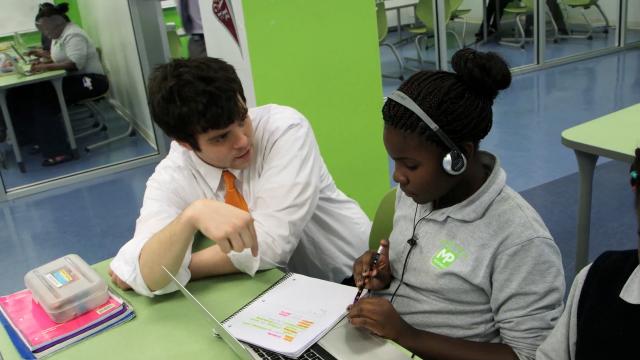
Plenty of buzz exists about blended learning and its transformational potential. But what does blended learning really mean? In this course we will explore the different models of blended learning and dive into key issues that impact students, teachers, and schools. Specifically, we will look at these issues through the lens of three high-performing schools that each use a different type of blended learning.

Class Deals by MOOC List - Click here and see Coursera's Active Discounts, Deals, and Promo Codes.

A few of the key topics will include:

  • The role of the student and how to support students in the transition from traditional to blended learning
  • Implications for teachers in their day-to-day work and overall role
  • Impact on the way schools are designed including staffing models, use of time, hardware/software selection, and the use of data
  • Implementation challenges, potential solutions, and the remaining open questions

We will live by the attributes of blended learning in this course, encouraging students to take quizzes at the beginning of the module to assess their understanding and skip material they already know. Overall, we will take a hand-on approach and the course will culminate in participants prototyping their own blended learning model.
If you are interested in learning more about how to best leverage technology in education and rethink the way we run schools, join this MOOC and encourage your colleagues to do the same. Become a part of this growing movement and learn first-hand how blended learning can help provide students a more personalized learning experience.

Syllabus

WEEK 1
Introduction and Blended Learning Models
An overview, definition, and introduction to several different models of blended learning.

WEEK 2
Creating the Ideal Student Experience
Learn how educators are redesigning schools and the use of time and teachers to create their most ideal blended learning environment. Explore how to help students transition smoothly from traditional education to blended learning.

WEEK 3
Rethinking the Role of the Teacher
Discover how the role of the teacher is changing in blended learning environments. What parts of the job stay the same and what is different? How does an organization support teachers in making the transition to blended learning?

WEEK 4
Redesigning a School
How can we challenge our assumptions about the ways that schools have always been organized and run? How do leaders manage the change as their organizations transition from traditional models to blended learning?

WEEK 5
Making Hardware, Software, and Space Decisions
Explore the choices you have to make around your software, hardware, and facilities, and how to make sure they support your educational model.

WEEK 6
Prototyping and the Innovation Process
Learn the steps of the design process to begin development of your own blended learning implementation.

Go to Class
MOOC List is learner-supported. When you buy through links on our site, we may earn an affiliate commission.

Related Courses

Teach English Now! Foundational Principles (Coursera) Coursera
Arizona State University

Teach English Now! Foundational Principles (Coursera)

Through a series of engaging metaphors and stories, prospective and current EFL/ESL teachers will identify, summarize, and evaluate 7 basic language learning paradigms. Learners will be presented information on such foundational principles as motivation, risk taking, two different modes of learning, and balancing the teacher profession. Learners are also given an understanding of basic techniques founded on those principles, such as teacher talk, looking “ridiculous” in order to lower the affective filter, and networking. With these foundational principles in mind, ESL/EFL teachers will scrutinize common assumptions about language learning by comparing how they stack up to research-based core principles.

Jun 22nd 2026
5-12 Weeks
Activity Design with PhET Simulations for STEM Education (Coursera) Coursera
University of Colorado Boulder

Activity Design with PhET Simulations for STEM Education (Coursera)

PhET Interactive Simulations, a project of the University of Colorado Boulder, provides fun, free, interactive, research-based science and mathematics simulations for use across, primary, secondary, and higher education levels. We extensively test and evaluate each simulation to ensure educational effectiveness. All simulations are open source and free to all students and teachers. In this course, we will review strategies for how to use PhET to create sim-based inquiry activities for math or science classes, including activity sheets that students can use as they work independently or in small groups while they have direct access to simulations on their own devices.

Jun 22nd 2026
3 Weeks
Training and Learning Programs for Volunteer Community Health Workers (Coursera) Coursera
Johns Hopkins University

Training and Learning Programs for Volunteer Community Health Workers (Coursera)

Volunteer community health workers (CHWs) are a major strategy for increasing access to and coverage of basic health interventions. Our village health worker training course reviews the process of training and continuing education of CHWs as an important component of involving communities in their own health service delivery. Participants will be guided through the steps of planning training and continuing education activities for village volunteers. The course draws on real-life examples from community-directed onchocerciasis control, village health worker programs, community case management efforts, peer educators programs and patent medicine vendor training programs, to name a few.

Jun 22nd 2026
5-12 Weeks
Introduction to EdTech (Coursera) Coursera
EDHEC Business School

Introduction to EdTech (Coursera)

Co-developed by Supercharger Ventures and EDHEC Business School. EdTech, short for Education Technology, is one of the most exciting sectors in the economy today poised to re-shape how education systems work and how people learn around the world. Introduction to EdTech MOOC is designed to explore EdTech fundamentals and build the foundational knowledge for educators, institutions, entrepreneurs and governments to appreciate the impact and potential of new tools, technologies, business models and learning methods in education.

Jun 22nd 2026
4 Weeks
Utilizing Engaging Assessment with Boom Learning (Coursera) Coursera
Coursera Project Network

Utilizing Engaging Assessment with Boom Learning (Coursera)

By the end of this project, you will be ready to use Boom Learning with your class. Boom Learning allows teachers to use self-grading digital task cards (Boom Cards) with their students to check for understanding. Students love using Boom Learning and teachers love the data they can collect as their students engage with technology and subject matter content. Throughout each task, we will work together to ensure that you are ready to use Boom Learning to engage and assess your students.

Jun 22nd 2026
Self-Paced
Critical Issues in Urban Education (Coursera) Coursera
University of Chicago

Critical Issues in Urban Education (Coursera)

Urban school reform in the United States is characterized by contentious, politicized debate. This course explores a set of critical issues in the education and educational reform space, with a focus on aspects of the field that have sparked controversy and polarized views. We will dig into these debates, situating them within the larger history of public education and school reform, and considering the viewpoints, the evidence, and translation of issues into educational policy.

Jun 22nd 2026
5-12 Weeks
THINK GLOBAL: TEACHERS TRAINING COURSE (IDP-ICE) (Coursera) Coursera
University of Barcelona

THINK GLOBAL: TEACHERS TRAINING COURSE (IDP-ICE) (Coursera)

A group of seven European partners from Catalonia, Belgium, and Wales worked together on the Erasmus+ funded ‘Think Global’ project on global competence. The project seeks to address the following research question through development and piloting of practical classroom activities: What is global competence, and how can it be learned effectively?

Jun 22nd 2026
5-12 Weeks
Multimodal Literacies: Communication and Learning in the Era of Digital Media (Coursera) Coursera
University of Illinois at Urbana-Champaign

Multimodal Literacies: Communication and Learning in the Era of Digital Media (Coursera)

Whereas the focus of traditional literacy pedagogy has been the written word in its standard and literary forms, this courser expands the scope of literacy learning to encompass contemporary multimodal texts and the wide range of ways of making meaning that occur in different social and cultural contexts. Another course, "Literacy Teaching and Learning: Aims, Approaches and Pedagogies" addresses pedagogical aspects of literacies. This "Multimodal Literacies" learning module does not require or expect that participants will have already completed the "Literacy Teaching and Learning" module.

Jun 22nd 2026
4 Weeks
How to Write and Publish a Scientific Paper (Project-Centered Course) (Coursera) Coursera
École Polytechnique

How to Write and Publish a Scientific Paper (Project-Centered Course) (Coursera)

In this project-based course, you will outline a complete scientific paper, choose an appropriate journal to which you'll submit the finished paper for publication, and prepare a checklist that will allow you to independently judge whether your paper is ready to submit. What you'll need to get started: This course is designed for students who have previous experience with academic research - you should be eager to adapt our writing and publishing advice to an existing personal project.

Jun 22nd 2026
4 Weeks
Educating Deaf Children: Becoming an Empowered Teacher (Coursera) Coursera
University of Cape Town

Educating Deaf Children: Becoming an Empowered Teacher (Coursera)

Many Deaf children around the world still leave school functionally illiterate. In some cases there is no allowance made for education of Deaf children at all. This 4 week course provides you with invaluable knowledge and skills about teaching Deaf children. You will learn about the importance of Deaf culture and community, the need for a language rich environment for the Deaf child from as young as possible, and that having access to sign language can help Deaf children academically, emotionally, and socially.

Jun 22nd 2026
4 Weeks
Expanding SEL (Coursera) Coursera
University of Colorado Boulder

Expanding SEL (Coursera)

Social and emotional learning, or SEL, programs have flourished in schools during the last decade. In this course the instructors (Emily Price and Ben Kirshner) introduce and help you examine community based and youth-empowerment approaches to social and emotional learning. Some of these approaches address the impact of social and political systems, such as immigration and structural racism, on children’s social and emotional experiences.

Jun 22nd 2026
5-12 Weeks
Constructivism and Mathematics, Science, and Technology Education (Coursera) Coursera
University of Illinois at Urbana-Champaign

Constructivism and Mathematics, Science, and Technology Education (Coursera)

This course is designed to help participants examine the implications of constructivism for learning and teaching in science, mathematics, and technology focused areas. Course readings, discussions, and assignments will examine constructivist views of learning, research on students' ideas and idea-based interactions, research on instructional approaches taking student ideas into account, and challenges in implementing constructivist perspectives in instruction.

Jun 22nd 2026
5-12 Weeks