Black Performance as Social Protest (FutureLearn)

Black Performance as Social Protest (FutureLearn)

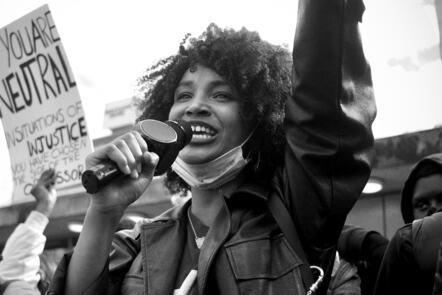
Understand artistic protest from the African Diaspora, and how Black performance impacts social justice movements today. Explore the history of social protest through Black performance. Black performance and social activism have been a model for protest globally. It has enriched and activated cries for justice in multiple contexts. This course will help you expand your understanding of Black performance as social protest and its active effects on performance and protest today.

Class Deals by MOOC List - Click here and see FutureLearn's Active Discounts, Deals, and Promo Codes.

Engage with artistic protests across key historical frames
The arts are a potent way of responding to issues of injustice. From slavery and lynching to incarceration and disenfranchisement, Black performance has resisted oppression across several historical frames.
On this course, you’ll read, watch, and listen to performances that illustrate various forms of artistic protest from the African Diaspora. You’ll cover chants of the enslaved and dances of heritage, before moving on to look at early 20th century migrations and United States protests.

Discover the role of performance in the Black Lives Matter movement
You’ll identify ways in which patterns of resistance from the past contribute to ongoing social justice movements, such as Black Lives Matter.
After investigating the history of Black performance as social protest, you’ll produce a reflective manifesto for achieving racial equity through performance.

Learn from experts in African American studies from the University of Michigan
This course is led by three professors at the school of Music, Theatre, and Dance at the University of Michigan, all of whom teach performance history as well as having lived experiences as Black performers.
They’ll each guide you through the importance and impact of Black performance in social protest, highlighting the intersections between the arts and social justice.

What topics will you cover?

  • Week 1: Black Representation (Slavery) - Covers protest chants of the enslaved and dances of heritage
  • Week 2: Early 20th Century Migrations and United States Protests (Jim Crow) - Explores lynching plays, protest songs and the Great Migration.
  • Week 3: Civil Rights Struggles for Justice (Equality) and Black Nationalism - Explores music and theatre of the Civil Rights movement and Black Revolutionary Arts forms.
  • Week 4: Social Justice Now: Black Lives Matter and the Performing Arts (Police Brutality) - Discusses the importance of performance past contributions to the Black Lives Matter movement.
  • Week 5: Call to Action - The course culminates in a reflective manifesto

Through these specific examples, participants will identify patterns of resistance against slavery, lynching, incarceration, and disenfranchisement while analysing ways in which they contribute to ongoing social justice movements.

What will you achieve?
By the end of the course, you‘ll be able to...

  • how Black performance resists oppression across several historical frames.
  • with performance content which illustrates various forms of artistic protest from the African Diaspora.
  • patterns of resistance against slavery, lynching, incarceration, and disenfranchisement.
  • ways in which patterns of resistance from the past contribute to ongoing social justice movements.

a manifesto for achieving racial equity through performance.
Go to Class
MOOC List is learner-supported. When you buy through links on our site, we may earn an affiliate commission.

Related Courses

Visualizing Women's Work: Using Art Media for Social Justice (FutureLearn) FutureLearn
University of Michigan

Visualizing Women's Work: Using Art Media for Social Justice (FutureLearn)

Explore the use of art media for social justice, and investigate how public art can be used to redress historic gender bias. Discover the historical erasure of women’s work through social justice art. Public art has often ignored the work and legacy of minorities and women, but recently there has been a welcome reappraisal of publicly displayed visual monuments and art media.

Jul 26th 2021
4 Weeks
Power, Politics, and Influence at Work (FutureLearn) FutureLearn
University of Manchester

Power, Politics, and Influence at Work (FutureLearn)

Discover the causes of global employment inequalities, how workers gain a voice through unions, and the future of work itself. Help build workers’ rights and a better future for employment and society. With the world of work in unprecedented flux, the role of workers’ rights has never been more pressing, as society grapples with issues such as how to ensure better employment equity and safety.

Self Paced
5-12 Weeks
Migrations internationales : un enjeu mondial (Coursera) Coursera
Sciences Po

Migrations internationales : un enjeu mondial (Coursera)

Le monde bouge, mais les opinions et les gouvernements ne sont pas tous prêts à accepter cette réalité mal connue. La question affecte à la fois les Etats, mais aussi la planète, dans un processus de mondialisation et de régionalisation des migrations, et pose de nouvelles questions aux relations internationales, en y incluant le sud. Ce cours cherche à la fois à parfaire la connaissance sur le sujet, à traiter les thèmes essentiels induits par les migrations internationales et à dresser les tendances de demain.

Nov 16th 2026
5-12 Weeks
Feminism and Social Justice (Coursera) Coursera
University of California, Santa Cruz

Feminism and Social Justice (Coursera)

"Feminism and Social Justice" is an adaptation of Distinguished Professor Bettina Aptheker's long-running course at UC Santa Cruz. In the course, Professor Aptheker presents a broad definition of feminism that serves to frame three significant events in the history of feminism and social justice: the Empire Zinc strike of 1951, the 1971-1972 trial of Angela Davis, and the #metoo Movement.

Nov 9th 2026
4 Weeks
Migration, Mobilities and Citizenship (FutureLearn) FutureLearn
University of Bristol

Migration, Mobilities and Citizenship (FutureLearn)

Explore who counts as a ‘migrant’ to better understand the processes and experiences of migration. Develop critical thinking skills around the concepts of migration and mobilities. This two-week multidisciplinary course will enable you to develop all the critical thinking skills you need surrounding the twin concepts of migration and mobilities. You’ll explore contemporary human movements within their historical context, and will also cover the current global situation of COVID-19, as well as the relation of race and racism to migration.

Self Paced
2 Weeks
Dementia and the Arts: Sharing Practice, Developing Understanding and Enhancing Lives (FutureLearn) FutureLearn
University College London,Created Out of Mind

Dementia and the Arts: Sharing Practice, Developing Understanding and Enhancing Lives (FutureLearn)

Explore, challenge and shape your perceptions of dementia through science and the creative arts. Creating a society that supports and includes those of us who are living with a dementia is a major challenge - and opportunity. In this course you will discover how the arts can create a common ground between people, and in doing so, learn what we can all do to improve the quality of life and care for people living with different dementias.

Self Paced
4 Weeks
Disability Inclusion in Education: Building Systems of Support (Coursera) Coursera
University of Cape Town

Disability Inclusion in Education: Building Systems of Support (Coursera)

Worldwide millions of children are not able to fully participate in schooling, and this is especially a problem for children with disabilities. In this course, we explore the support that teachers need in order to meet the needs of children with severe to profound hearing, visual and intellectual disabilities. We consider how this can be done by talking with a range of experts (from teachers to activists) about inclusive education as well as sharing experiences of education.

Nov 9th 2026
5-12 Weeks
From Freedom Rides to Ferguson: Narratives of Nonviolence in the American Civil Rights Movement (Coursera) Coursera
Emory University

From Freedom Rides to Ferguson: Narratives of Nonviolence in the American Civil Rights Movement (Coursera)

The Modern Civil Rights Movement is a significant landmark in United States history. This movement was a struggle for human rights directly challenging the nation to extend its democratic principles to African Americans and all peoples. This course sheds light on the often overlooked strategic planning that supported the direction of the events and is told by a voice intimately involved in the organization of movement—Dr. Bernard LaFayette, Jr. Topics include the history of the campaigns, the different coalitions and groups, philosophy and methods of nonviolent direct action, and the contemporary application of nonviolent conflict transformation. The course hosts several guest speakers, including Andrew Young, Reverend C.T. Vivian, Henry "Hank" Thomas, and Constance Curry.

Nov 16th 2026
5-12 Weeks
Fashion Values: Society (FutureLearn) FutureLearn
London College of Fashion

Fashion Values: Society (FutureLearn)

Examine the relationship between fashion and society, using fashion activism to challenge social injustice. Understand the links between fashion and society through a range of perspectives. Fashion and society are deeply intertwined through everyday actions, behaviours and business models, and can be both empowering and exploitative.

Mar 28th 2022
4 Weeks
Cultural impact of housing displacement gentrification (Coursera) Coursera
University of Glasgow

Cultural impact of housing displacement gentrification (Coursera)

This course provides an introduction to gentrification and to the cultural impacts of housing displacement for people in cities and neighbourhoods across the world. Gentrification is a term which has been used to describe the process by which wealthier people move into an area leading to the displacement of poorer groups who are priced out of the area by increases in rents and housing prices. It is usually associated with physical improvements to the housing stock and to changes in local shops and services. Sometimes it is closely associated with the displacement of black people by white people.

Nov 16th 2026
4 Weeks
Designing and Building Institutional Anti-Racist Spaces (Coursera) Coursera
Wesleyan University

Designing and Building Institutional Anti-Racist Spaces (Coursera)

Designing and Building Institutional Antiracist Spaces (D-BIAS) is a course whose mission is to teach and apply tenets of equity, anti-racism, and cultural justice to students from Institutions to achieve social change. The course is aimed at educators and administrators in educational spaces, lawyers and advocates in spaces that touch civil rights, equity, and whose Institutional mission it is to achieve greater cultural equity.

Nov 16th 2026
4 Weeks