Approximation Algorithms (Coursera)

Offered by EIT Digital,
Approximation Algorithms (Coursera)

Many real-world algorithmic problems cannot be solved efficiently using traditional algorithmic tools, for example because the problems are NP-hard. The goal of this course is to become familiar with important algorithmic concepts and techniques needed to effectively deal with such problems. These techniques apply when we don't require the optimal solution to certain problems, but an approximation that is close to the optimal solution. We will see how to efficiently find such approximations.

Class Deals by MOOC List - Click here and see Coursera's Active Discounts, Deals, and Promo Codes.

Prerequisites:
In order to successfully take this course, you should already have a basic knowledge of algorithms and mathematics. Here's a short list of what you are supposed to know:

  • O-notation, Ω-notation, Θ-notation; how to analyze algorithms
  • Basic calculus: manipulating summations, solving recurrences, working with logarithms, etc.
  • Basic probability theory: events, probability distributions, random variables, expected values etc.
  • Basic data structures: linked lists, stacks, queues, heaps
  • (Balanced) binary search trees
  • Basic sorting algorithms, for example MergeSort, InsertionSort, QuickSort
  • Graph terminology, representations of graphs (adjacency lists and adjacency matrix), basic graph algorithms (BFS, DFS, topological sort, shortest paths)

The material for this course is based on the course notes that can be found under the resources tab. We will not cover everything from the course notes. The course notes are there both for students who did not fully understand the lectures as well as for students who would like to dive deeper into the topics.
The video lectures contain a few very minor mistakes. A list of these mistakes can be found under resources (in the document called "Errata"). If you think you found an error, report a problem by clicking the square flag at the bottom of the lecture or quiz where you found the error.

Syllabus

WEEK 1
Introduction to Approximation algorithms
In the module the motivation for studying approximation algorithms will be given. We will discuss what optimization problems are, and what the difference between heuristics and approximation algorithms is. Finally, we will introduce the concept of approximation ratio, which plays a central role in the analysis of the quality of approximation algorithms.

WEEK 2
The Load Balancing problem
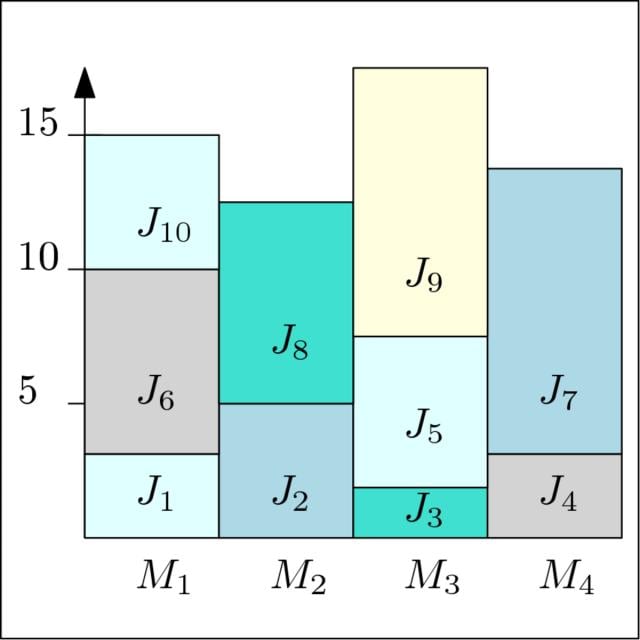
In this module we will study various approximation algorithms for the load balancing problem. This problems asks to distribute a given set of jobs, each with a certain processing time, over a number of machine. The goal is to do this such that all jobs are finished as soon as possible. We will analyze the quality of the computed solutions computed using the concept of rho-approximation, which we saw in the previous lecture. In this analysis we will see that lower bounds on the optimal solution play a crucial role in the analysis (or, for maximization problems: upper bounds).

WEEK 3
LP Relaxation
In this module we will introduce the technique of LP relaxation to design approximation algorithms, and explain how to analyze the approximation ratio of an algorithm based in LP relaxation. We will do this using the (weighted) Vertex Cover problem as an example. Before we explain the technique of LP relaxation, however, we first give a simple 2-approximation algorithm for the unweighted Vertex Cover problem.

WEEK 4
Polynomial-time approximation schemes
In this module we will introduce the concept of Polynomial-Time Approximation Scheme (PTAS), which are algorithms that can get arbitrarily close to an optimal solution. We describe a general technique to design PTASs, and apply it to the famous Knapsack problem. Finally we will see how to analyze PTASs that are designed with the general technique.


Go to Class
MOOC List is learner-supported. When you buy through links on our site, we may earn an affiliate commission.

Related Courses

Algorithmic Toolbox (Coursera) Coursera
University of California, San Diego,Higher School of Economics - HSE University

Algorithmic Toolbox (Coursera)

The course covers basic algorithmic techniques and ideas for computational problems arising frequently in practical applications: sorting and searching, divide and conquer, greedy algorithms, dynamic programming. We will learn a lot of theory: how to sort data and how it helps for searching; how to break a large problem into pieces and solve them recursively; when it makes sense to proceed greedily; how dynamic programming is used in genomic studies. You will practice solving computational problems, designing new algorithms, and implementing solutions efficiently (so that they run in less than a second).

Jun 22nd 2026
5-12 Weeks
Algorithms on Graphs (Coursera) Coursera
University of California, San Diego,Higher School of Economics - HSE University

Algorithms on Graphs (Coursera)

If you have ever used a navigation service to find optimal route and estimate time to destination, you've used algorithms on graphs. Graphs arise in various real-world situations as there are road networks, computer networks and, most recently, social networks! If you're looking for the fastest time to get to work, cheapest way to connect set of computers into a network or efficient algorithm to automatically find communities and opinion leaders in Facebook, you're going to work with graphs and algorithms on graphs.

Jun 22nd 2026
5-12 Weeks
Cloud Computing Concepts, Part 1 (Coursera) Coursera
University of Illinois at Urbana-Champaign

Cloud Computing Concepts, Part 1 (Coursera)

Cloud computing systems today, whether open-source or used inside companies, are built using a common set of core techniques, algorithms, and design philosophies—all centered around distributed systems. Learn about such fundamental distributed computing "concepts" for cloud computing. Some of these concepts include: clouds, MapReduce, key-value/NoSQL stores, classical distributed algorithms, widely-used distributed algorithms, scalability, trending areas, and much, much more!

Jun 22nd 2026
5-12 Weeks
Finding Hidden Messages in DNA (Bioinformatics I) (Coursera) Coursera
University of California, San Diego

Finding Hidden Messages in DNA (Bioinformatics I) (Coursera)

This course begins a series of classes illustrating the power of computing in modern biology. Please join us on the frontier of bioinformatics to look for hidden messages in DNA without ever needing to put on a lab coat. In the first half of the course, we investigate DNA replication, and ask the question, where in the genome does DNA replication begin? We will see that we can answer this question for many bacteria using only some straightforward algorithms to look for hidden messages in the genome.

Jun 22nd 2026
5-12 Weeks
Digital Signal Processing 4: Applications (Coursera) Coursera
École Polytechnique Fédérale de Lausanne

Digital Signal Processing 4: Applications (Coursera)

Digital Signal Processing is the branch of engineering that, in the space of just a few decades, has enabled unprecedented levels of interpersonal communication and of on-demand entertainment. By reworking the principles of electronics, telecommunication and computer science into a unifying paradigm, DSP is a the heart of the digital revolution that brought us CDs, DVDs, MP3 players, mobile phones and countless other devices.

Jun 22nd 2026
3 Weeks
Introduction to Google SEO (Coursera) Coursera
University of California, Davis

Introduction to Google SEO (Coursera)

Ever wonder how major search engines such as Google, Bing and Yahoo rank your website within their searches? Or how content such as videos or local listings are shown and ranked based on what the search engine considers most relevant to users? Welcome to the world of Search Engine Optimization (SEO). This course is the first within the SEO Specialization and it is intended to give you a taste of SEO with some fun practices to get seen in Google.

Jun 22nd 2026
4 Weeks
Algorithms, Part II (Coursera) Coursera
Princeton University

Algorithms, Part II (Coursera)

This course covers the essential information that every serious programmer needs to know about algorithms and data structures, with emphasis on applications and scientific performance analysis of Java implementations. Part I covers elementary data structures, sorting, and searching algorithms. Part II focuses on graph- and string-processing algorithms.

Jun 22nd 2026
5-12 Weeks
Parallel programming (Coursera) Coursera
École Polytechnique Fédérale de Lausanne

Parallel programming (Coursera)

With every smartphone and computer now boasting multiple processors, the use of functional ideas to facilitate parallel programming is becoming increasingly widespread. In this course, you'll learn the fundamentals of parallel programming, from task parallelism to data parallelism. In particular, you'll see how many familiar ideas from functional programming map perfectly to to the data parallel paradigm.

Jun 22nd 2026
4 Weeks
Object Oriented Programming in Java (Coursera) Coursera
University of California, San Diego

Object Oriented Programming in Java (Coursera)

Welcome to our course on Object Oriented Programming in Java using data visualization. People come to this course with many different goals -- and we are really excited to work with all of you! Some of you want to be professional software developers, others want to improve your programming skills to implement that cool personal project that you’ve been thinking about, while others of you might not yet know why you’re here and are trying to figure out what this course is all about.

Jun 22nd 2026
5-12 Weeks
Packet Switching Networks and Algorithms (Coursera) Coursera
University of Colorado System

Packet Switching Networks and Algorithms (Coursera)

In this course, we deal with the general issues regarding packet switching networks. We discuss packet networks from two perspectives. One perspective involves external view of the network, and is concerned with services that the network provides to the transport layer that operates above it at the end systems. The second perspective is concerned with the internal operation of a network, including approaches directing information across the network, addressing and routing procedures, as well as congestion control inside the network.

Jun 22nd 2026
5-12 Weeks