Applications of Software Architecture for Big Data (Coursera)

Applications of Software Architecture for Big Data (Coursera)

The course is intended for individuals who want to build a production-quality software system that leverages big data. You will apply the basics of software engineering and architecture to create a production-ready distributed system that handles big data. You will build data intensive, distributed system, composed of loosely coupled, highly cohesive applications.

Class Deals by MOOC List - Click here and see Coursera's Active Discounts, Deals, and Promo Codes.

Applications of Software Architecture for Big Data can be taken for academic credit as part of CU Boulder’s Master of Science in Data Science (MS-DS) degree offered on the Coursera platform. The MS-DS is an interdisciplinary degree that brings together faculty from CU Boulder’s departments of Applied Mathematics, Computer Science, Information Science, and others. With performance-based admissions and no application process, the MS-DS is ideal for individuals with a broad range of undergraduate education and/or professional experience in computer science, information science, mathematics, and statistics.
Course 3 of 3 in the Software Architecture for Big Data Specialization.

What You Will Learn

  • Practice software engineering fundamentals; test first development, refactoring, continuous integration, and continuous delivery.
  • Architect and create a big data or distributed system using rest collaboration, event collaboration, and batch processing.
  • Create a performant, scalable distributed system that handles big data.

Syllabus

WEEK 1
Project Overview
In this module, we will introduce a project where you can apply some of the concepts from Fundamentals of Software Architecture for Big Data. You will learn about the expectations for the project as well as how to establish features for the project.

WEEK 2
MVP & Development Environment
In this module you will learn about the concept of a Minimum Viable Product (MVP), how to incrementally add features to the MVP. Additionally, we will show you how to get going with a development environment and set up appropriate tests.

WEEK 3
Affixing Features
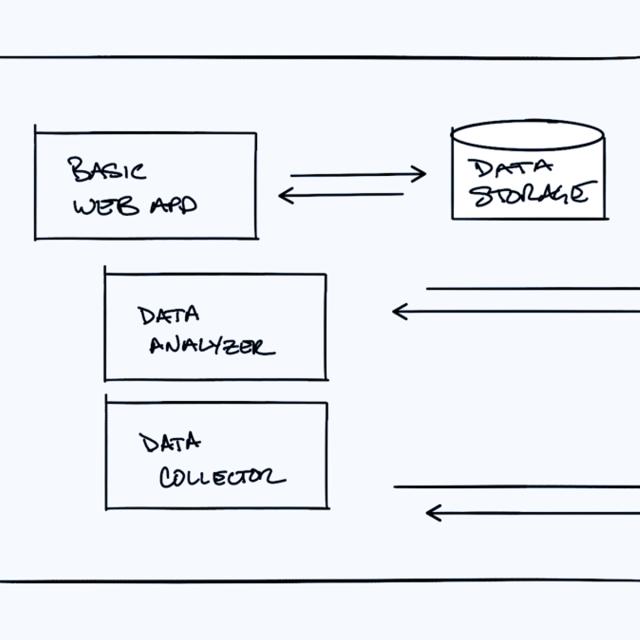
This module builds upon an MVP created in the previous module. Here we show you how to create a database, populate the database as well as analyze the data in the database. The module ends by elaborating on testing.

WEEK 4
Scaling your MVP & Wrapping Up
Here we add more features to the project inclusive of collaborative messaging. We end things off by building a simple health check for production monitoring and discussing acceptance testing.

Go to Class
MOOC List is learner-supported. When you buy through links on our site, we may earn an affiliate commission.

Related Courses

The Importance of Listening (Coursera) Coursera
Northwestern University

The Importance of Listening (Coursera)

In this second MOOC in the Social Marketing Specialization - "The Importance of Listening" - you will go deep into the Big Data of social and gain a more complete picture of what can be learned from interactions on social sites. You will be amazed at just how much information can be extracted from a single post, picture, or video.

Jun 22nd 2026
4 Weeks
AI Fundamentals for Non-Data Scientists (Coursera) Coursera
University of Pennsylvania

AI Fundamentals for Non-Data Scientists (Coursera)

In this course, you will go in-depth to discover how Machine Learning is used to handle and interpret Big Data. You will get a detailed look at the various ways and methods to create algorithms to incorporate into your business with such tools as Teachable Machine and TensorFlow. You will also learn different ML methods, Deep Learning, as well as the limitations but also how to drive accuracy and use the best training data for your algorithms.

Jun 22nd 2026
4 Weeks
Machine Learning With Big Data (Coursera) Coursera
University of California, San Diego

Machine Learning With Big Data (Coursera)

Want to make sense of the volumes of data you have collected? Need to incorporate data-driven decisions into your process? This course provides an overview of machine learning techniques to explore, analyze, and leverage data. You will be introduced to tools and algorithms you can use to create machine learning models that learn from data, and to scale those models up to big data problems.

Jun 22nd 2026
5-12 Weeks
Arquitecturas de Big Data (Coursera) Coursera
Universidad de los Andes

Arquitecturas de Big Data (Coursera)

El curso de Arquitecturas de Big Data busca que identifiques las características de una solución de Big Data, los datos asociados a estas soluciones, la infraestructura requerida, y las técnicas de procesamiento escalable. Desarrollaremos ejemplos usando infraestructuras basadas en Hadoop y en Spark, teniendo presente la pertinencia de las plataformas basadas en nube pública para soportar la escalabilidad de estas soluciones.

Jun 22nd 2026
4 Weeks
Managing Big Data with MySQL (Coursera) Coursera
Duke University

Managing Big Data with MySQL (Coursera)

This course is an introduction to how to use relational databases in business analysis. You will learn how relational databases work, and how to use entity-relationship diagrams to display the structure of the data held within them. This knowledge will help you understand how data needs to be collected in business contexts, and help you identify features you want to consider if you are involved in implementing new data collection efforts.

Jun 22nd 2026
5-12 Weeks
Python Scripting: Dates, Classes and Collections (Coursera) Coursera
LearnQuest

Python Scripting: Dates, Classes and Collections (Coursera)

This course is the second course in a series that aims to prepare you for a role working as a programmer. In this course, you will be introduced to the four main concepts in programming: Advanced String Operations and Dates, Modeling Classes, Development of Classes and Collections. Labs will allow the students to apply the material in the lectures in simple computer programs designed to re-enforce the material in the lesson.

Jun 22nd 2026
4 Weeks
Fundamentals of Big Data (Coursera) Coursera
LearnQuest

Fundamentals of Big Data (Coursera)

Welcome to Fundamentals of Big Data, the fourth course of the Key Technologies of Data Analytics specialization. By enrolling in this course, you are taking the next step in your career in data analytics. This course is the fourth of a series that aims to prepare you for a role working in data analytics. In this course, you will be introduced to many of the core concepts of big data.

Jun 22nd 2026
3 Weeks
Big Data Analytical Platform on Alibaba Cloud (Coursera) Coursera
Alibaba Cloud Academy

Big Data Analytical Platform on Alibaba Cloud (Coursera)

Building an Analytical Platform on Alibaba Cloud can empower how you take in, analyze, and demonstrate clear metrics from a set of Big Data. This course is designed to teach engineers how to use Alibaba Cloud Big Data products. It covers basic distributed system theory and Alibaba Cloud's core products like MaxCompute, DataWorks, E-MapReduce as well as a bundle of ecosystem tools.

Jun 22nd 2026
5-12 Weeks
Infonomics II: Business Information Management and Measurement (Coursera) Coursera
University of Illinois at Urbana-Champaign

Infonomics II: Business Information Management and Measurement (Coursera)

Even decades into the Information Age, accounting practices yet fail to recognize the financial value of information. Moreover, traditional asset management practices fail to recognize information as an asset to be managed with earnest discipline. This has led to a business culture of complacence, and the inability for most organizations to fully leverage available information assets. This second course in the two-part Infonomics series explores how and why to adapt well-honed asset management principles and practices to information, and how to apply accepted and new valuation models to gauge information’s potential and realized economic benefits.

Jun 22nd 2026
4 Weeks
Deploying Machine Learning Models (Coursera) Coursera
University of California, San Diego

Deploying Machine Learning Models (Coursera)

In this course we will learn about Recommender Systems (which we will study for the Capstone project), and also look at deployment issues for data products. By the end of this course, you should be able to implement a working recommender system (e.g. to predict ratings, or generate lists of related products), and you should understand the tools and techniques required to deploy such a working system on real-world, large-scale datasets.

Jun 22nd 2026
4 Weeks
Introdução à Ciência e Engenharia de Dados (Coursera) Coursera
FIA Business School

Introdução à Ciência e Engenharia de Dados (Coursera)

Neste curso, você aprenderá que os dados se tornaram o principal ativo de negócios nos dias de hoje. Com o aumento do Big Data e criação de novas tecnologias, as organizações em todo o mundo estão inovando e descobrindo novas formas para analisar o potencial dos dados à sua disposição, o que ajuda no crescimento, na lucratividade, no direcionamento das operações gerais e no aumento da satisfação do cliente. Mas para que tudo isso funcione corretamente e seja possível extrair todo o potencial de forma precisa e que seja viável para o negócio, criou-se a área de ciência de dados.

Jun 22nd 2026
4 Weeks