EdX

Advanced Fluid Mechanics 2: The Navier-Stokes Equations for Viscous Flows (edX)

Offered by MIT, MITx,
Advanced Fluid Mechanics 2: The Navier-Stokes Equations for Viscous Flows (edX)

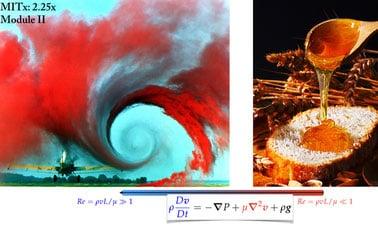
Learn to apply the Navier-Stokes equations to viscous-dominated flows; including pipe flows, channel flows and free surface flows, use dynamical similarity and dimensional analysis, Stokes flows, similarity solutions and transient responses, lubrication analysis and surface tension. This course covers the Navier-Stokes equations for viscous flows: including pipe flows, channel flows and free surface flows, dynamical similarity and dimensional analysis, Stokes flows, similarity solutions and transient responses, lubrication analysis and surface tension.

Class Deals by MOOC List - Click here and see EdX's Active Discounts, Deals, and Promo Codes.

This course features lecture and demo videos, lecture concept checks, practice problems, and extensive problem sets.
This course is the second of a three-course sequence in incompressible fluid mechanics consisting of Advanced Fluid Mechanics 1: Fundamentals; Advanced Fluid Mechanics 2: The Navier-Stokes Equations for Viscous Flows, and Advanced Fluid Mechanics 3: Potential Flows, Lift, Circulation & Boundary Layers. The series is based on material in MIT’s class 2.25 Advanced Fluid Mechanics, one of the most popular first-year graduate classes in MIT’s Mechanical Engineering Department. This series is designed to help people gain the ability to apply the governing equations, the principles of dimensional analysis and scaling theory to develop physically-based, approximate models of complex fluid physics phenomena. People who complete these three consecutive courses will be able to apply their knowledge to analyze and break down complex problems they may encounter in industrial and academic research settings.
The material is of relevance to engineers and scientists across a wide range of mechanical chemical and process industries who must understand, analyze and optimize flow processes and fluids handling problems. Applications are drawn from hydraulics, aero & hydrodynamics as well as the chemical process industries.

What you'll learn

  • The Navier-Stokes equation and appropriate boundary conditions
  • The concept of Dynamical similarity
  • Application of Dimensional analysis to complex problems
  • Analysis of complex viscous flows such as Stokes flows or transient responses
  • Lubrication Analysis for thin films and free surfaces

Prerequisites
Comfort with undergraduate-level fluid mechanics, multivariable calculus and undergraduate differential equations: elementary vector and tensor manipulation, Fourier transforms, solving second order linear ODEs and PDEs. Students without this background will find there is a steep learning curve and may have to put in more than the estimated time effort.

Syllabus

  1. The Navier-Stokes equation and viscous flow
  2. Pipe flows, channel flows and free-surface flows
  3. Dynamical Similarity and dimensional analysis
  4. More Complex Viscous Flows; Stokes Flows, Similarity Solutions and Transient Responses
  5. Lubrication Analysis for Thin fluid films and slender geometries
Go to Class
MOOC List is learner-supported. When you buy through links on our site, we may earn an affiliate commission.

Related Courses

A System View of Communications: From Signals to Packets (Part 3) (edX) EdX
The Hong Kong University of Science and Technology - HKUST,HKUSTx

A System View of Communications: From Signals to Packets (Part 3) (edX)

Explore the tradeoffs in designing communication systems like mobile phones, and the engineering tools to handle them. Have you ever wondered how information is transmitted using your mobile phone or a WiFi hotspot? Gain an understanding of the basic engineering tools used and tradeoffs encountered in the design of these communication systems.

Self Paced
Self-Paced
Software Engineering: Introduction (edX) EdX
The University of British Columbia,UBCx

Software Engineering: Introduction (edX)

Learn how to apply engineering principles, such as Agile, to build a full-stack software system. You will learn software engineering principles that are applicable to the breadth of large-scale software systems. The course explores topics such as agile development, REST and Async programming, software specification, design, refactoring, information security, and more.

Self Paced
Self-Paced
Nanophotonic Modeling (edX) EdX
Purdue University,PurdueX

Nanophotonic Modeling (edX)

Learn a comprehensive set of simulation techniques to predict the performance of photonic nanostructures. This engineering course is an introduction to photonic materials and devices structured on the wavelength scale. Generally, these systems will be characterized as having critical dimensions at the nanometer scale. These can include nanophotonic, plasmonic, and metamaterial components and systems.

Feb 12th 2024
5-12 Weeks
Water and Wastewater Treatment Engineering: Biochemical Technology (edX) EdX
Tsinghua University,TsinghuaX

Water and Wastewater Treatment Engineering: Biochemical Technology (edX)

Learn the basic principles and characteristics of biochemical technology in water and wastewater treatment engineering. Biochemical technology in water and wastewater treatment engineering is essential in the field of water treatment. In this environmental studies course you will learn the basic principles and characteristics of biochemical technology.

Self Paced
Self-Paced
Logistics Fundamentals (edX) EdX
LOGYCAX

Logistics Fundamentals (edX)

Have you ever wondered how products arrive at your hands? From the clothes we wear to the food we consume, they have been through a series of links, processes, operations and flows we know as logistics. Logistics are the first trait for a company’s success! Learn all about logistics and how you can use it to achieve every goal in your organization. In this online course you will gain a holistic view of logistics and transportation within your company, which is useful to understand how a company can thing strategically thanks to basic but essential content.

Self Paced
Self-Paced
水力学 | Hydraulics (edX) EdX
Tsinghua University,TsinghuaX

水力学 | Hydraulics (edX)

This Hydraulics course explores the science of hydraulics and focuses on hydrodynamic laws and their applications, which are indispensable and a critical factor in the development and utilization of water resources. 水,是人类生活不可或缺的资源。水力学是人类开发利用水资源的有力工具。本课教你认识和掌握水流静止和运动的力学规律,了解在相关领域的工程应用。

Self Paced
Self-Paced
Forensic Engineering: Learning from Failures (edX) EdX
Delft University of Technology,DelftX

Forensic Engineering: Learning from Failures (edX)

Don’t let good failures go to waste! Identify the causes of failure and use this knowledge to enhance safety and improve performance. What do collapsed buildings, infected hospital patients, and crashed airplanes have in common? If you know the causes of these events and conditions, they can all be prevented. In this course, you will learn how to use the TU Delft mind-set to investigate the causes of such events so you can prevent them in the future.

Self Paced
Self-Paced
Solar Energy: Photovoltaic (PV) Technologies (edX) EdX
Delft University of Technology,DelftX

Solar Energy: Photovoltaic (PV) Technologies (edX)

Explore the main PV technologies in the current market. Get in-depth knowledge on the design and processing methods of solar cells. The technologies used to produce solar cells and photovoltaic modules are advancing to deliver highly efficient and flexible solar panels. In this course you will explore the main PV technologies in the current market.

Self Paced
5-12 Weeks
Fundamentos de la obtención, estructura y modificación de materiales poliméricos (edX) EdX
Universitat Politècnica de València,UPValenciaX

Fundamentos de la obtención, estructura y modificación de materiales poliméricos (edX)

Aprende sobre la gran versatilidad de los polímeros en aplicaciones cotidianas así como también en sectores altamente tecnológicos como la aeronáutica, los deportes de competición y el sector médico. Los materiales poliméricos, se consideran materiales con un gran potencial de uso en el ámbito de la ingeniería. Actualmente, los polímeros se han convertido en materiales fundamentales en nuestra cultura y vida cotidiana, ya que los podemos encontrar en todo tipo de productos como ropa, automóviles, juguetes, etc.

Self Paced
Self-Paced
The Basics of Transport Phenomena (edX) EdX
Delft University of Technology,DelftX

The Basics of Transport Phenomena (edX)

Learn the basic framework to work on a broad spectrum of engineering problems concerning transfer of heat, mass and momentum. Learn through examples of everyday processes at home, in the lab and in industry. Have you ever wondered why ventilation helps to cool down your hot chocolate? Do you know why a surfing suit keeps you warm? Why iron feels cold, while wood feels warm at room temperature? Or how air is transferred into aqueous liquids in a water treatment plant? How can we sterilize milk with the least amount of energy? How does medicine spread in our tissue? Or how do we design a new cooling tower of a power plant? All these are phenomena that involve heat transfer, mass transfer or fluid flow.

Self Paced
Self-Paced
Modeling and Simulation of Multibody Systems - Part II (edX) EdX
LouvainX,Université Catholique de Louvain - UCL

Modeling and Simulation of Multibody Systems - Part II (edX)

90% of daily life multibody systems contain loops of bodies, e.g. vehicle or bike suspensions, parallel manipulators or robots, and musculoskeletal systems. They can also include joint constraints. In this second course about multibody systems, learn how to model them and how to deal with more advanced numerical analyses.

Self Paced
Self-Paced